Claiming Divine Inspiration

inspirationSome Christian writers face a terrifying dilemma. They think God has inspired their work. That may be true. But then they proceed a step further and assume that “if God has given these words to me, they can’t be changed.”

The inference, of course, is that the message is essentially inspired in the same sense as Christians normally view the Holy Scriptures themselves. They become, in a word, inviolate.

It’s almost as though the author has appropriated the words of the Apostle John, who in his Revelation was inspired to write:

I warn everyone who hears the words of the prophecy of this book: if anyone adds to them, God will add to him the plagues described in this book, and if anyone takes away from the words of the book of this prophecy, God will take away his share in the tree of life and in the holy city, which are described in this book. (Revelation 22:18-19, ESV).

Naturally, this mindset can cause a bit of a problem when it rears its head in a writing critique group. I’ve witnessed it more times than I can recall, having been a member of such groups on several continents.

I’ve learned to be extremely cautious in how I attempt to explain to the person that while they may rightly feel that their work is inspired by their faith, it doesn’t necessarily follow that it remains in an unblemished condition . . . as it was received by our imperfect human senses, processed by our imperfect minds, and put into words via our imperfect skills and finite vocabulary.

No matter how gently this is said, most of these individuals don’t last long in writers groups. They drop out when others offer suggestions on how to improve their work, seemingly stunned that everyone else doesn’t simply fall prostrate in adoration at their words. It’s quite sad.

That’s why it was so refreshing to read the following in the preface to J. Budziszewski’s What We Can’t Not Know, which I highly recommend.

It seems to me that every writer should end with gratitude to the one who was in the beginning, and whose very name is Word. A reviewer—a friendly one—once remarked that it seemed strange to see that sort of thanks in a book, as though the author were claiming divine inspiration. Of course, for whatever is amiss in these pages (and there will be much), the blame is mine. But permit me to be grateful if anything in them is true.

I love this paragraph. In part, because I share his sentiments. It echoes my own words, spoken at my military retirement, “attribute to me all of the failings and disappointments in my work, and to God any positive or healing results that followed my ministry.”

This worldview proclaims Soli Deo Gloria,* and simultaneously acknowledges that I am not God. It is good for writers to occasionally be reminded of that fact.

It should come as no surprise that our friend C.S. Lewis offers worthwhile insight into inspiration. In his essay, “The Vision of John Bunyan,” he considers that writer’s comments about how the classic Pilgrim’s Progress came to be.

Lewis begins with a quotation, and offers his own wise insights, with which I will close.

For having now my Method by the end;

Still as I pull’d, it came.

It came. I doubt if we shall ever know more of the process called “inspiration” than those two monosyllables tell us.

Perhaps we may hazard a guess as to why it came at just that moment. My own guess is that the scheme of a journey with adventures suddenly reunited two things in Bunyan’s mind which had hitherto lain far apart.

One was his present and lifelong preoccupation with the spiritual life. The other, far further away and longer ago, left behind (he had supposed) in childhood, was his delight in old wives’ tales and such last remnants of chivalric romance as he had found in chap-books. The one fitted the other like a glove. Now, as never before, the whole man was engaged.

_____

* Glory to God alone or all glory be to God.

Greek Mythology & Modern Humanity

narcissusThere is a very important mental health tome that describes psychological disorders in detail. It’s called The Diagnostic and Statistical Manual of Mental Disorders (DSM).

Since the American Psychiatric Association is constantly discovering new mental ailments—and they occasionally recognize that previously unhealthy mindsets and behaviors have become so pervasive they can no longer be considered aberrations—the DSM requires periodic revision.

The current authoritative version is DSM-IV-TR, or DSM, fourth edition, text revision. That means that if you were diagnosed with a defect according to the third edition standards, you may now have a clean bill of health. And, for those of you whose diagnosis is still included in DSM IV, don’t despair; they are currently consulting about version five, and who knows what psychoses may soon become “normal.”

I had to study these things during my seminary training, for my counseling work as a chaplain and civilian pastor. I was thinking about the manual recently as I pondered the spirit of Narcissus that seems to hold sway in our age. Like C.S. Lewis, I understand there is value in studying Greek and Roman myths, as many contain seeds of Truth. (Lewis’ appreciation for myth is most evident in Till We Have Faces, which is a reworking of one ancient Greek tale.)

Narcissus, of course, is the mythological Greek who was so consumed by his own handsomeness that he perished because he was unable to tear himself away from gazing at his own likeness. (The image above was painted by Michelangelo Caravaggio in the sixteenth century.)

Narcissism, which echoes his name, describes the unbridled vanity and self-concern (i.e. selfishness) that motivates growing numbers in our individualistic and hedonistic world. Since narcissism has become so rampant, the DSM now concerns itself only with “pathological narcissism.” That distinction will probably remain, even if Narcissistic Personality Disorder (NPD) is eliminated from the fifth edition as a distinct illness, as many have recommended.

God Save Us from the Narcissists

Pathological narcissists are terrible indeed. Their characteristic arrogance, envy, sense of entitlement and lack of empathy make them unhealthy members of society. In fact, large numbers of sociopaths and psychopaths are also narcissists.

But here’s the problem. At the rotten core of the disorder we find a putrid seed that negatively affects many of us who appear otherwise to be so normal. The source of the corruption is, in part, sinful pride.

Let’s take a look at the “diagnostic criteria” for NPD which confronted me when I first studied DSM III. (Perhaps you may wish to skip this section, since modest hints of some of these traits may strike close to home.) I’ve added my own introspective comments in italics.

Diagnostic criteria for 301.81, Narcissistic Personality Disorder:

A pervasive pattern of grandiosity (in fantasy or behavior) hypersensitivity to the evaluation of others, beginning by early adulthood and present in a variety of contexts, as indicated by at least five of the following:

(1) Reacts to criticism with feelings of rage, shame, or humiliation (even if not expressed).

— I’ve never “raged,” but it’s embarrassing to be criticized in public

(2) Is interpersonally exploitive: takes advantage of others to achieve his or her own ends.

— Never. I won’t tolerate manipulation–either as the manipulator or the manipulatee.

(3) Has a grandiose sense of self-importance, e.g., exaggerates achievements and talents, expects to be noticed as “special” without appropriate achievement.

— Have I told you lately about being Thespian of the Year when I graduated from high school . . ?

(4) Believes that his or her problems are unique and can be understood only by other special people.

— Not this trait, I’m aware everyone in this fallen world is faced with challenges . . . many of them worse than my own.

(5) Is preoccupied with fantasies of unlimited success, power, beauty, or ideal love.

— I do daydream about accomplishing special goals, although I never lusted after power and I accepted the facts about “beauty” long ago. I have, however, found ideal love, and we’ve been married 37 years!

(6) Has a sense of entitlement: unreasonable expectations of especially favorable treatment, e.g., assumes that he or she does not have to wait in line when others must do so.

— I’m the opposite. I always pick the longest and slowest line to stand in.

(7) Requires constant attention and admiration, e.g., keeps fishing for compliments.

— If people weren’t so frugal with compliments, I wouldn’t need to.

(8) Lack of empathy: inability to recognize and experience how others feel, e.g., annoyance and surprise when a friend who is seriously ill cancels a date.

— Nope. I really do care about others. That’s the reason good clergy and caregivers often suffer compassion fatigue.

(9) Is preoccupied with feelings of envy.

— Well, what about those cases where the person doesn’t deserve the honors they’ve received . . ?

There, I feel much better, having made a public confession of my almost-narcissistic human self-centeredness.

In his essay “Christianity and Culture,” C.S. Lewis warns that “A man is never so proud as when striking an attitude of humility.”

When we admit, instead, that there remains much in our soul that is base and prideful, we’re on the proper path. The course that leads to a rejection of Narcissus-in-us, and the embracing of what is precious in our neighbors and our world, is the road that leads to contentment.

Theological Training

I’m proud I graduated from a well-respected seminary. And I’m proud of following that Master of Divinity degree with an advanced Master of Theology degree in Patristics. And that’s precisely the problem . . . I’m proud.

As a Christian, I recognize that pride is one of the most destructive and insidious sins. As a pastor and chaplain, I have seen all too frequently how pride expressly targets members of the clergy. Our vulnerability to the temptation to be proud is one of the common chinks in the armor of the ordained.

C.S. Lewis recognized this fact. In A Severe Mercy, he wrote:

I think there is a great deal to be said for having one’s deepest spiritual interest distinct from one’s ordinary duty as a student or professional man. St. Paul’s job was tent-making. When the two coincide I shd. have thought there was a danger lest the natural interest in one’s job and the pleasures of gratified ambition might be mistaken for spiritual progress and spiritual consolation; and I think clergymen sometimes fall into this trap. . . .

In fact, the change [to a Christian ministry] might do good or harm. I’ve always been glad myself that Theology is not the thing I earn my living by. On the whole, I’d advise you to get on with your tent-making. The performance of a duty will probably teach you quite as much about God as academic Theology wd. do. Mind, I’m not certain: but that is the view I incline to.

Lewis understood that “advancement” in ecclesiastical contexts can mask the inner heart and be mistaken as a form of holiness when it is in actuality vanity. I was reminded of this weakness in clerical armor recently, when I read a tribute to a Chinese Christian whose name is little known beyond his homeland. Dr. Sun Yi-yin, known in America as “Freddie Sun,” died in August at the age of 76. A professor of Geology, he lost his faculty position for failing to deny Christ.

Like thousands of other Christians living under the atheist regime, he was imprisoned for his work in establishing churches and Bible schools. He raised the funds to start no fewer than 154 of these training centers, and was key to the equipping of approximately 60,000 underground pastors and teachers. The “underground” Church in China is distinguished from the government-controlled “Three-Self Patriotic Movement.”

For his labors, Sun endured a decade in a Chinese labor camp. (His wife, Dorothy Chang, was also imprisoned. Rather than reducing his faith, during his sojourn in the harshest of conditions, Sun experienced a personal revival and his zeal increased.

His story is amazing, but here is the aspect that hit the mark in the center of my conscience. In his autobiography, The Man in the Fiery Furnace, Sun described his imprisonment as his “seminary” experience: “Instead of learning homiletics, hermeneutics, Greek, and Hebrew, I was being taught the greater lessons of obedience, submission, forgiveness, love, endurance, and patience.”

Now, I am grateful that God has preserved me from the “fiery furnace,” but I do long to experience the fruit of the spirit that Sun so richly harvested in prison. While not dismissing the importance of the classical subjects of homiletics and hermeneutics, as the Apostle says, “If I speak in the tongues of men and of angels, but have not love, I am a noisy gong or a clanging cymbal. And if I have prophetic powers, and understand all mysteries and all knowledge, and if I have all faith, so as to remove mountains, but have not love, I am nothing. If I give away all I have, and if I deliver up my body to be burned, but have not love, I gain nothing.” (I Corinthians 13:1-3, ESV).

In The Problem of Pain, Lewis’ treatise on suffering, he addresses how God can redeem terrible things such as unjust punishments. For those desiring to understand how an omnipotent God can allow evil to occur, Lewis’ presentation is quite helpful. And, the life example of Dr. Sun provides a superb example of its validity.

I advance six propositions necessary to complete our account of human suffering which do not arise out of one another and must therefore be given in an arbitrary order. 1. There is a paradox about tribulation in Christianity. Blessed are the poor, but by ‘judgement’ (i.e., social justice) and alms we are to remove poverty wherever possible. Blessed are we when persecuted, but we may avoid persecution by flying from city to city, and may pray to be spared it, as Our Lord prayed in Gethsemane.

But if suffering is good, ought it not to be pursued rather than avoided? I answer that suffering is not good in itself. What is good in any painful experience is, for the sufferer, his submission to the will of God, and, for the spectators, the compassion aroused and the acts of mercy to which it leads. In the fallen and partially redeemed universe we may distinguish (1) the simple good descending from God, (2) the simple evil produced by rebellious creatures, and (3) the exploitation of that evil by God for His redemptive purpose, which produces (4) the complex good to which accepted suffering and repented sin contribute.

Now the fact that God can make complex good out of simple evil does not excuse—though by mercy it may save—those who do the simple evil. And this distinction is central. Offences must come, but woe to those by whom they come; sins do cause grace to abound, but we must not make that an excuse for continuing to sin. The crucifixion itself is the best, as well as the worst, of all historical events, but the role of Judas remains simply evil.

I thank God for the life and testimony of Sun. I pray God will reap an abundance of believers in China, and elsewhere, due to his faithfulness. And I thank God for using Sun’s words to cause me to stop in the midst of my busy activities and take the time to examine my own heart and motives.

Treasuring Books

Most of us love and respect books, don’t we? We take care of our literary treasures, and the more deeply we are attached to a particular volume, the better we treat it.

Many of us are reluctant to loan out the books which line our shelves like so many gems, resting in a jeweler’s pristine cases. When we do agree to share them, we’re afraid they may never find their way home. And, when they eventually return to our welcoming grasp, they sometimes bear the scars of their sojourn in the paws of others who do not esteem them as they ought to. Page corners may be scored. Coffee or tea stains may have “embellished” the text. Bindings may have been carelessly mistreated. And, unbelievably, the borrowers are likely to be unaware of how they have abused the tome’s dignity and disfigured its beauty.

Speaking honestly, my own bookshelves are in constant disarray, and too many of my books still remain unpacked after our move into our retirement home. But I am absolutely serious about how painful I find it to witness the mistreatment of books by those ignorant of their value.

C.S. Lewis loved books. He recognized their power. He embraced their wonder. And—most wonderfully for us—he penned a number of classics that will continue to inspire readers for generations.

Yet, as much as Lewis treasured books, he took his own creations for granted. This changed in December of 1954, when he received a precious package from his publisher. Among his Christmas gifts that year were specially bound copies of Surprised by Joy and Mere Christianity. Receipt of the thoughtful present opened his eyes to an interesting notion. On the twenty-second day of the month, he wrote:

I never had a handsomer present. . . . Perhaps these two charming volumes will teach me at last to have for the bodies of my own books the same reverence I have for the bodies of all other books. For it is a curious fact that I never can regard them as being really books; the boards and print, in however mint a condition, remain a mere pretense behind which one sees the scratchy, inky old manuscript.

I daresay that those writers among us can relate to Lewis’ mindset. Even with the pride that accompanies having books or articles in print, our work somehow seems “different” than the other published materials we invariably respect. This is due in large part, I believe, to their familiarity. Writers, better than most, understand what familiarity breeds. We know these works that flowed from our own consciousness and sweat . . . we know them intimately. And we are keenly aware that if given another opportunity, there are parts of them we would even now edit to be clearer, sharper, and more eloquent.

I never cease to be surprised by the humility of new writers who almost whisper their accomplishments to others. It’s as though they are embarrassed . . . that they assume their friends would consider them braggarts if they spoke with the pride they genuinely feel about their work. Some of us hold onto our rejection letters. (I do.) How much better though, to print out high quality copies of articles or devotions we’ve written and place them in a prominent binder or display located near our keyboard.

Who knows, I may actually follow my own advice and do something like that. Sadly, I don’t have a grateful publisher eager to prepare special editions for me. Nevertheless, I’m glad Lewis did. I learned from his insight that whenever we release our literary progeny to the world, they merit the same degree of respect and affection that we book-lovers bestow so generously on the works of others.

___

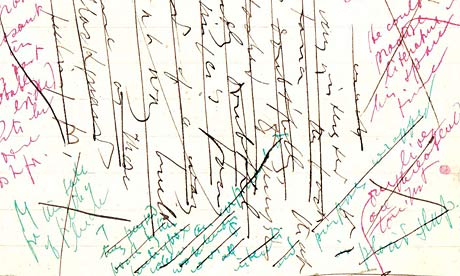
Postscript: The image above is an actual manuscript page from James Joyce’s Ulysses. (It makes me feel much more confident about my own initial scribblings.)