Discordant Dictionaries

dictionary 1Most “word people” like dictionaries. Some writers go so far as to love dictionaries, but I don’t wish to quibble about where one rests on the affection spectrum in terms of these repositories of words.

This guy, though, has to be pegged on the extreme (idolatry) end of the meter. Ammon Shea wrote Reading the OED: One Man, One Year, 21,730 Pages after having done just that. The Oxford English Dictionary, you may know, comprises 25 volumes, and Shea warns that reading it at such a rapid pace took a toll on his eyesight. It’s not surprising, that he admits he is not your typical reader.

One could say that I collect word books, since by last count I have about a thousand volumes of dictionaries, thesauri, and assorted glossaries. . . . I do not collect these words because I want to impress friends and colleagues with my erudition. . . .

My friends know that I read dictionaries for fun, and have come to accept this proclivity with relative good grace, but they are not terribly interested in or impressed by my word collection.

Pierre Jules Théophile Gautier advised his fellow poets to read the dictionary. No better way to enrich one’s language, he claimed, although he also read cook books, almanacs and the like. In fact, his biographer offered this fascinating observation.

He found pleasure in the most indifferent novels, as he did in books of the highest philosophical conceptions, and in works of pure science. He was devoured with the desire to learn, and said: “No conception is so poor, no twaddle so detestable that it cannot teach us something by which we may profit.”

C.S. Lewis indicated that so-called “definitions” offered outside the ordinances of the dictionary must be approached warily. “When we leave the dictionaries we must view all definitions with grave distrust” (Studies in Words). He offers a very sensible reason for such precautions.

It is the greatest simplicity in the world to suppose that when, say, Dryden defines wit or Arnold defines poetry, we can use their definition as evidence of what the word really meant when they wrote. The fact that they define it at all is itself a ground for scepticism.

Unless we are writing a dictionary, or a text-book of some technical subject, we define our words only because we are in some measure departing from their real current sense. Otherwise there would be no purpose in doing so (Studies in Words).

Dictionaries are, of course, their own genre. Lectionaries, collections of words and meanings, are different than any other type of written composition. For example, glossaries may draw together specialized vocabulary—say for medical or theological purposes—but by their very nature they are not intended to blaze any new literary pathways.

There is, invariably, an exception to this rule. Some “dictionaries” are creative exercises. They are works of fiction, and some are entertaining indeed.

The most famous of these satirical works is Ambrose Bierce’s Devil’s Dictionary (originally published as The Cynic’s Word Book). The volume is not expressly irreverent, although people of faith will encounter some offensive examples in its pages. However, a number of the entries are brilliant.

Kilt

  1. A costume sometimes worn by Scotchmen in America and Americans in Scotland.

Rank

  1. Relative elevation in the scale of human worth.

He held at court a rank so high

That other noblemen asked why.

“Because,” ’twas answered, “others lack

His skill to scratch the royal back.”

Emancipation

  1. A bondman’s change from the tyranny of another to the despotism of himself.

He was a slave: at word he went and came;

     His iron collar cut him to the bone.

Then Liberty erased his owner’s name,

     Tightened the rivets and inscribed his own.

Goose

  1. A bird that supplies quills for writing. These, by some occult process of nature, are penetrated and suffused with various degrees of the bird’s intellectual energies and emotional character, so that when inked and drawn mechanically across paper by a person called an “author,” there results a very fair and accurate transcript of the fowl’s thought and feeling. The difference in geese, as discovered by this ingenious method, is considerable: many are found to have only trivial and insignificant powers, but some are seen to be very great geese indeed.

Another Frenchman, Gustave Flaubert, composed his Dictionary of Received Ideas, which found humor in peculiarities of common understandings.

Absinthe

Extra-violent poison: one glass and you’re dead. Newspapermen drink it as they write their copy. Has killed more soldiers than the Bedouin.

Archimedes

On hearing his name, shout “Eureka!” Or else: “Give me a fulcrum and I will move the world.” There is also Archimedes’ screw, but you are not expected to know what it is.

Omega

Second letter of the Greek alphabet. [Note: this would only apply to biblically literate societies.]

The earliest such example of a satirical dictionary was that by the Persian writer Nezam od-Din Ubeydollah Zâkâni. I have not located a copy of his 14th century lexicon, but it apparently includes entries that are still understandable in our modern world.

Thought

What uselessly makes people ill.

Orator

A donkey.

Word lovers can easily get caught up in conversations like this. In fact, I’m certain more than one Mere Inkling reader has contemplated compiling their own creative dictionary! It’s not an insurmountable project, since it’s accomplished one word at a time.

_____

For those desiring to create their own dictionary “entries” such as the one that graces the top of this blog, there a free meme generator you can use online. Available here, it’s a fun little tool. It’s also suitable for creating a little self-deprecating humor.
dictionary 2

Confusing Creeds

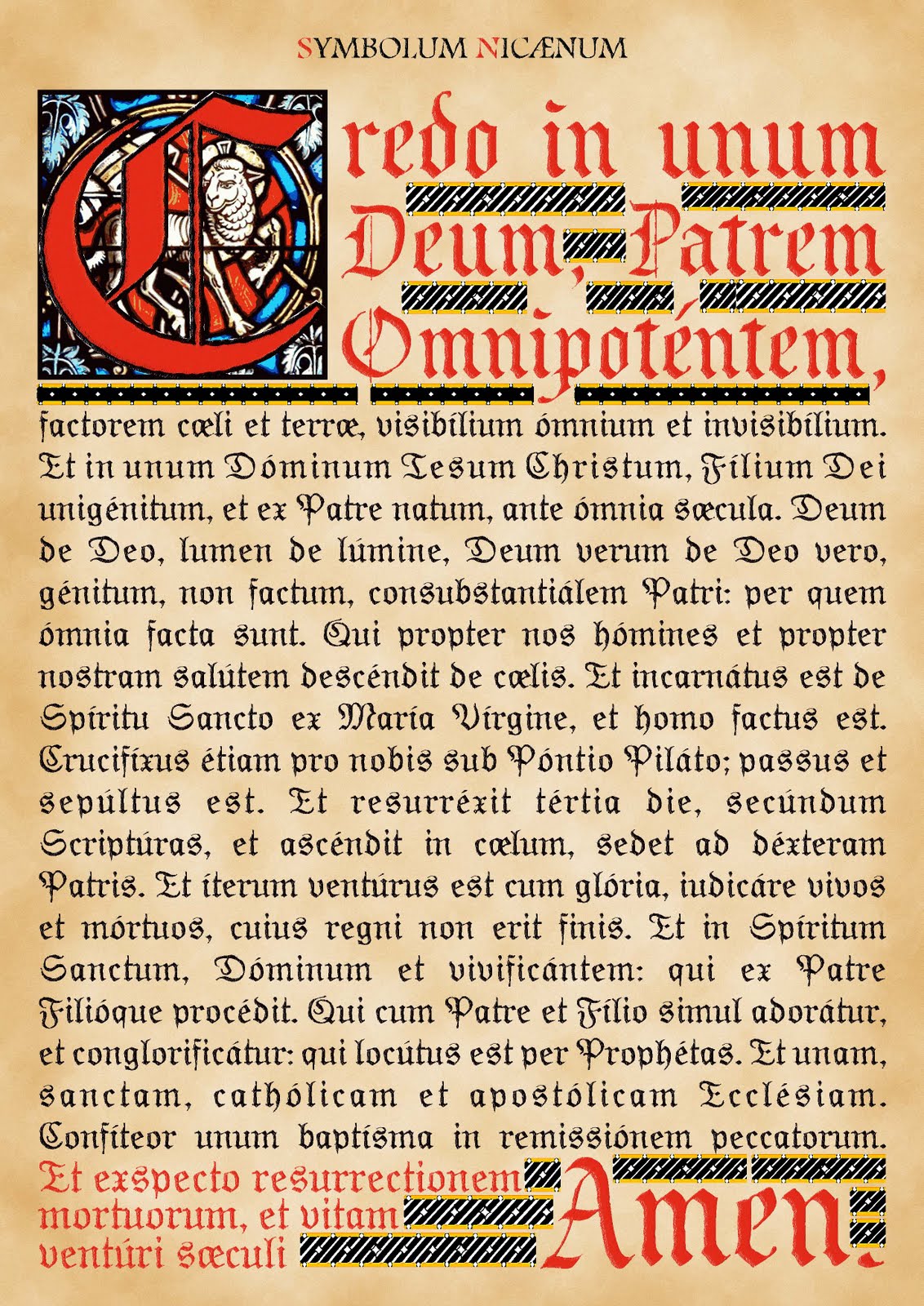
Nicene CreedThere are a couple of sentences in the traditional translation of the basic Christian creeds (statements of faith) that lead to confusion.

Due to the literary examples below, Christian readers may find the following discussion more interesting than non-Christians—but everyone interested in clarity versus confusion should find something intriguing.

The creeds offer a prime example of why it is absolutely crucial to ensure that gradual shifts in language do not undermine or blur the intended meaning of a given sentence. To illustrate, consider this line from the Nicene Creed.

. . . [Jesus] who for us men and for our salvation came down from heaven and was incarnate by the Holy Spirit of the virgin Mary and was made man. (1662, Anglican Book of Common Prayer).*

The potential confusion here lies in the archaic usage of the word “of.” Whose Holy Spirit are we referring to? Mary’s innate holiness and purity? The educated Christian may stumble over that dated phrase—which is still used in some denominations—but a person not acquainted with the doctrine of the Trinity might easily misinterpret it as a Maryological, rather than Christological, confession.

Let’s consider two more recent translations, and note how the first restores the intent of the original writers. The second of these commonly used translations reflects the hand(s) of “politically correct” revisers.

For us and for our salvation he [Jesus] came down from heaven: by the power of the Holy Spirit he became incarnate from the Virgin Mary, and was made man. (1975 International Consultation on English Texts version).

For us and for our salvation he came down from heaven, was incarnate of the Holy Spirit and the Virgin Mary and became truly human. (1988, English Language Liturgical Consultation version).

We will consider a second example momentarily, but let’s first look at something C.S. Lewis wrote about reflecting on the importance of the creeds. He noted that too often we rattle through the words without considering their significance. This is unfortunate.

In an essay entitle “On Forgiveness,” Lewis describes a personal epiphany and offers counsel to those tempted to take familiar words for granted.

We say a great many things in church (and out of church too) without thinking of what we are saying. For instance, we say in the Creed “I believe in the forgiveness of sins.” I had been saying it for several years before I asked myself why it was in the Creed. At first sight it seems hardly worth putting in. “If one is a Christian,” I thought “of course one believes in the forgiveness of sins. It goes without saying.”

But the people who compiled the Creed apparently thought that this was a part of our belief which we needed to be reminded of every time we went to church. And I have begun to see that, as far as I am concerned, they were right. To believe in the forgiveness of sins is not so easy as I thought. Real belief in it is the sort of thing that easily slips away if we don’t keep on polishing it up.

As usual, the Oxford don was correct. However, just as good translations possess the power to inspire, so too poor or antiquated translations exercise the ability to confuse.

Here is the promised second example.

And the third day he rose again according to the Scriptures . . . (1662).

Ah, I understand, think the uncatechized, the Bible teaches us that Jesus rose from the dead on Easter. Well, yes it does, but that is not the sense in which the second phrase is intended. Here, “according to the Scriptures,” means that Jesus’ life, death and resurrection were all accomplished in accordance with the promises of the Word of God.

In other words, “just as was promised in the Garden of Eden and foretold by the prophets, Jesus won victory when he rose from the grave in accordance with the loving plan of God the Father.” The newer versions make that fact only slightly clearer.

On the third day he rose again in accordance with the Scriptures . . . (1975 and 1988).

Perhaps a future revision will replace “in accordance with,” using something like “as foretold in” or “fulfilling the scriptural promises.”

Some of us worship in congregations using a variant of the seventeenth century creed, but at least we can take comfort in the fact that most of them have at least replaced “And he shall come again with glory to judge both the quick and the dead” with “both the living an the dead.” After all, we wouldn’t want people to think that one’s salvation is dependent upon their speed.

_____

* This slightly contemporized version of the creed has already remedied the terribly confusing term “Holy Ghost,” which evokes images of disembodied souls and hauntings.

Obstreperous Language

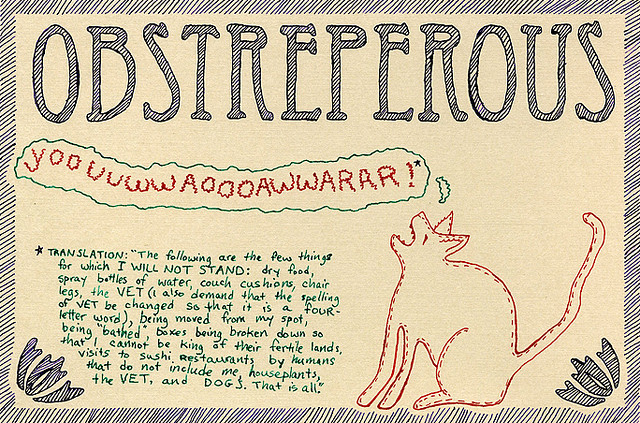
obstreperous

© Stella Belikiewicz and used by permission.

Despite my many shortcomings, I do “pride” myself on possessing a rather considerable vocabulary. My 97th percentile score of the GRE* reinforced my impression that I knew a lot about words.

One technique which has increased my vocabulary is to never let an unknown word pass by without making an effort to learn its meaning. This is simple when I’m working at the computer. If I’m unsure of a definition, I immediately look it up in an online dictionary such as this.

Very rarely do I “guess” at a meaning, based upon its context. This mainly occurs if I’m listening to the radio while I’m driving, and I don’t have recourse to a dictionary. Even then I try to impress the new word on my memory so that I can research it when I return home.

The word in this column’s title motivated me to discuss the importance of accurately understanding word definitions. When I encountered “obstreperous,” it rang vague bells of recollection. And, I was able to discern the word’s general meaning from the context of the article. While some readers of Mere Inkling are already familiar with its meaning—and perhaps use it in daily conversations—allow me to share the context in which I encountered it.

I was reading an article in a military journal about the “battle over ballistic missiles” which was fought inside the Air Force as the manned-bombers-only mindset had to be breached so the United States could advance into the ICBM age. The champions of the two positions were two successive Air Force Chiefs of Staff, Thomas White and Curtis LeMay.

White struggled with how to control the obstreperous LeMay. He knew he didn’t have the political power to force LeMay out, nor could he outwait his [Strategic Air Command] chief. LeMay received his fourth star in 1951 at age 44, which made him the youngest four-star U.S. general since Ulysses S. Grant.**

I’m rarely content with possessing an amorphous definition of a word, so I looked it up. My general impressions of its meaning were confirmed, and I added another word to my personal vocabulary. (The fact that I may never use it beyond its appearance in this post is irrelevant.) Here’s the dictionary entry:

ob·strep·er·ous [uhb-strep-er-uhs]

adjective

1. resisting control or restraint in a difficult manner; unruly.

2. noisy, clamorous, or boisterous: obstreperous children.

Parents give their children a precious gift by encouraging the growth of their own vocabularies. In the pre-computer days, we had a dictionary not far away when we had dinner, and it wasn’t uncommon for it to find its way to the table during our conversations.

Consciously adding new words to our vocabulary is a skill especially vital to writers.

C.S. Lewis wrote about how common usage of familiar words requires no contextual definition. However, he warns of the danger of accepting subjective “definitions” offered outside the context of credible dictionaries.

When we leave the dictionaries we must view all definitions with grave distrust. It is the greatest simplicity in the world to suppose that when, say, Dryden defines wit or Arnold defines poetry, we can use their definition as evidence of what the word really meant when they wrote.

The fact that they define it at all is itself a ground for scepticism. Unless we are writing a dictionary, or a text-book of some technical subject, we define our words only because we are in some measure departing from their real current sense. Otherwise there would be no purpose in doing so. . . .

The word wit will illustrate this. We . . . find old critics giving definitions of it which are contradicted not only by other evidence but out of the critics’ own mouths. Off their guard they can be caught using it in the very sense their definition was contrived to exclude.

A student who should read the critical debate of the seventeenth century on wit under the impression that what the critics say they mean by wit is always, or often, what they really mean by wit would end in total bewilderment.

He must understand that such definitions are purely tactical. They are attempts to appropriate for one side, and to deny to the other, a potent word. You can see the same “war of positions” going on today.

A certain type of writer begins “The essence of poetry is” or “All vulgarity may be defined as,” and then produces a definition which no one ever thought of since the world began, which conforms to no one’s actual usage, and which he himself will probably have forgotten by the end of the month. (Studies in Words)

I find it rather fitting to include this passage from Lewis, with its martial imagery, in a column inspired by a description of a surly advocate of massive nuclear bombing as the best deterrence of World War III.

Writers, particularly those attempting to be persuasive, are wise to ponder Lewis’ wise counsel. We cannot surrender the battlefield to those who would revise the clear and historic meanings of words in an effort “to appropriate for one side, and to deny to the other, a potent word.”

_____

* The Graduate Record Exam is a standardized test used as part of the admission process for many university graduate programs in the United States. We won’t be discussing my mathematics score here . . .

** If the source article interests you, you can read it at Air Force Magazine.

The artwork above is copyrighted by its creator, Stella Belikiewicz, and used with her permission.