
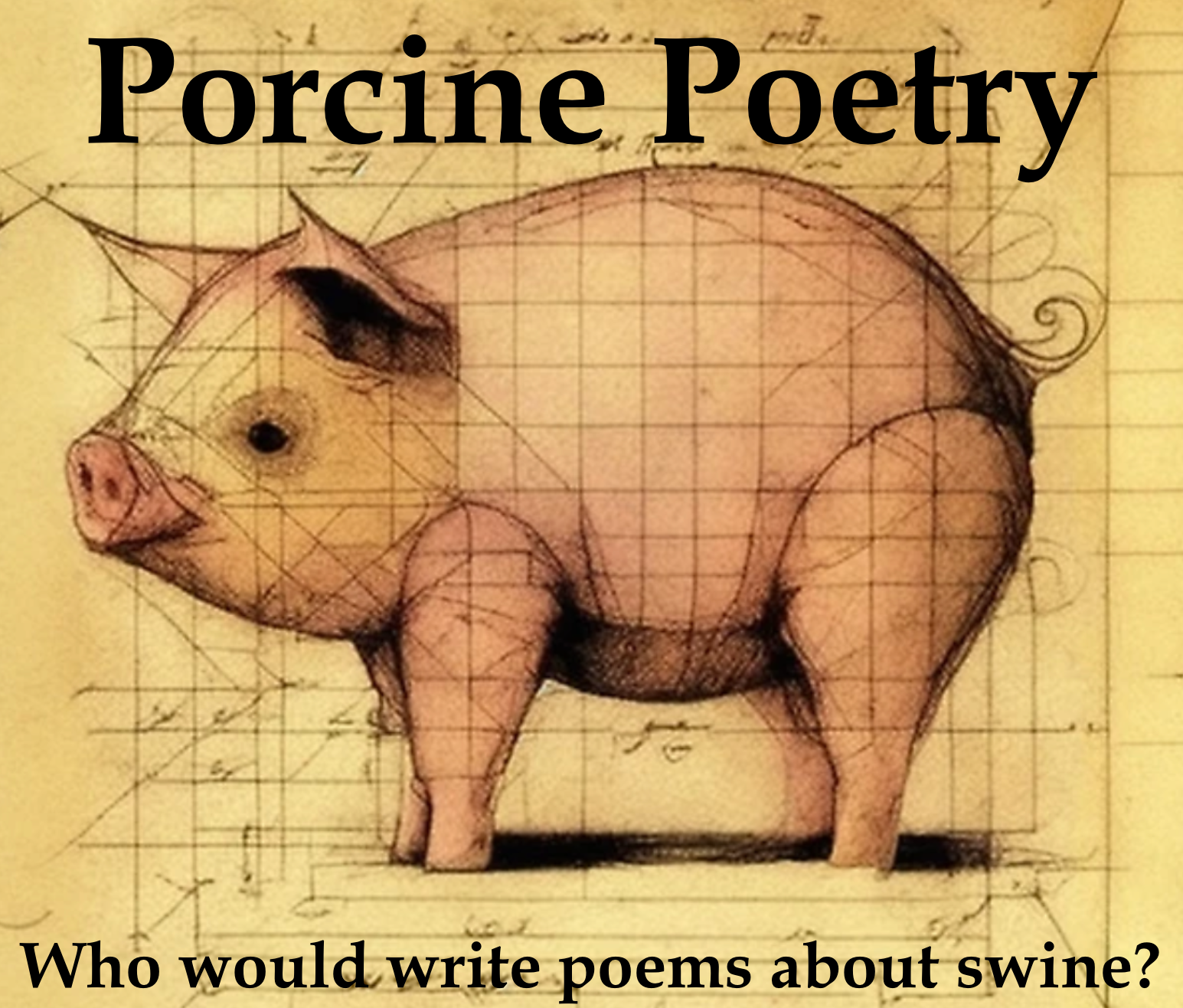
Would you purchase a collection of poetry inspired by pigs? It was certainly not what I was looking for, but my local library has once again seduced me by conducting one of their periodic “used book sales.”
I find them irresistible. Just as I was unable to bypass, without browsing, any “secondhand bookshop” while I lived in the United Kingdom.
One never knows what treasures are buried in the stacks, since many of the volumes came from personal libraries where they may have rested for decades.
We had just finished our regular writing critique meeting when I accompanied two of my companions into the wilderness of temptation. Alas, on one of the first shelves I perused, I encountered an oddity I was unable to resist.
The title attracted my interest – The Porcine Legacy. The minimalist sketches of pigs illustrating the text drew me in. And the final element, which captured me, was that it was autographed by both the author and the artist. The bargain price sealed the deal.
Scanning the poems I saw curious mentions of God, which I considered intriguing. The swinish images reminded me of some of DaVinci’s quick sketches of animals.
Sadly, although he professes the love he had for his hogs and piglets, the author did consign them to the market. I understand that’s their intended fate, and I do enjoy lean bacon, but it seems sad. Especially in an ode to porcine intelligence and their congeniality as pets.
The author, David Lee, moved on from animal husbandry to teaching at a university in Utah. Presumably it was his contributions there, rather than on his farmstead, which earned him the honor of becoming the very first poet laureate of Utah.
A Taste of Porcine Poetry
The poem which follows is entitled “Jubilate Agno, 1975.” As often happens when I expose myself to unfamiliar works, I learned far more than I anticipated. In this case, I discovered the “1975” in the title was included because the poem was based upon a religious poem originally penned between 1759 and 1763, while its author, Christopher Smart, was convalescing as a “Curable Patient” at London’s St. Luke’s Hospital for Lunatics.
Lee’s version follows the basic structure of Smart’s 1200 line work. Cat lovers will enjoy a section of seventy-four lines where the original author praises the wonders of his cat, Jeoffry. This is the portion of the original which most closely resembles the copy, since the latter extols its author’s favorite sow. Lee also proposes a shift in the deity upon whom the creature focuses.
For I will consider my Cat Jeoffry.
For he is the servant of the Living God duly and daily serving him.
For at the first glance of the glory of God in the East he worships in his Way.~~~~~~
For I will consider my black sow Blackula.
For she is the servant of the god of the feed bucket and serveth him.
For she worships the god in him and the secret of his pail in her way.
The title, “Jubilate Agno” actually translates as “Rejoice in the Lamb.” And, while Lee includes no such reference, the beginning lines of Smart’s work proclaim its vision in inspiring terms.
Rejoice in God, O ye Tongues; give the glory to the Lord, and the Lamb.
Nations, and languages, and every Creature, in which is the breath of Life.
Let man and beast appear before him, and magnify his name together.
I encourage interested readers to read the edifying “Jubilate Agno” by Christopher Smart, which is available here. Ailurophiles (cat lovers) can go directly to the feline section here. The complete text of “Jubilate Agno, 1975” is available at the Poetry Foundation.
Although I don’t believe C.S. Lewis ever wrote porcine poetry, there is an interesting passage which appears in Boxen, the collection of his childhood stories. Apparently, the first king of the northern region of Animal-Land, set out to add Pig-Land to his domain.
The pigs under their various chiefs (who had now united against Hacom, as a common enemy) advanced to meet him. The 2 armies met at a place called Kuckton (near where Marston now stands). Hacom fought well, and would have won had he not been outwitted by a clever feint on the part of the pigs.
The [invading] force was beaten, but still, much had been done towards the subjection of the pigs. Hacom was severely wounded by a stray arrow, but might have recovered, had he not been obliged to spend the night in the fields. It was winter, and the wound froze causing instant death. He had been an excellent king.
Surprisingly, to me at least, there are many other poems inspired by pigs. Since I’ve written in the past about Roald Dahl (and his slight connection to C.S. Lewis), seeing his poem entitled “The Pig” incited my curiosity. The All Poetry website includes the poem, and offers as part of its analysis:
“The Pig” by Roald Dahl is a humorous and macabre poem that explores the existential crisis of a highly intelligent pig. The poem is characterized by its playful language, which contrasts with the gruesome subject matter. . . .
The pig’s realization that he is destined for slaughter also highlights the existential themes of meaninglessness and the inevitability of death. Overall, “The Pig” is a clever and thought-provoking poem that combines humor, darkness, and a touch of existential angst, showcasing Dahl’s versatility as a storyteller.
So, if you want to end this peculiar discussion with a bit of existential porcine angst, ponder Dahl’s poem, “The Pig.”
In England once there lived a big,
A wonderfully clever pig.
To everybody it was plain
That Piggy had a massive brain.
He worked out sums inside his head,
There was no book he hadn’t read.
He knew what made an airplane fly,
He knew how engines worked and why.
He knew all this, but in the end
One question drove him round the bend:
He simply couldn’t puzzle out
What LIFE was really all about.What was the reason for his birth?
Why was he placed upon this earth?
His giant brain went round and round.
Alas, no answer could be found.
Till suddenly one wondrous night.
All in a flash he saw the light.
He jumped up like a ballet dancer
And yelled, “By gum, I’ve got the answer!”
“They want my bacon slice by slice
“To sell at a tremendous price!
“They want my tender juicy chops
“To put in all the butcher’s shops!
“They want my pork to make a roast
“And that’s the part’ll cost the most!
“They want my sausages in strings!
“They even want my chitterlings!
“The butcher’s shop! The carving knife!
“That is the reason for my life!”Such thoughts as these are not designed
To give a pig great peace of mind.
Next morning, in comes Farmer Bland,
A pail of pigswill in his hand,
And piggy with a mighty roar,
Bashes the farmer to the floor . . .
Now comes the rather grizzly bit
So let’s not make too much of it,
Except that you must understand
That Piggy did eat Farmer Bland,
He ate him up from head to toe,
Chewing the pieces nice and slow.
It took an hour to reach the feet,
Because there was so much to eat,
And when he finished, Pig, of course,
Felt absolutely no remorse.Slowly he scratched his brainy head
And with a little smile he said,
“I had a fairly powerful hunch
“That he might have me for his lunch.
“And so, because I feared the worst,
“I thought I’d better eat him first.”
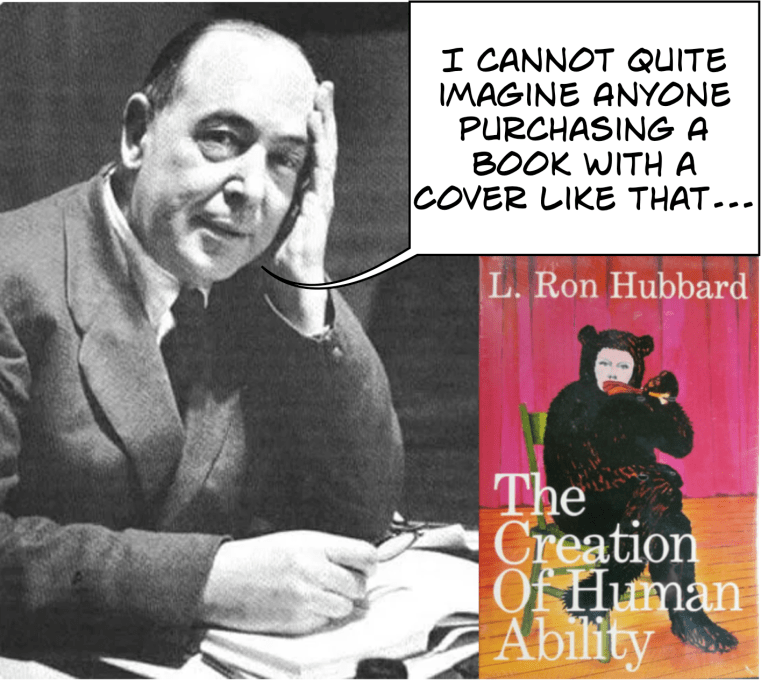
 I wanted to convey an accurate image of the book, while also allowing for some ambiguity so the reader could project their own meaning onto the cover. C.S. Lewis books are traditionally marketed toward Christian audiences, and often have light-hearted covers. . . . I wanted the books to appeal to a non-Christian audience, and I wanted the books to have a gritty and more emotional feeling, while also alluding to the extraordinary qualities inside the book.
 Mere Inkling Press