Most American think C.S. Lewis was English. But that’s not quite right, is it? After all, he was born in Belfast, which is in Northern Ireland. And that makes him Irish, doesn’t it? Well, yes but not exactly.
The most accurate description is that C.S. Lewis was Anglo-Irish, with an identity linked to both English and Irish identities. Unfortunately, even that designation is subject to potential confusion, since it holds more than one definition. It is sometimes used for persons of English descent living in Ireland, Irish folks living in England, or those of mixed Irish and English ancestry.
The classical definition, directly applicable to C.S. Lewis, is: “of English descent but born or resident in Ireland, or a member of such a family, and associated particularly with the Protestant Ascendancy” (Oxford Reference).
The Emerald Isle is particularly confusing to most Americans. Only a minority possess any awareness of the history which led to the division of Ireland into today’s Republic of Ireland and Northern Ireland, which is part of the United Kingdom. (Read to the end and discover a little known aspect about America’s dominant ethnicities.)
If Ireland is a mystery to those in the United States, so too are other identifications. The “United Kingdom” itself is perplexing to many on “this side of the pond” (i.e. the Atlantic).
People find it baffling that a nation consists of three one-time kingdoms (England, Wales and Scotland) and the northeast counties on the island of Ireland. Add to that the fact that the initial three also comprise “Great Britain,” and eyes can glaze over.
Why does it matter? Because a person’s background and heritage often influences many aspects of their personality and values. And the outcome of this blending is particularly manifest in the unique combination of the Irish and English cultures. The Hiberno-English dialect provides a colorful example, with words like the adjective “cats” (awful), “amn’t” (am not), plámás (flattery), and “the jacks” (bathroom), plus phrases such as “acting the maggot” (misbehaving).
Like all other tongues, Hiberno-English continues to evolve.
Anglo-Irish Writers
Anglo-Irish literature constitutes a distinct category of poetry and prose. Ironically, it is the essential Irishness of the style in “Anglo-Irish literature [which] registers itself [as] the most difficult . . . and the most important” element to be identified.
Few non-Europeans recognize there are many prominent Anglo-Irish writers.* Many, including C.S. Lewis who studied and taught in England, celebrated their Irish heritage. An example taken from a letter written in 1917 to his friend Arthur Greeves provides an illustration of this pride. Describing a day spent walking with a classmate while debating the merits of various authors, he wrote:
Like all Irish people who meet in England we ended by criticisms on the invincible flippancy and dulness of the Anglo-Saxon race. After all, there is no doubt, ami, that the Irish are the only people: with all their faults I would not gladly live or die among another folk.
While this tongue in cheek remark reflects Lewis’ youthful humor, you can read a more brilliant study of the subject in “C.S. Lewis: An Irish Writer.”
It discusses, among other matters, why “Lewis, a proud Irishman, [chose] not to promote himself as an Irish writer or write more regularly about Irish themes.”
American Geographical Eccentricities
Sadly, geography is quite undervalued in the American educational system. The common ignorance about the makeup of other continents is nothing less than embarrassing. Of course, Americans aren’t the only people ignorant about such matters, as GeoCurrents notes.
But if geographical ignorance is pronounced in the United States . . . the problem does seem to be even more extreme in some other parts of the world.
The United States as it exists today, is the product of constant immigration. During the early years of the colonies and Republic, most arrivals were Europeans, with nearly eleven million Africans brought involuntarily to North America, most during the rule of the British (Gilder Lehrman Institute of American History).
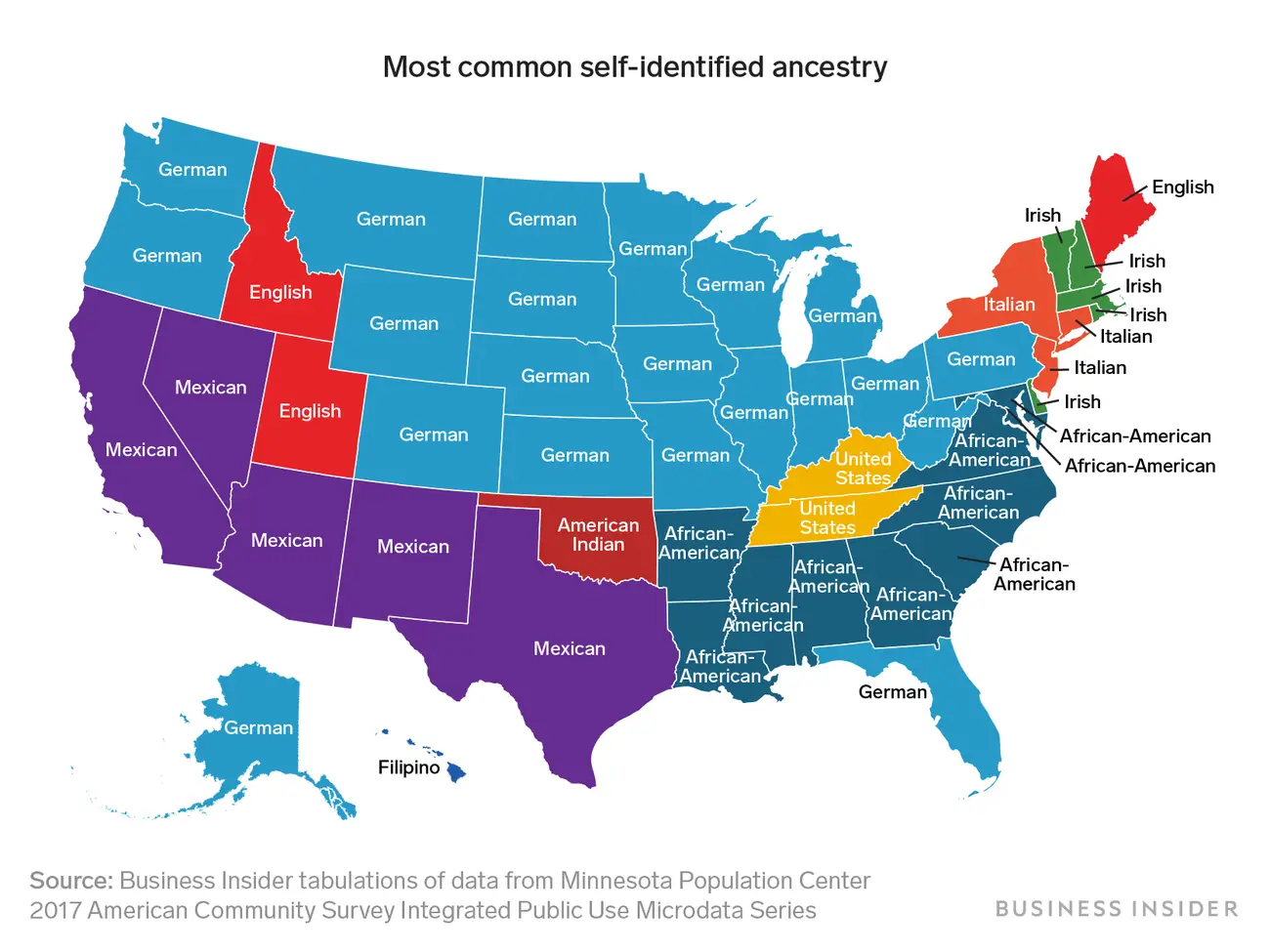
As a result of this influx of foreigners, each state possesses its own unique identity (or, more accurately, identities). The following map shows the largest single ancestral ethnicity of the residents of each state. It contains a few surprises.
The fact that Irish descendants represent a plurality in five states raises the question of just how many talented Irish-American writer may have shared the intercultural experiences of C.S. Lewis.
* A list of noteworthy Anglo-Irish writers would include, in addition to C.S. Lewis:
Jonathan Swift (1667 – 1745)
Oliver Goldsmith (c. 1730 – 1774)
Maria Edgeworth (1768 – 1849)
Joseph Sheridan LeFanu (1814 – 1873)
Dionysius Boucicault (1820 – 1890)
Lady Augusta Gregory (1852 – 1932)
Oscar Wilde (1854 – 1900)
George Bernard Shaw (1856 – 1950)
John Bagnell Bury (1861 – 1927)
William Butler Yeats (1865 – 1939)
James Owen Hannay (aka George A. Birmingham) (1865 – 1950)
John M. Synge (1871 – 1909)
Edward John Moreton Drax Plunkett (aka Lord Dunsany) (1878 – 1957)
Lady Clodagh Beresford (1879 – 1957)
Emily Lorimer (1881 – 1911)
James Joyce (1882 – 1941)
Terence James Stannus Gray (aka Wei Wu Wei) (1895 – 1986)
Elizabeth Bowen (1899 – 1973)
Cecil Day-Lewis (1904 – 1972)
Samuel Beckett (1906 – 1989)
Louis MacNeice (1907 – 1963)
Mitch Teemley
 Mere Inkling Press