It’s Still Christmas

nativity iconMerry Christmas!

One of the sad things about living in a secular nation is that people understand very little about the real meaning of Christmas. For example, many people take their trees down on 26 December, mistakenly thinking Christmas is “over.” In reality, the Christian celebration of the Nativity of Jesus only begins on Christmas Day!

The commercial world celebrates the season of Advent and deceptively calls it “Christmas.” These weeks, which should mark a spiritual preparation akin to Lent, are instead transformed into a frantic race to accumulate the perfect gifts to show others just how much we value each of them. And, since we love our family and close friends, there is a constant temptation to be far more extravagant in our gift giving than we can afford.

Returning to the season of Christmas, in which we find ourselves this day . . . we discover a brief occasion to focus our spiritual reflections on the singular Christmas miracle, the Incarnation. God becoming a human being. The Word through whom all things were created, becoming a mortal like the sons of Adam and daughters of Eve fashioned in his own likeness.

Christmas is, indeed, a glorious season.

C.S. Lewis had many insights into the Incarnation miracle. It is most certainly worthy of our serious attention. If it did not actually happen, Jesus should be dismissed altogether, for he claimed to be one with our heavenly Father. However, as Lewis declared in Miracles, “If the thing happened, it was the central event in the history of the Earth.”

One of the great literary treasures of the world is a precious book written before the year Anno Domini 318. Athanasius of Alexandria wrote a treatise called “On the Incarnation,” which makes great reading and is readily available online. A fairly modern translation was written by Sister Penelope Lawson, an Anglican nun.

Sister Penelope prevailed upon C.S. Lewis to write an introduction to her translation, in which he said, “This is a good translation of a very great book.” The full volume, complete with Lewis’ outstanding preface, is available. Here is just one of his gems:

Every age has its own outlook. It is specially good at seeing certain truths and specially liable to make certain mistakes. We all, therefore, need the books that will correct the characteristic mistakes of our own period. And that means the old books. All contemporary writers share to some extent the contemporary outlook—even those, like myself, who seem most opposed to it. Nothing strikes me more when I read the controversies of past ages than the fact that both sides were usually assuming without question a good deal which we should now absolutely deny. They thought that they were as completely opposed as two sides could be, but in fact they were all the time secretly united—united with each other and against earlier and later ages—by a great mass of common assumptions.

Still, as wonderful as Lewis’ introductory comments are, the greatest treasures here are the bishop’s teachings about Jesus. To whet your appetite, taste the following wisdom from Athanasius’ own introduction to his work:

You must understand why it is that the Word of the Father, so great and so high, has been made manifest in bodily form. He has not assumed a body as proper to His own nature, far from it, for as the Word He is without body. He has been manifested in a human body for this reason only, out of the love and goodness of His Father, for the salvation of us men. We will begin, then, with the creation of the world and with God its Maker, for the first fact that you must grasp is this: the renewal of creation has been wrought by the Self-same Word Who made it in the beginning. There is thus no inconsistency between creation and salvation for the One Father has employed the same Agent for both works, effecting the salvation of the world through the same Word Who made it in the beginning.

You can read the entire work at this site. Have a blessed Christmas season!

Our Personal Libraries

printing lettersWhat a blessing it is to live in an age when even the most modest home can treasure its personal library. Public libraries are a community boon, but because of the printing press, books are no longer restricted to the homes of the wealthy.

Books—or, more properly the reading of books—has a direct correlation to human intelligence, knowledge and (occasionally) even to wisdom itself.

In 1905, at the age of seven, C.S. Lewis moved with his family into a large home in the countryside. It was so spacious, in fact that in his autobiography Surprised by Joy, Lewis says, “to a child it seemed less like a house than a city.”

Lewis proceeds to describe the “mansion,” and its most notable feature . . . the profusion of books.

The New House is almost a major character in my story. I am a product of long corridors, empty sunlit rooms, upstairs indoor silences, attics explored in solitude, distant noises of gurgling cisterns and pipes, and the noise of wind under the tiles.

I am a product . . . of endless books. My father bought all the books he read and never got rid of any of them. There were books in the study, books in the drawing room, books in the cloakroom, books (two deep) in the great bookcase on the landing, books in a bedroom, books piled as high as my shoulder in the cistern attic, books of all kinds reflecting every transient stage of my parents’ interest, books readable and unreadable, books suitable for a child and books most emphatically not. Nothing was forbidden me. In the seemingly endless rainy afternoons I took volume after volume from the shelves. I had always the same certainty of finding a book that was new to me as a man who walks into a field has of finding a new blade of grass.

I’m privileged to own a large library. It’s not a matter of pride. It’s a matter of joy. Like Lewis, and most readers of Mere Inkling, I love books. And, like most bibliophiles, I am fascinated by numerous things related to books.

While attending college I worked for a small publisher. I was able to do a bit of writing, but most of the job involved using an enormous Linotype Phototypesetting machine and pasting up the projects. It was an interesting process, which is now long obsolete.

letterpress

Nevertheless, due to my love for books, reinforced by my own experience as a “printer’s devil,”* I have an affection for items related to publishing. I recently purchased several items from a family business called Type-tiques.

They offer a wide range of reasonably priced letterpress printer’s blocks which look wonderful on bookshelves and literary desktops.**

I also recently accepted an offer for ten free letterpress bookmarks from Peach Farm Studio. You can read about their promotion here. (Since my comment there is still awaiting “moderation,” I’m unsure of the status of the project, but I’ll keep you posted.)

___

* Just a note that, should you be unfamiliar with the term “printer’s devil,” it’s simply trade parlance for the shop’s apprentice or flunkey.

** When my wife proofread this, she asked if I literally meant “literary desktops.” Then she motioned towards my own book-laden desk and queried, “and where will you put them?” Fortunately, I have lots of shelves!

Knowing Our ABCs

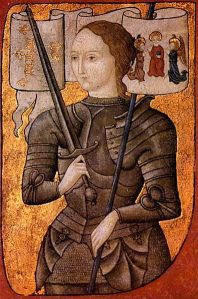
Most readers are familiar with the amazing story of Jeanne D’ Arc (Joan of Arc). She was a French peasant who received visions which proved accurate. She foresaw victory for a humbled nation which had not experienced a major military victory for an entire generation.

Jeanne led the army of the Dauphin (the heir to France’s throne who would reign as Charles VII) to unimaginable victories. She was seriously wounded but inspired her troops with her swift return to battle. She counseled, and prayed for mercy, but recognized England could only be repulsed from French shores by force.

Tragically, she was captured and the English, following a sham trial, judged her guilty of heresy. Jeanne was only nineteen when she perished in flames in an English blaze. Just twenty-five years later, a special court convened by the Pope found her “not guilty” of the crime, and proceeded to declare her a martyr. She was canonized in 1920, nearly five centuries after her brief but brilliant life.

Recently, while reading more about her life I was reminded of something startling she said during her first “inquisition.” When she originally presented herself to the Dauphin, no one could believe a modest young farm girl could be France’s rescuer. A commission of inquiry, comprised of a number of senior clergy, offered the Dauphin a “favorable presumption” that she might, indeed, have divine sanction.

During that “trial,” she was vigorously questioned. The following account comes from Medieval History by Israel Smith Clare.

It is very interesting to see how she evaded the difficulties, overcame the objections, and quietly set aside the learned cavils of the doctors by the simplicity and directness of her replies. They first asked her what signs she could show them to prove her mission. She answered: “I have not come to Poitiers to show a sign. Give me some men-at-arms and lead me to Orleans, and I will then show you signs. The sign I am to give is to raise the siege of Orleans.” One of the [theological] doctors responded thus: “But if God wished to deliver the city he could do it without soldiers.” Jeanne replied: “The soldiers will fight, and God will give them the victory.” Brother Seguin of Limousin asked her, in his provincial dialect, in what idiom her angels spoke. She answered: “In a better idiom than yours.” Said he, somewhat angrily: “Do you believe in God?” Jeanne replied: “I have more faith in God than you have.” The sharp man was thus silenced.

Still the doctors proceeded with their examinations, asking repeated questions and suggesting many learned difficulties. Said Jeanne: “Why do you ask me all these things? I do not know even my A, B, C; but I have come, by God’s command, to raise the siege of Orleans and crown the king.” Having nothing more to say, the doctors finally decided in the maiden’s favor, to which they were somewhat influenced by the great reverence which she inspired among the people of Poitiers by her holiness and piety . . .

Jeanne’s final comment which stands out. The fact that she was illiterate was, to her, no disgrace. She was confident God had chosen her to accomplish the historic events which surely followed.

We live in an era where nearly all adults in the industrialized world are literate. Even in less privileged lands, literacy rates hover around fifty percent.

We—especially those of us who love words and write—tend to look down on those who are not as eloquent as we consider ourselves to be. A woman like Jeanne reminds us that one need not be educated to be truly eloquent. She put the ecclesiastical patricians in their proper place. And rubbed their proverbial noses in it, when she emphasized her illiteracy. Devout, courageous, humble . . . and sarcastic toward condescending clerics—I’m eager to one day meet her!

While knowing one’s ABCs bears little correlation to personal virtue or merit, literacy is essentially a good thing. How impoverished our lives would be if books were sealed to us and we could not be transported to novel places and new epiphanies in their pages.

C.S. Lewis shared this awareness that illiteracy was something that could bar some from experiencing life’s most important treasures. In The Pilgrim’s Regress, he draws a wonderful picture of the relationship between the image and the word. In this allegory, the Landlord represents God.

“. . . The Landlord has circulated other things besides the Rules. What use are Rules to people who cannot read?”

“But nearly everyone can.”

“No one is born able to read: so that the starting point for all of us must be a picture and not the Rules. And there are more than you suppose who are illiterate all their lives, or who, at the best, never learn to read well.”

“And for those people the pictures are the right thing?”

“I would not quite say that. The pictures alone are dangerous, and the Rules alone are dangerous. That is why the best thing of all is to find Mother Kirk at the beginning, and to live from infancy with a third thing which is neither the Rules nor the pictures and which was brought into the country by the Landlord’s Son. That, I say, is the best: never to have known the quarrel between the Rules and the pictures. But it very rarely happens. The Enemy’s agents are everywhere at work, spreading illiteracy in one district and blinding men to the pictures in another. . . . As often as men become Pagans again, the Landlord again sends them pictures and stirs up sweet desire and so leads them back to Mother Kirk even as he led the actual Pagans long ago. There is, indeed, no other way.”

“. . . The Landlord succeeded in getting a lot of
messages through.”

“. . . These pictures woke desire.”

“. . . And then the Pagans made mistakes. They would keep on trying to get the same picture again: and if it didn’t come, they would make copies of it for themselves. Or even if it did come they would try to get out of it not desire but satisfaction.”

Elsewhere, in the essay “Some Thoughts” in God in the Dock, Lewis expressly (and correctly) declares literacy itself as one of the things for which Europe should be grateful to the Church.

[One looking at] Christian activities which are, in a sense directed toward this present world . . . would find that this religion had, as a mere matter of historical fact, been the agent which preserved such secular civilisation as survived the fall of the Roman Empire; that to it Europe owes the salvation, in those perilous ages, of civilised agriculture, architecture, laws, and literacy itself. He would find that this same religion has always been healing the sick and caring for the poor; that it has, more than any other, blessed marriage; and that arts and philosophy tend to flourish in its neighbourhood.

Avoiding Fantasy Clichés

We’re all familiar with that classic paradigm of suspenseful introductions: “It was a dark and stormy night.” While this is not intrinsically poor writing, it has been parroted and ridiculed for so long as a lightweight cliché, that the author’s name has become a byword for writing “purple prose.”

In the same way, there are certain plotlines or story devices that are overused, particularly in genre literature. For example, J.R.R. Tolkien’s genius in creating Middle Earth cannot be exaggerated. Yet, since his epic, dwarves, elves and orcs innumerable have been written about in chronicles ad nauseum by lesser poets. Many of Tolkien’s inventions seem rather tired when repeated by contemporary writers for the hundredth time. (Hundred thousandth time, if you count fan fiction.)

This literary dilemma has led to the creation of “The Fantasy Novelist’s Exam,” designed to be taken by aspiring authors before submitting their manuscripts for publication. (The link for the exam will be found below.)

The purpose of the test is to determine how derivative your storytelling is. If you use too many of the listed elements, you are in danger of composing a parody rather than a masterpiece. Some of the questions posed in the exam are astute, many are glib, and most are humorous. Here’s a sampling, with my responses (speculative, of course, since I haven’t written any fantasy proper).

Is your main character the heir to the throne but doesn’t know it?

How about an anonymous member of minor nobility?

Do inns in your book exist solely so your main characters can have brawl?

I never visit bars, but isn’t hosting altercations a primary purpose of all drinking establishments?

Do you think you know how feudalism worked but really don’t?

Ah, a conundrum. If I know I don’t really know . . .

Do any of your female characters exist solely to be captured and rescued?

You mean they have another role they can perform? (Wait, I’m just joking!)

Do you think that “mead” is just a fancy name for “beer?”

My Viking ancestors would never forgive me if I did!

Do you think horses can gallop all day long without rest?

I wasn’t raised on a ranch, but I’m not that stupid.

Is this the first book in a planned trilogy?

Whoops.

As you see, the questions are fun to read, but there’s one that bothered me a bit. Well, not the question itself. It’s innocent enough. But it alludes to a particular scene in The Lord of the Rings films which I find stunning—in the original sense of the word. It strikes me viscerally, almost leaving me breathless.

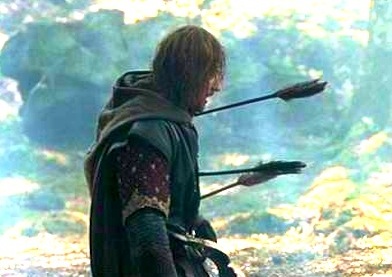
Do you really think it frequently takes more than one arrow in the chest to kill a man?

Generally, no . . . but if that hero is Boromir, most certainly!

The Death of Boromir

One of the most moving scenes in The Lord of the Rings involves the death of Boromir as he sacrifices his life in a futile battle to allow the hobbits time to escape the Uruk-hai. It’s impact is magnified by the fact that it immediately follows Boromir’s near-betrayal, under the corrupting influence of the Ring.

The irony is that this spectacular scene is not described in detail in Tolkien’s book. It is a tribute to director Peter Jackson’s cinematic brilliance. This is the original telling:

Even as [Aragorn] gazed his quick ears caught sounds in the woodlands below, on the west side of the River. He stiffened. There were cries, and among them, to his horror, he could distinguish the harsh voices of Orcs. Then suddenly with a deep-throated call a great horn blew, and the blasts of it smote the hills and echoed in the hollows, rising in a mighty shout above the roaring of the falls.

“The horn of Boromir!” he cried. “He is in need!” He sprang down the steps and away, leaping down the path. “Alas! An ill fate is on me this day, and all that I do goes amiss. Where is Sam?”

As he ran the cries came louder, but fainter now and desperately the horn was blowing. Fierce and shrill rose the yells of the Orcs, and suddenly the horn-calls ceased. Aragorn raced down the last slope, but before he could reach the hill’s foot, the sounds died away; and as he turned to the left and ran towards them they retreated, until at last he could hear them no more. Drawing his bright sword and crying Elendil! Elendil! he crashed through the trees.

A mile, maybe, from Parth Galen in a little glade not far from the lake he found Boromir. He was sitting with his back to a great tree, as if he was resting. But Aragorn saw that he was pierced with many black-feathered arrows; his sword was still in his hand, but it was broken near the hilt; his horn cloven in two was at his side. Many Orcs lay slain, piled all about him and at his feet.

Aragorn knelt beside him. Boromir opened his eyes and strove to speak. At last slow words came. “I tried to take the Ring from Frodo” he said. “I am sorry. I have paid.” His glance strayed to his fallen enemies; twenty at least lay there. “They have gone: the Halflings: the Orcs have taken them. I think they are not dead. Orcs bound them.” He paused and his eyes closed wearily. After a moment he spoke again. “Farewell, Aragorn! Go to Minas Tirith and save my people! I have failed.”

“No!” said Aragorn, taking his hand and kissing his brow. “You have conquered. Few have gained such a victory. Be at peace! Minas Tirith shall not fall!” Boromir smiled.

“Which way did they go? Was Frodo there?” said Aragorn.

But Boromir did not speak again.

“Alas!” said Aragorn. “Thus passes the heir of Denethor, Lord of the Tower of Guard! This is a bitter end. Now the Company is all in ruin. It is I that have failed. Vain was Gandalf’s trust in me. What shall I do now? Boromir has laid it on me to go to Minas Tirith, and my heart desires it; but where are the Ring and the Bearer? How shall I find them and save the Quest from disaster?”

He knelt for a while, bent with weeping, still clasping Boromir’s hand. So it was that Legolas and Gimli found him. (Lord of the Rings, Book III Chapter 1).

So, we understand that while a single arrow might slay a common warrior, it could well take a quiver full to lay low a champion such as this.

___

If you would like to review “The Fantasy Novelist’s Exam,” simply follow this link.

Vivacious Vocabularies

One reason I love reading C.S. Lewis arises from his adroit use of the English language. His vocabulary is immense. It is pleasant to run into words one seldom encounters on the drab byways of modern journalism and tangled thoroughfares of contemporary “social media.”

Consider the following example. I was exploring The Allegory of Love when I read this: “There is nothing in literature which does not, in some degree, percolate into life.”

What a delightful verb! It evokes for me recollections of my youth when my parents would refer to our coffee pot as the percolator. Simultaneously, it reminds me of more recent—less happy—usages: “I’m sorry, but inadequate soil percolation means you’ll have to install a far more expensive septic system than normally required.”

It’s discouraging when you consider the sad state of modern vocabularies. I read somewhere that people typically only use about 10% of the words they know. So a common vocabulary of 5,000 spoken words would mean they know (i.e. can recognize written or audible forms of) about 50,000 words. Shakespeare used 29,000 words in his plays and sonnets, suggesting an expansive vocabulary. Likewise, brilliant authors like C.S. Lewis would boast a praiseworthy mental dictionary.

I am sometimes curious about my own vocabulary. I consciously attempt—in conversation as well as writing—to utilize at least 15% of the words I know. After all, the English language is so rich, it’s criminal to limit ourselves to pedestrian words. It’s like having all the ingredients for a delicious feast available to us and settling for slapping together a peanut butter sandwich.

I also love the precision that comes from using the exact word that suits the occasion. For example, in a thriller it matters greatly how the hero’s nemesis inflicts injury. A skilled writer would never say “Professor Moriarty cut Holmes.” Instead, we would learn that he slashed . . . stabbed . . . sliced . . . scarred . . . carved . . . or perhaps he merely nicked the detective. Likewise, we would probably know the type of weapon he was using. It would not be a mere “knife.” It might be a saber . . . a dagger . . . a pocketknife . . . scalpel . . . carving knife . . . or perhaps even a bayonet.

Lewis addressed this richness in vocabulary in an essay on “Transposition” which appears in The Weight of Glory.

If the richer system is to be represented in the poorer at all, this can only be by giving each element in the poorer system more than one meaning. The transposition of the richer into the poorer must, so to speak, be algebraical, not arithmetical. If you are to translate from a language which has a large vocabulary into a language that has a small vocabulary, then you must be allowed to use several words in more than one sense. If you are to write a language with twenty-two vowel sounds in an alphabet with only five vowel characters than you must be allowed to give each of those five characters more than one value. If you are making a piano version of a piece originally scored for an orchestra, then the same piano notes which represent flutes in one passage must also represent violins in another.

It is wonderful to be fortunate enough to speak a language with a diverse vocabulary. English is such a tongue. Now, if we could just simplify its complexities and purge its irregularities, we would enjoy the best of all linguistic worlds.

The Brevity of Life

O Lord, make me know my end and what is the measure of my days; let me know how fleeting I am! Behold, you have made my days a few handbreadths,
and my lifetime is as nothing before you. Surely all mankind stands as a mere breath! Surely a man goes about as a shadow! (Psalm 39:4-6, ESV).

I was reminded this week of that terrible cloud that hangs over all humanity . . . the brevity of our lives.

The Psalmist David lived a long life. Yet, during it he experienced great trials, some of which he failed. In this Psalm, he describes the vast gap between God and his creation.

Even human beings, created in the Lord’s very image so that we might worship him and live in fellowship with him for all time . . . even we human beings, because of sin, are destined to perish. We all die.* It is one of very few certainties that exist; as Benjamin Franklin famously wrote: “In this world nothing can be said to be certain, except death and taxes.”

The Bible can sound almost depressing when touching on the theme of life’s swift passage. But if we begin to despair, we have entirely missed the purpose of these verses. They are simply there to remind us of our utter dependence on God.

We must not trust in the pagan wishful thinking of the “immortality of the soul,” apart from its Creator. Nor should we deny God’s presence and surrender to the belief that there is no existence beyond this life. The latter is a particularly sad “religion,” or worldview. And like all beliefs, it requires “faith” (trust) to believe there is no afterlife. C.S. Lewis described that fact in a 1956 epistle included in Letters to Children.

People do find it hard to keep on feeling as if you believed in the next life: but then it is just as hard to keep on feeling as if you believed you were going to be nothing after death. I know this because in the old days before I was a Christian, I used to try.

The message of the Scriptures is not for us to bemoan the fact that we will die, and that our days in this world are brief. On the contrary, God’s word paints this picture vividly, with the sharp colors of reality (rather than numbing pastels of euphemisms) because it is vital that we understand how this life is merely a prelude to the life that follows.

I began this post by saying I’d recently been reminded of death’s immanence. Last year I had written a brief letter to Calvin Miller, the anointed author I quoted in my previous meditation. He graciously responded. Well, it dawned on me that he might enjoy reading my comments about The Philippian Fragment, so I wrote him again four days ago. I had not heard back, and eagerly awaited his reaction . . . only to learn yesterday that Dr. Miller had passed away two days after I wrote to him.

While I was saddened (on behalf of his family and fans) to hear of his death, I recognize that he is already experiencing a more abundant and true life this very moment, than any he could ever know here. Still, I wish I’d written to him just a few days earlier, since I’m curious what he might have thought about my modest words on the subject of compassionate ministry.

Since we began with a Psalm of David despairing about the brevity of human life, it is fitting to end with another song penned by the same royal composer. Once again he acknowledged the shortness of our lives. But here, he makes it very clear that due to God’s immeasurable love for his children, we have an “everlasting” destiny, which will never end. His children by faith, who have trusted in his only begotten Son, already possess the gift of eternal life. And we will experience it fully after the resurrection, when we have discarded this fallen shell and been clothed in our new body.

As for man, his days are like grass; he flourishes like a flower of the field; for the wind passes over it, and it is gone, and its place knows it no more. But the steadfast love of the Lord is from everlasting to everlasting on those who fear him, and his righteousness to children’s children, to those who keep his covenant and remember to do his commandments. The Lord has established his throne in the heavens, and his kingdom rules over all. (Psalm 103:15-19, ESV).

* For theological clarification, it is possible for God to raise someone to heaven without dying (e.g. Elijah), and those who are still living when Christ returns in the Parousia, will not have to experience physical death.

Your Writing Style

Each of us writes in a unique manner.

You can study writing patterns in various ways, by considering vocabulary, changes in sentence lengths, repeated phrases, and various other measurable elements.

Then there are more subjective aspects of our writing, but these too are recognizable. They would include tone and more abstract things like pacing.

When you add them all together, you arrive at an amorphous quality called the writer’s “voice.” And, as I said above, each of our “voices” are different.

It may be that we dabble in a variety of forms and genres. For example, in addition to these casual blog posts, I also write about theology and military ministry from a much more “professional” perspective. And, shockingly (to my own writing identity) I’ve recently received encouragement related to poetry with which I’ve been experimenting.

Even when we write in various literary forms, and they clearly differ from one another in their voice, the truth is that for each of these documents we develop a personal, inimitable voice.

Now, after emphasizing our literary uniqueness, I want to switch perspectives and consider that our various styles and voice resemble those of others. Occasionally, when reading someone’s work it strikes you as familiar. You may even recall the author that the work reminds you of. (I’m not referring to plagiarism, of course, although the internet has apparently made that particular plague even more common now than in the past.)

It would be vanity to claim that our own writing voice resembles that of no one else. Yes, some voices are so peculiar that they are clearly “rarities,” but others have shared even those odd personalities in the past. I suspect that’s even true for the senseless ramblings with which some self-styled “artists” assail the public. (Even insanities can resemble one another.)

In any case, if you ponder this subject it’s natural to wonder: who do I write like?

Today, through the amazing processing abilities of the computer, you may be able to get an answer to that very question. It’s not a definitive answer, because as I said above, our writing voice possesses both material (words and syntax) and spiritual (ephemeral and aesthetic) dimensions. And, while a computer may be without peer in comparing the former, I believe it to be quite deficient in discerning the latter.

Nevertheless, a rudimentary program is available online to compare your writing with that of a number of writers of varying reputation. The program has a number of limitations, but I think there may be something to it. It requires an extensive section of your writing (several paragraphs, at least). I assume more would be better, in terms of promoting accuracy.

As I just mentioned, it includes a limited number of authors currently entered into the database, and I suspect that the gifted C.S. Lewis is not among them. (I say this not because I expected to be aligned with him, but because of some of the included authors I am aware of. In addition, the program’s creator is actually Russian, so I would be curious to learn how the represented English authors were selected.)

It would limit the program’s value, for example, if I only input data on three writers and you were matched with the one you resembled most closely. Would you prefer, for example, to be told you write like Edward Bulwer-Lytton, Georgette Heyer, or Fabius Planciades Fulgentius?

Even with a significant number of writers included, the program’s accuracy will be affected by the quantity (and specific choice) of what is included to represent each. For example, the programmer properly included Stephen King. How valuable would that be, however, if he had only used King’s poetry and excluded his prose works? (Yes, the horror master has also penned poetry—now, that’s a scary thought!)

Well, despite the limitations of the “I Write Like” program, it is fun to try out. And it sounds impressive, in that it relies upon a naive Bayesian classifier. (Well, the “naive” part doesn’t sound especially remarkable, but the formula looks pretty imposing to someone who never took calculus.

You can use take the “test” at this site.

Make sure you include lengthy selections from your work. Also, testing the program with different genres (assuming you write in different styles) will actually give you new matches. (That is, of course, as it should be.)

If you do decide to experiment with it, a comment below about your results would be interesting for others. And now, for the moment that you have been awaiting . . . with whose writing did the program match mine?

I tried a number of times (no—not fishing for results I wanted, but using a variety of types of my writing) and here were the repeated results:

For my blog posts: H.P. Lovecraft or J.R.R. Tolkien

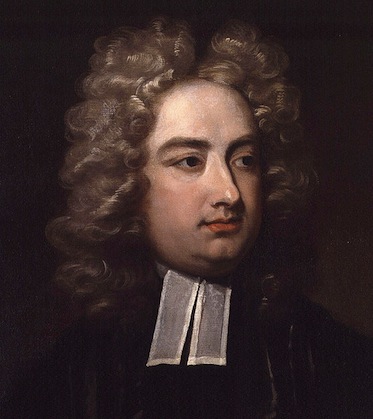
For my more formal essays: J.R.R. Tolkien or Jonathan Swift

(It’s Swift’s picture, you’ll note, that begins this post.) Actually, the majority of the results linked to Swift, whose work I don’t recall ever reading in full, not even Gulliver’s Travels. However, our shared emphasis on wit, advocacy and satire account for what I deem a genuinely accurate assessment. And it does not hurt that Swift was Anglo-Irish, like my favorite author!

So, until Dmitry Chestnykh adds C.S. Lewis to the writers included in the “classifier,” I’m quite content to rest on my matches. Because even if I don’t share Lovecraft’s worldview, I can still respect his literary skill. And being identified with the other gentlemen, is a grand compliment.

[Special thanks to Julie Catherine who introduced me to the site via her post on the subject.]

Screwtape Goes to War

I edit a free online journal for military chaplains. Articles have been contributed by clergy from most of the world’s continents, sharing their experiences and opinions. Much of the material will be of interest to anyone interested in the nature of ministry within the armed forces.

The current issue was “published” at the end of June, and includes one article that may be of particular interest to the readers of Mere Inkling.

On page fifty-seven you’ll find the preface to a series of six letters. They are collected under the same title as this post, “Screwtape Goes to War.” It is available via this link: Curtana: Sword of Mercy.

Those familiar with C.S. Lewis’ masterpiece of diabolical correspondence will require no introduction. Here’s an excerpt from one of the six epistles gathered in this modest collection. Remember, it is from the pen of a senior demon advising a junior Tempter on how to corrupt his “patient” (in this case a chaplain).

While preaching can in theory be used by the Enemy to draw his servants closer to himself, it’s equally possible to use the pulpit to drive a wedge between the Enemy and those ordained to serve him. In fact, there is something uniquely satisfying about using a chaplain’s own preaching to immunize him to the disgusting message of hope and forgiveness.

There are so many tactics to undermining the effectiveness of your chaplain’s sermons . . . where to begin? I have found the following methods to be most useful.

1. Encourage him to subscribe to all sorts of periodicals and keep him as far away from the Enemy’s book as possible. Tell him that by this means he “will remain in touch with the culture” to which he is preaching. We do not want him opening the Scriptures. It’s not too challenging persuading many clergy today that they’ll bore and alienate their audience by citing passages from that archaic text. Let him explore all sorts of publications so he discovers ones he honestly enjoys. That will make the choice easier when he looks on his desk at a tempting contemporary publication lying next to that black book.

Not all journals are created equal, of course. Some actually contribute to the knowledge and comprehension of the Enemy’s book. Avoid these. Secular publications are usually safe, the more so when they celebrate selfishness, man’s favorite religion. The most precious, however, are those published by “religious” presses. You know those to which I refer. The ones penned by our allies who where wear the garb of the Enemy but live with either themselves or some other idol on the throne of their souls. Those who may praise him with their lips but deny him access to their hearts. Mind you, these documents need to be chosen with great care. But if you can find some which appeal to him, it will aid you immeasurably in bringing about his demise. . . .

Curtana discusses both historical matters and contemporary issues. It is interfaith and international in scope. The website includes a “subscription” form for those who wish to be notified whenever a new issue of the journal is published.

Don’t be confused when you see the date on the current issue. Like many minimally-staffed, free publications, we’ve fallen slightly “behind schedule.” Thus, the current issue is dated Fall & Winter 2011. (I promise this is due not merely to procrastination, but also to the editor’s chronic propensity for terribly over-extending himself.) At any rate, Curtana 3.1 is indeed the issue which includes the afore-described article.

C.S. Lewis the Poet

Many of us desire to write. And yet, we often consider ourselves “failed” writers because the novel buried within us is never published. Print on Demand technology has addressed this to a degree . . . but the fact remains that few of us are destined to receive accolades for our work.

And that, simply, is life. We cannot all be “successful,” especially as the world defines the concept.

It is good to have family and friends who remind us of what does truly make us precious, especially if we are enslaved by our passion to write, and discouraged by the meager fruits of our efforts.

In the writers group in which I participate, we enjoy that sort of supportive “family.” While we encourage everyone to refine their skills, expand their horizons and pursue their dreams . . . we are also realistic in our expectations. One of the most important things we can do for novice writers, in my humble opinion, is to help them discover the particular fields in which their literary labors will be most effective.

For example, many writers compose memoirs that prove invaluable to family members. When these stories capture the flavor of a bypast locale, their value extends to others who are interested in that beloved community. Likewise, I’ve known people whose gift for writing was most radiant in terms of letters. Their personal correspondence was glorious. Like radiant gems carved to perfection for each of the individual persons to whom they were addressed. In past eras, such correspondence was highly esteemed. Gifted writers such as these owe no apology for not writing best-selling fiction.

Still, we often judge ourselves by our failures, rather than our successes.

C.S. Lewis was no different. He was quite successful as a writer, and was certainly in high demand as a professor and adviser at Oxford and Cambridge. He received international praise for his work, and yet he was despondent about at least one aspect of his writing.

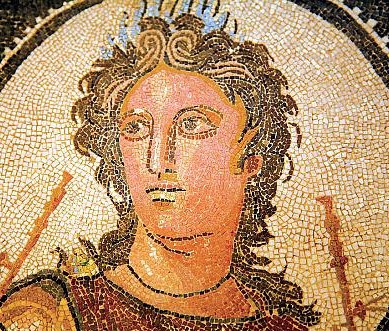
Lewis had longed from his adolescence to become a respected poet. This was partly due to the age in which he was reared. Poetry was viewed as the most cultured and elegant form of writing. Much more so than is true today. (Although I assume today’s poets still regard Euterpe, pictured above, as the most wondrous of Greece’s Muses. Her domain was Music and Poetry.)

Lewis’ poetry did not receive much critical praise. We’ll consider the subject more in the future, but for now suffice it to say that this fact caused him much grief. Walter Hooper, Lewis’ secretary writes in his C.S. Lewis: Companion & Guide: “The most noticeable effect of Lewis’ conversion [to Christianity] was the death of his old ambition as a poet and the emergence of a man never thereafter at a loss for the right words.”

Lewis still wrote poetry, of course, but he no longer sought his identity in it. The following love poem, inspired by his deep affection for his wife Joy, is quite powerful. As they faced her illnesses and death, I believe his words reach heights rarely attained by many a poet laureate.

As the Ruin Falls by C. S. Lewis

All this is flashy rhetoric about loving you.

I never had a selfless thought since I was born.

I am mercenary and self-seeking through and through:

I want God, you, all friends, merely to serve my turn.

Peace, re-assurance, pleasure, are the goals I seek,

I cannot crawl one inch outside my proper skin:

I talk of love—a scholar’s parrot may talk Greek—

But, self-imprisoned, always end where I begin.

Only that now you have taught me (but how late) my lack.

I see the chasm. And everything you are was making

My heart into a bridge by which I might get back

From exile, and grow man. And now the bridge is breaking.

For this I bless you as the ruin falls. The pains

You give me are more precious than all other gains.

If you find this poem moving, it is well worth taking a moment to listen to Phil Keaggy’s musical treatment of Lewis’ lyrics.

Charting Our Life Course

In our last conversation we considered the fact that life is a journey. And during this journey which encompasses our very existence, we follow a variety of paths.

Not all of the paths lead to “happy endings.” I almost wrote “fairy tale endings,” but then I recalled that some old folk tales conclude in a rather grim fashion.

Signposts stand as sentinels at the junctions. “Take this path to self-fulfillment.” “Follow this lane to explore forbidden pleasures.” “This way leads to power.” They offer promises aplenty, but their veracity is not guaranteed. In fact, the more outlandish the claims, the more suspect they become to the wise.

Speaking of wisdom, some of the most powerful words in the Book of Proverbs relate to this notion of choosing paths cautiously. Wisdom and Folly are personified as two women. One offers life-enriching knowledge and insight. The other proffers more carnal and transitory wares.

My son, keep my words


    and treasure up my commandments with you . . .

Say to wisdom, “You are my sister,”


    and call insight your intimate friend,

to keep you from the forbidden woman,


    from the adulteress with her smooth words.

. . . and I have seen among the simple,


    I have perceived among the youths,


    a young man lacking sense,

passing along the street near her corner,


    taking the road to her house . . .

And behold, the woman meets him,


     dressed as a prostitute, wily of heart.

She is loud and wayward;


     her feet do not stay at home;

now in the street, now in the market,


    and at every corner she lies in wait. . . .

I have spread my couch with coverings,


    colored linens from Egyptian linen;

I have perfumed my bed with myrrh,


    aloes, and cinnamon.

Come, let us take our fill of love till morning;


    let us delight ourselves with love.

For my husband is not at home;


    he has gone on a long journey . . .

With much seductive speech she persuades him;


    with her smooth talk she compels him.

All at once he follows her,


    as an ox goes to the slaughter,

or as a stag is caught fast

    till an arrow pierces its liver;

as a bird rushes into a snare;


    he does not know that it will cost him his life.

And now, O sons, listen to me,


    and be attentive to the words of my mouth.

Let not your heart turn aside to her ways;


    do not stray into her paths,

for many a victim has she laid low,


    and all her slain are a mighty throng.

Her house is the way to Sheol,


    going down to the chambers of death.

The power of this proverb is in its truth. I have actually known the seductresses (and seducers) described in these verses. Well, I’ve been acquainted with emanations of both female and male versions of Folly, since they are legion.

Despite the Lies, There is Still Hope

The key to journeying through life with the fewest deadly detours is to rely on a trustworthy guide. A compass, so to speak. A map or handbook that soundly advises which paths to take, and what precipices to avoid.

Of course, if we would rather take the risk, we can rely on human ignorance (is West to my right or my left?) . . . or worldly counsel (let us take our fill . . .).

The Bible lays out the safe and proven path. What’s more, our Savior—who calls himself “The Way,”—promises to accompany us on the journey itself.

One of C.S. Lewis’ least read books is entitled The Pilgrim’s Regress. It is modeled on the classic Pilgrim’s Progress, written by John Bunyan in 1678. The Pilgrim’s Regress was Lewis’ first published work of prose fiction. His protagonist goes through a period of disbelief, mirroring Lewis’ own. It is well worth the read, although, perhaps, it is best preceded by a reading of Bunyan’s original work.

Toward the end of his allegory, Lewis brilliantly describes the course of travel for many who sojourn for a season in foreign (unbelieving) realms. The traveler learns that all who earnestly seek the Truth ultimately find it in a single Source. I offer the following passage not as a “spoiler,” but to illustrate the importance of following the right path—and to entice you to consider reading The Pilgrim’s Regress.

“What do you see?” said the Guide.

“They are the very same shape as that summit of the Eastern Mountain which we called the Landlord’s castle when we saw it from Puritania.”

“They are not only the same shape. They are the same.”

“How can that be?” said John with a sinking heart, “for those mountains were in the extreme East, and we have been travelling West ever since we left home.”

“But the world is round,” said the Guide, “and you have come nearly round it. The Island is the Mountains: or, if you will, the Island is the other side of the Mountains, and not, in truth, an Island at all.”

“And how do we go on from here?”

The Guide looked at him as a merciful man looks on an animal he must hurt.

“The way to go on,” he said at last, “is to go back. There are no ships. The only way is to go East again and cross the brook.”

“What must be must be,” said John. “I deserve no better. You meant that I have been wasting my labour all my life, and I have gone half-round the world to reach what Uncle George reached in a mile or so.”

“Who knows what your uncle has reached, except the Landlord? Who knows what you would have reached if you had crossed the brook without ever leaving home? You may be sure the Landlord has brought you the shortest way: though I confess it would look an odd journey on a map.”