Beware Your Personal Dragon

Readers of C.S. Lewis possess differing opinions on the film adaptations of the Chronicles of Narnia. One element from the latest film that is presented quite faithfully, is Eustace’s transformation into a dragon.

“He had turned into a dragon while he was asleep. Sleeping on a dragon’s hoard with greedy, dragonish thoughts in his heart, he had become a dragon himself.” (Voyage of the Dawn Treader).

With his brilliant insight and typical mirth, Lewis reveals for us a powerful dynamic of human existence. Two, in fact.

First, what we are inside—our genuine essence or spirit—will ultimately be revealed. This is true for most of us during this life. And, it will be experienced by all humanity as we stand before our Creator.

Second, what we desire—the longings upon which we focus our hearts and energies—shape that very essence. In a sense, Lewis is saying, we become what we covet!

What a wonderful lesson for us. It resounds with echoes of the Scriptures.

The title of this column suggests that we beware of the dragons to which we are particularly vulnerable. They vary from person to person, of course. And, they frequently shift, dependent on our biological age circumstances.

Martin Luther alludes to this in his broader comments about temptation and spiritual maturity:

To feel temptation is therefore a far different thing from consenting or yielding to it. We must all feel it, although not all in the same manner, but some in a greater degree and more severely than others; as, the young suffer especially from the flesh, afterwards, they that attain to middle life and old age, from the world, but others who are occupied with spiritual matters, that is, strong Christians, from the devil. But such feeling, as long as it is against our will and we would rather be rid of it, can harm no one. For if we did not feel it, it could not be called a temptation. But to consent thereto is when we give it the reins and do not resist or pray against it. (Luther’s Large Catechism).

Lewis reveals vividly what becomes of us when we surrender to our dragons. It’s not a pretty sight. And, sometimes it’s terminal. It would have been so, in Eustace’s own case, had not Aslan come to him with his healing grace

And so it is with us. No matter how dragonish you and I have grown, we can be healed of the affliction by the same Aslan, who is known in our world by a different name . . . Yeshua (Jesus).

The Church Militant (Or Not)

I was surfing wordpress sites the other day and came across one that linked to a fascinating collection of distinctive church buildings. I’ll include the link at the end of this column (so you don’t get too distracted, and fail to finish reading my impressions).

Many of the edifices are intriguing. Most are unique. A handful are truly inspiring.

One of the “unique” designs is found in the architecture of Saint Joseph Ukrainian Catholic Church in Chicago. For some viewers, the structure suggests minarets. Others see it as a contemporary version of Moscow’s Cathedral of Saint Basil. For me, it evokes a rather more martial memory.

In the early 1990s I was stationed at RAF Greenham Common where we were part of the nuclear deterrence mission. We supported the GLCM (ground launched cruise). We actually accomplished our national goal, in persuading the Soviet Union to mutually disarm through the Intermediate-Range Nuclear Forces Treaty. That was a significant accomplishment.

As part of the process, NATO and the Soviets dispatched Verification Teams to ensure that each was following through with the reduction and ultimate elimination of the missiles. After all of ours had been removed, I was privileged to serve as a Soviet Escort Officer during one such visit. It was interesting to watch how the highlight for the Soviets was their visit to our base exchange. (They were shocked by the diverse offerings of everyday capitalism and suspected that we depleted other stores to stock this one in a manner that would impress them.)

While they were visiting, they conducted pro forma inspections of all the locations where a missile could be hidden, including under regular manhole covers, as I recall.

Perhaps by now you understand why the Saint Joseph building reminds me of that tour of duty?

I am probably the only person whose first thought upon viewing this building is: what an amazing disguise for missile silos! Of course, one factor for my reaction is the clearly Russian/Ukrainian shape of the entire structure. A peculiar response to the picture, right? And yet . . . without inspecting the tubes, who can say with certainty whether or not my first reaction may have been accurate?

Here’s the link to the 50 Most Extraordinary Churches.

Jesus & Gandalf

Today Christians celebrated our Lord’s Transfiguration. (If you attend a church that doesn’t follow the historic “Church Year,” ask your pastor about it. It can be a healthy and educational spiritual discipline.)

The Transfiguration took place on a mountaintop where God the Father brought Moses and Elijah to speak with Jesus. During this encounter, Jesus and his garments shined with a pure, clear light that dazzled the eyes.

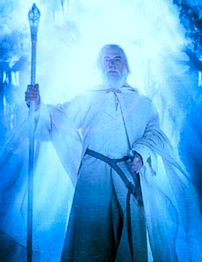
It was quite likely the Transfiguration that inspired J.R.R. Tolkien to include one powerful image in his Lord of the Rings tale. (The Lord of the Rings is often referred to as a trilogy, although it is actually a single intricate novel which consists of six “books” plus appendices.)

In the Middle Earth myth, the heroic Gandalf dies in battle with a champion of evil . . . only to be resurrected with even greater power and focus. In this point, the two events differ, since Jesus’ nature never changed. He was incarnate and born as both God and human being. The Transfiguration merely revealed momentarily a portion of his divine identity which was masked, in a sense, by his human flesh.

The aspect in which the accounts are similar comes in the appearance of the glorified Savior and the resurrected Wizard . . . they exude a holy radiance so powerful it even affects their garb.

Thus, Tolkien’s beloved Gandalf the Grey is transformed into the triumphant Gandalf the White.

The Transfiguration of Jesus was one small piece of evidence that he was who he claimed to be. It wasn’t given to the disciples to persuade them of his divinity; in fact, those who witnessed it were enjoined not to share the miracle with others until much later.

Ultimately, what one believes about Jesus does not come down to adding up his miracles and weighing them against the claims of other faiths. Jesus claimed to be the Son of God, the promised Messiah, and humanity’s Savior. If he wasn’t exactly that, he should be condemned and his memory forgotten. As the brilliant C.S. Lewis wrote:

Christians believe that Jesus Christ is the Son of God because He said so. The other evidence about Him has convinced them that He was neither a lunatic nor a quack. (C.S. Lewis, “The Language of Religion”)

Those familiar with Lewis’ writings may recognize how this quotation echoes others where he discusses his divine trilemma.

The world is full of hypocrites who want to force Jesus into their warped pantheons as a “prophet” or “teacher.” Jesus doesn’t allow himself to be embraced as anything other than who he is—God’s Son. Since he made that claim so clearly, he is either precisely that, or he is a liar. Or, it’s possible as Lewis points out, that he may have been insane. In which case he also falls short of being someone who should be followed.

For those who do not presently know Christ, simply pray in humility that God would open your eyes in a personal epiphany. God desires that no one would remain separated from him. And then, one day we can all look forward to seeing our Lord in the fullness of his glory.

Christian Marriage

Not all people should marry. But those who are led to marry—if they establish their marriage on the cornerstone of Christ—are in for a most glorious adventure. Yet, even with faith, marriages still require effort (i.e. proper choices) to bloom.

Sadly, it is possible for a marriage to end, even when one of the members is unreservedly devoted to “making it work.” Still, when wife and husband focus their eyes heavenward . . . when they recognize their marriage is, in a sense, a figure of the Trinity, including God as well as themselves . . . it can weather any storm the world throws at it. That’s one consequence of possessing that earnest love which “covers a multitude of sins” (I Peter 4:8).

And, never doubt it, the world and the lord of this world, love few things more than destroying a marriage. All of that holy promise, crushed. The joy and peace that come from living in lifelong intimacy, devastated. The miracle of two becoming one, forfeited.

One of the things that often surprises young Christian converts as they enter the Church, is the longevity of the marriages there. In some congregations, the thirty-five years my wife and I have been married still qualify us as “newlyweds.”

In light of these thoughts on this Valentine’s Day, the following quotation from C.S. Lewis is extremely apropos.

The Christian idea of marriage is based on Christ’s words that a man and wife are to be regarded as a single organism . . . The male and female were made to be combined together in pairs, not simply on the sexual level, but totally combined. The monstrosity of sexual intercourse outside marriage is that those who indulge in it are trying to isolate one kind of union (the sexual) from all the other kinds of union which were intended to go along with it and make up the total union. The Christian attitude does not mean that there is anything wrong about sexual pleasure, any more than about the pleasure of eating. It means that you must not isolate that pleasure and try to get it by itself, any more than you ought to try to get the pleasures of taste without swallowing and digesting, by chewing things and spitting them out.

As a consequence, Christianity teaches that marriage is for life.

Screwtape Letters Anniversary

I was recently reminded that February 2012 marks the seventieth anniversary of C.S. Lewis’ masterpiece, The Screwtape Letters. Other bloggers have remarked on the anniversary, for example here and here.

Lewis dedicated the book to his dear friend and fellow Inkling, J.R.R. Tolkien.

If you’re unfamiliar with the letters, you really should rectify that gap in your knowledge. The letters are penned by Screwtape, a senior Devil, to Wormword, a less experienced tempter. They illuminate Satan’s demonic tactics and provide keen insight into our fallen human nature, replete with its countless vulnerabilities.

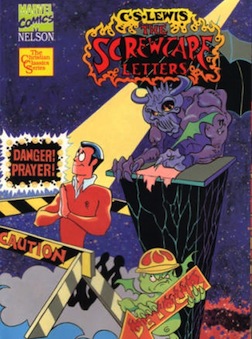
There’s even a graphic novel version of the collection which was published in 1994 by Thomas Nelson in partnership with Marvel Comics.

While the anniversary of the Letters in and of itself is certainly significant enough to merit a blog announcement . . . this post includes something quite rare. The fact is we’ve come into possession of one of Screwtape’s instructional emails, written to another subordinate demon.

For the benefit of those who would arm themselves against the snares of the Enemy, we reproduce it in full below.

(Oh, and as a reminder, when Screwtape refers to his Enemy, he is actually talking about the Creator of heaven and earth. Also, you can’t actually trust anything he writes since he’s a Liar, just like the archangel he followed so long ago. For example, note his incorrect reference to his own “immortality.”)

My Dear Esculentus,*

Another decade has passed since that puppet of the Enemy released to the world a portion of my correspondence with Wormwood. Of course, the lamentable Wormwood has had ample time to regret his carelessness in that matter, as I often remind you.

A decade’s but a snippet to immortals such as us, of course, but to the mortals it marks a significant portion of their brief lives. Why the Enemy loves those pitiable insects so much goes beyond logic!

Still, another halfscore has flown past and that damaging treatise remains in print. In fact, if anything, it continues to grow in popularity.

We simply cannot have our “patients” made aware of our treatment regimen for them. If they come to realize that our most successful deception is untrue, the relentless work of centuries will be undone.

We have labored tirelessly up to the present day to persuade humanity that all truth is subjective! Fortunately, the vast majority of the population in what are ironically labeled “enlightened nations,” has accepted our suggestion. This allows them to eagerly swallow the comforting lie that “all roads lead to god.” If they realize that all roads do indeed lead to a ‘god,’ they might abandon one of the many paths that lead to our Master who is ever-eager to “swallow” them in turn.

Better by far that those entrusted to our misleading, nourish our infernal Father than that you and I sate his appetite. (As you know, I say that figuratively, since our Father’s hunger for power can never be truly satiated. His all consuming hunger is one of his infinite qualities, which we rightly extol.)

But, back to your primary concern my appetizing friend, your patient. By all means keep him from reading The Screwtape Letters. In fact, the farther you keep him from anything written by Clive Staples Lewis, the better!

Keep him in the company of liberal companions who have embraced the myth of there being no objective truth. That way, we can prevent him from ever meeting the Enemy who proclaims himself to be—yes, disgusting isn’t it—the Way, the Truth and the Life.

Never pass up an opportunity to impress upon your patient that such a claim is politically incorrect to the utmost. Remind him he will be shunned by society if he argued there was a single truth. Indeed, make him think the very suggestion that anyone sincerely following another path might be lost, is repugnant.

Many of your fellow tempters have experienced great success in motivating the humans they treat to replace in their world views the virtue of Truth with the sentimentality of Sincerity. This you must do as well.

Persuade him that the eternal destiny of all who believe in something, is secure. Convince him that it is by their sincerity that they are saved. Oh how sweet it is when they accept this dark epiphany!

And it has never been easier to win humans over to this view than it is today. If you wish to embellish the doctrine with vague language about “God being love” and all that, so be it. Just see to it that they never open the Enemy’s book to recognize how grossly they have edited and distorted that concept!

Oh, and in closing, allow me to once again remind you of how I began this digital epistle. (We both know that it frequently takes a dozen or more reminders to make a firm impression on your dull mind.)

Do whatever it takes to ensure that your patient never reads the Letters! And, be wise to guard our own correspondence, lest you end up in the agonizing company of the afore-censured Wormwood.

Your affectionate adoptive Uncle,

Screwtape

*Esculentus translates from the Latin as either “delicious” or “succulent,” and if you have read The Screwtape Letters you know what that suggests about Screwtape’s interest in his protégé.

C.S. Lewis on Xmas

Advent has begun! As the Christian Church celebrates its “New Year,” it’s fun to look at C.S. Lewis’ essay, “Xmas and Christmas: A Lost Chapter from Herodotus.” He describes the predicament of secularized western civilization. Reversing the spelling of “Britain,” Lewis points out how a new holiday has displaced a profound holy-day.

In the middle of winter when fogs and rains most abound, [the Niatirbians] have a great festival called Exmas, and for 50 days they prepare for it (in the manner which is called,) in their barbarian speech, the Exmas Rush.

When the day of the festival comes, most of the citizens, being exhausted from the (frenzies of the) Rush, lie in bed till noon. But in the evening they eat five times as much as on other days, and crowning themselves with crowns of paper, they become intoxicated. And on the day after Exmas, they are very grave, being internally disordered by the supper and the drinking and the reckoning of how much they have spent on gifts and on the wine.

A few among the Niatirbians have also a festival, separate and to themselves, called Crissmas, which is on the same day as Exmas. And those who keep Crissmas, doing the opposite to the majority of Niatirbians, rise early on that day with shining faces and go before sunrise to certain temples where they partake of a sacred feast.

But as for what Hecataeus says, that Exmas and Crissmas are the same, this is not credible. It is not likely that men, even being barbarians, should suffer so many and so great things (as those involved in the Exmas Rush), in honor of a god they do not believe in.

Niatirb might just as well be the Setats Detinu. We see the same signs all around us. One shocking fact is how the secular seasonal movies now do not even feel compelled to offer the slightest nod to the true meaning of the season. Santa, for many, has utterly eclipsed the Babe in the manger. And “Christ” has literally been crossed out of Xmas.

May this entertaining portrait remind each of us of the true significance of the approaching season. And, may God also use the season of Advent to prepare our individual hearts to receive the most priceless and precious Christmas gift ever given.

Alone—With God

“In prayer God shows himself to us. That he answers prayers is a corollary—not necessarily the most important one—from that revelation.” (C.S. Lewis, “The Efficacy of Prayer”)

Most people think of prayer primarily as a (frequently formal) conversation in which we appeal to God for particular blessings—followed by his response with a “yes,” “no,” or “not yet.” The formulation might look like this: Human Petition = Divine Response.

While prayer truly is a conversation with our Creator . . . this simplistic view is incomplete. In focusing on the answer, it misses out on the holy awe of being in the presence of God itself. C.S. Lewis grasps this precious truth. “In prayer God shows Himself to us.”

I was chatting with my grandson the other day. He’s home on leave from his assignment at Kadena Air Base in Okinawa. Andrew was describing how his Christian lifestyle has isolated him from many of his fellow airmen. They sometimes ridicule him for his chastity and can’t fathom his choice not to squander his time at the club.

But Andrew also shared with me how the ostracism has positively impacted his spiritual life. He’s discovered deep joy in spending time alone with the Lord. He’s active in church worship too, of course, but he also enjoys his time alone. And that is a spiritual epiphany for a gregarious young man who is intensely social by nature.

He shared with me this verse from a song by a contemporary Christian band we both enjoy:

“Loneliness and solitude are two things not to get confused ’cause I spend my solitude with You.” (Reliant K, Lyrics from “Therapy”)

I hear in these words an echo of Lewis’ insight. As Christians, we are never alone. And sometimes in “solitude” we experience the most amazing intimacy a human being can ever know.

Addendum:

True . . . God is ever with us. As Saint John Chrysostom, Patriarch of Constantinople, said: “Quietude in solitude is no small teacher of virtue.”

Stained Glass Fiasco

It’s shocking, what you come across on the internet. You see many things that were never meant to be. I place this stained glass window of Mr. T in that category.

Yes, I recognize that he is a Christian, and his gold (24 carat) cross is prominently displayed. But still . . .

I was surfing in search of a good portrayal of Saint Martin of Tours. Not quite sure how the most distinctive member of the A-Team appeared in the list.

At least it provides an excellent reminder that a person should be prepared for the unexpected whenever they enter the worldwide web. (It’s not likened to a spider’s domain without reason.)

Addendum:

I realize that you are not comparing Mr. Tureaud to an arachnid, but you really should be much more careful in how you jump from thought to thought.

Pornography Pays . . . and Costs

See No Evil

Some years ago I was a member of an “online” fiction critique group. It was secular, and few members worked with religious themes. I recall how one of the other writers bemoaned the fact that she had become “trapped” in a cycle of needing to write pornography. She said, “I can’t stop because it’s so easy to write and the market pays so well.” Now, I can’t attest to either of those statements . . . but her next sentence sure rang true.

“It simple to write and profitable . . . but writing this stuff makes me feel dirty.”

This impressed me. Even the theologically unenlightened mind (spirit/soul) recognizes the corrupting influence of immersing oneself in filth. God has written his (natural) law on the conscience of all those created in his image.

An article in today’s news brought this story to my mind. It appears a Roman Catholic publishing house has been found to include pornography in its frontlist. My first reaction is that this had to be a mistake, but the evidence seems quite significant.

The facts are simple. The press is in Germany and called Weltbild, and it’s second only to Amazon in book sales there. It publishes material most would deem pornographic. (The legal but vile industry calls itself “erotic” literature, but it’s eros-defiled.) While it’s sad enough that such material even exists, that’s not all. The more depressing issue is that Weltbild is owned in whole by the dioceses of the Roman Catholic Church in Germany.

Now, if you’re like me, you’ll want to give the church the benefit of the doubt. After all, you think, some unknown editor probably slipped a single title into their immense publishing list. I’m sure the senior people were never even aware of the mistake.

If you’re like me, you’d be mistaken. Turns out over 2,000 titles are found in their online store under the category of erotica. And, back in 2008 a group of concerned Catholics brought this matter to the attention to the attention of the bishops. In a seventy-page document.

What a tragedy.

But there is a lesson here. Those of us who call ourselves “Christian” should strive to maintain the highest possible standards. Associating ourselves with ugly things reflects poorly not only on us, but also on our Lord. This story is shameful, and I pray the leaders involved will repent of their error, no matter what the financial consequences may be. On the other hand, I too need to avoid shameful actions. And, whenever I do fall short of the Christian ideals which are my goal—I need to be swift to acknowledge my sin and seek to restore what has been lost.

Addendum:

Very true. Paul’s counsel to the church in Philippi remains timely. “Whatever is true, whatever is honorable, whatever is just, whatever is pure, whatever is lovely, whatever is commendable, if there is any excellence, if there is anything worthy of praise, think about these things.”

Faith Makes Sense of Our Existence

“If we discover a desire within us that nothing in this world can satisfy, also we should begin to wonder if perhaps we were created for another world.” (C.S. Lewis, Mere Christianity).

It would be a sad thing if we existed only for this brief lifetime. And an awareness of this tragic fact rests like a dark cloud over human existence. Many atheists cling to this as a fundamental justification for their rejection of God. “Because of our awareness of our own mortality,” they argue, “people create gods to worship.”

Now, we Christians can acknowledge one aspect of their reasoning. It actually is reasonable to think that if there were no Creator, people would be inclined to invent something to explain the cosmos. We see evidence of this in the fact that when people reject the Son of God—they vainly strive to fill the vacuumleft in their spirits. Human beings share a deep spiritual emptiness (called by some a “God-shaped hole”). And while atheists use that fact to argue against faith . . . C.S. Lewis provides us with the true reason for the conundrum.

It is precisely because of our broken relationship with God—because we were created for a perfect world we no longer inhabit—that we have an innate yearning for the eternal which only God can satisfy. You and I were created to live in the presence of our Lord in a Garden richer than we could ever imagine. And those who trust Christ now will find that a place has been prepared for us in a glorious new home.

 †††

Our faithful commentatorComment: Amen. As the North African Church father Augustine of Hippo wrote: Crede, ut intelligas. “Seek not to understand that you may believe, but believe that you may understand.”