
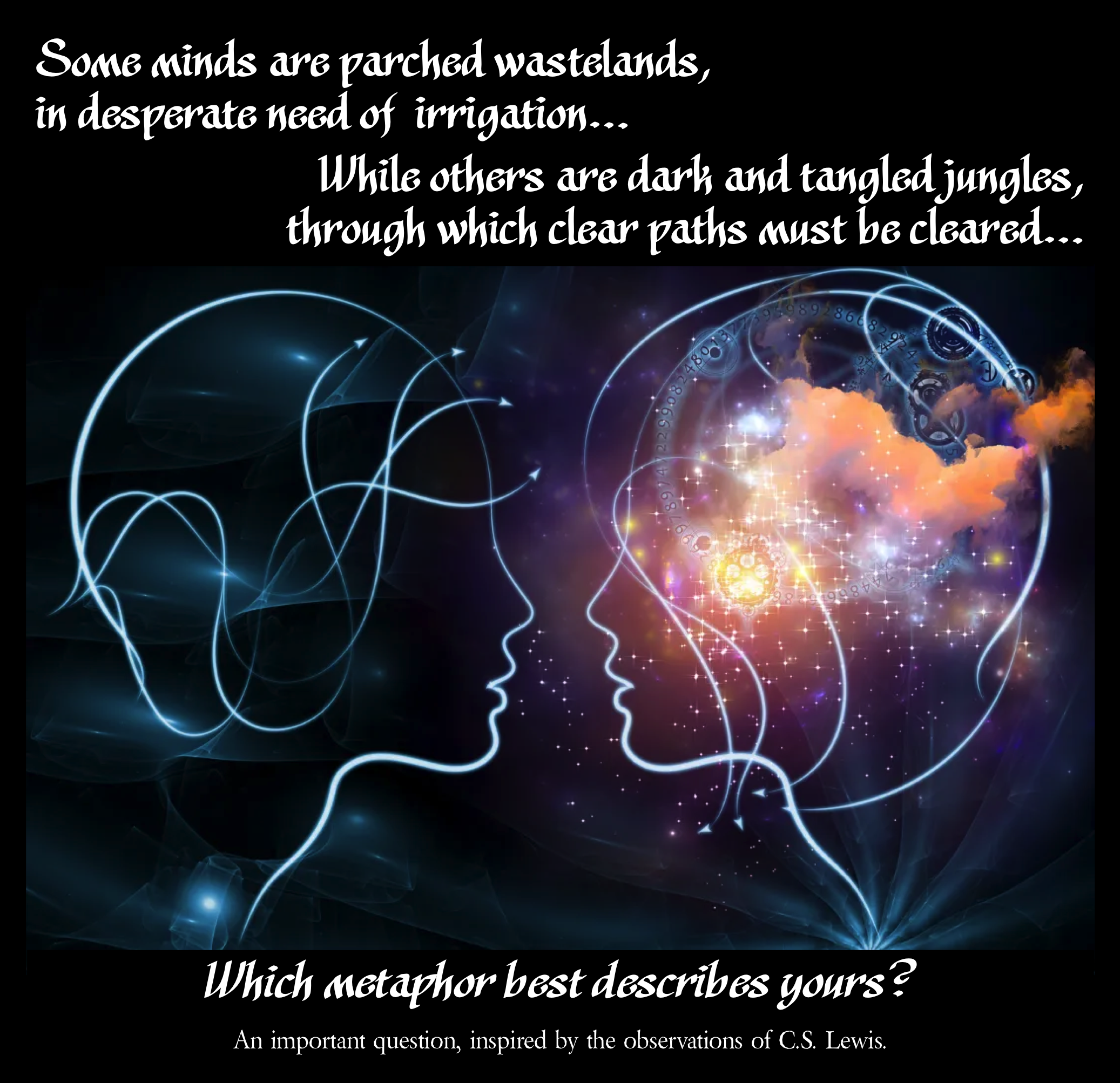
Learning is fun. Education can be enjoyable too. But obviously, they are not the same.
C.S. Lewis wrote a great deal about learning. A master of metaphors, he brilliantly described two distinct challenges faced by educators. In The Abolition of Man, he stated “the task of the modern educator is not to cut down jungles but to irrigate deserts.”
Wheaton professor, Robert McKenzie, offers a concise explanation of Lewis’ keen observation.
‘Cutting down jungles,’ as I understand that phrase, means helping students with passionate convictions to evaluate critically their world views, to examine what lies beneath the personal beliefs they profess.
‘Irrigating deserts,’ conversely, involves nurturing in apathetic or cynical students the hope that there is meaning and purpose in human existence.
Quite true, and I believe Lewis’ insight is more timely today than it was during the past century.
Classical Versus Modern Education
Today I read a passage that reminded me just how dramatically contemporary curricula deviate from the traditional educational materials used before the modern era.
While conducting research for a book about imperial Rome, which I hope to complete this year, I came upon the following passage.
It would have been easy to swell this little volume to a very considerable bulk, by appending notes filled with quotations; but to a learned reader such notes are not necessary; for an unlearned reader they would have little interest; and the judgment passed both by the learned and by the unlearned on a work of the imagination will always depend much more on the general character and spirit of such a work than on minute details.
It appears in Lays of Ancient Rome by Thomas Babington Macaulay, which is available for free download at Internet Archive.
Macaulay (1834-59) was a prominent British historian and politician. His histories were thoroughly researched and widely respected, especially by those on the (liberal) Whig* end of the political spectrum.
A contemporary of Macaulay described his preparation for writing in poetic fashion. According to novelist William Makepeace Thackeray (1811-63), “he reads twenty books to write a sentence; he travels one hundred miles to make a line of description.”
It appears that, like C.S. Lewis, Macaulay possessed a lasting recollection of all he read.
Returning to our beginning dichotomy – jungles versus deserts – both writers were a product of wide and critical literary study. Their minds were, in a sense, like a “rain forest.” Albeit, with C.S. Lewis it was certainly an orderly, well-tended forest. For some less stably grounded and more scatterbrained, the result is a jungle which requires radical clearing.
Alas, today’s more common problem, the unceasing pursuit of entertainment and distraction, leaves many with barren mental landscapes. In consequence, our calling as parents, educators, and friends, becomes one of irrigating the sparse flora and planting healthy new seeds in the hope that they will one day bloom.
* There is an interesting Mythlore article about C.S. Lewis’ view of history you can read here. In it, the author notes that “Lewis rejected a Whig history of unidirectional progress…” For a succinct article on the dangers of Whiggishness, I recommend “Evangelicals and Whig History” at First Things.
⁑ The brain truly can resemble a jungle, as a “digital reconstruction” reproduced on BrainFacts illustrates.
Immediately recognizable by its intricate folds and grooves, the cerebral cortex is the wrinkly, outer layer of the brain responsible for awareness, perception, and thought. Its interconnected neurons are arranged in six layers, a bit like the layers of tropical rainforests. . . . The findings may bring scientists closer to understanding how the complex jungle of cortical neurons interpret sensory information.
 Mere Inkling Press
There is so much I want to say in response to this. But I will keep it brief, because, honestly, my thoughts would be better expressed in person while drinking coffee in the late afternoon…
But, as a teacher, I will agree that “irrigate deserts” is the challenge of teaching. And there are so many factors in play with this metaphor. Yes, technology is one of the major ones, but also other social factors like family dynamics, social norms, and others.
On a last personal note, I also find it frustrating to ‘irrigate deserts’ because I am a firm believer in Emerson’s idea of ‘Man Thinking’ from his speech “The American Scholar”.
As always, even if I don’t always reply, I enjoy your insights!
Glad you enjoyed the post, Jamey. Also, that it triggered your own insights. I completely agree with your additional influences on the desertification of vulnerable minds.
Family dynamics are are likely the most critical element in the overall development of young human beings. That makes the collapse of the nuclear family so very tragic.
I’m off now to read about “Man Thinking.” (I fear my education was lacking…)
It is in his speech The American Scholar (I use to teach it in an American Lit class).
It certainly is a landmark document, that would belong in American literature class. I had to lay aside my distaste for Transcendentalism to read the speech.
The concept of Man Thinking is quite inspiring. A worthy goal for people, particularly educators, such as yourself. The following passage resonated strongly with me.
“In this distribution of functions, the scholar is the delegated intellect. In the right state, he is, Man Thinking. In the degenerate state, when the victim of society, he tends to become a mere thinker, or, still worse, the parrot of other men’s thinking.”
Sadly, I’ve encountered far more “mere thinkers” than truly inspired minds, grounded in the Truth. And then, referring to “parrots,” well, there is certainly no shortage of these.
I also appreciated his discussion of “books,” despite the fact that he clothed it in language a bit too poetic for my personal tastes.
Thanks for pointing me to this essay. I applaud his declaration that the Man Thinking “is the world’s heart. He is to resist the vulgar prosperity that retrogrades ever to barbarism, by preserving and communicating heroic sentiments, noble biographies, melodious verse, and the conclusions of history.”
There is little reward in an excellent teacher these days, either. The schools have laden the pupils with Chromebooks, with the insistence of their use for ‘instruction,’ and the teacher with a similar duct edict.
I feel all parties would find land to irrigate if they threw all devices into the ditches and dug right in with their hands.
Great comment, Chel. Good teachers (sadly, a minority, although I know many and am related to several) are actually handicapped by politics and procedures…
Agreed. Their challenges bother me to no end.
Pingback: Pop Tubes – A Mother Speaks Out
I wish you much success w/ your upcoming book, Rob.
In all honesty, part of the problem is that I have a half dozen “book” projects in various stages right now. I get inspired about different ones at different times, and will probably just leave a worthless “pile” of digital files as part of my inheritance to my descendants. (Not that I am completely resigned to that sad legacy!)
Yes, this is the right kind of question to ask. I’ve been ruminating on it for a decade and haven’t come to a fully satisfied conclusion.
You’re still a young man, my friend. Surely you’ll solve the puzzle one day!
Rob,
The mind is a terrible thing to waste. May we fill our hearts and minds with good things that last.
Thank you, Gary
We have several church friends right now in various stages of dementia. Such a sad thing. Still, deep in their hearts remains their trust in Christ… and the Lord will certainly, one day soon, restore all they have known that is good.
Amen.
Gary Avants Forbear Productions * *garyavants66@gmail.com garyavants66@gmail.com
Quite insightful article! Worth reading.
Glad you enjoyed it.