

A newly captured image of a supernova remnant in our Milky Way galaxy has me curious about where J.R.R. Tolkien may have gained inspiration for the elegant style of his Elvish scripts.*
America’s NASA has gifted all of Earth’s citizens with an array of stunning, and enlightening images. Recently, the James Webb Space Telescope directed its focus to Cassiopeia A, created thousands of years ago when a star 11,000 light years away went supernova.
It may be my imagination, or perhaps its an elevated mental talent for “core object recognition,” but for some inscrutable reason, I have recognized in the aftermath of the explosion faint echoes of Elvish script.
The light from Cassiopeia A (or Cas A, as we pseudo-astronomers refer to it) “first reached us around 340 years ago. As that was approximately 272 years before The Lord of the Rings was published, Tolkien had ample time to analyze the spectacular light source. Even factoring in the fact that the stories were composed between 1937 and 1949, the supernova’s existence had been known for a millennia and a half before LOR was written.
I will leave it to other researchers to determine just how Tolkien was able to gain a detailed view of the explosion’s aftermath. My purpose here is to simply alert the public to the unexplainable parallel between the cosmic residue and Tolkien’s own renditions of Elvish writing as he perceived it.
In a moment, I will allow the self-evident facts to speak for themselves.
Like his friend C.S. Lewis, Tolkien was a student of astronomy. As Professor Kristine Larsen says, “J.R.R. Tolkien based the stars and constellations of his created world of Middle-earth on ‘real world’ astronomy.” Dr. Larsen, a preeminent “Tolkienian Astronomer,” has published widely on the subject.
Of particular interest to readers of Mere Inkling will be “Medieval Cosmology and Middle-earth: A Lewisian Walk Under Tolkienian Skies,” which can be downloaded here. In the essay, Larsen points out,
. . . as is well known in Tolkien scholarship, during and after writing The Lord of the Rings Tolkien made various attempts to more closely align his cosmology with 20th century astronomical knowledge.
Fortunately for those of us who are drawn to the mythological textures of his legendarium, Tolkien never completed this “radical transformation of the astronomical myth” (as son Christopher termed it), but it is important to understand that this tension existed within Tolkien’s mind.
Having narrowly escaped the snare of surrendering to twentieth century astronomical theories, Tolkien preserved the mythical spirit of his cosmology. Larsen’s essay considers “whether or not Tolkien’s subcreation would, in reality, pass muster as a medieval cosmology, as defined by Lewis.” Thesis established, she takes readers on a pleasing journey. “So let us take a stroll under Middle-earth skies, and observe just how well the Dome of Varda matches with Lewis’s challenge.”
Returning to Cas A
As the images below will clearly illustrate, the preservation of the medieval nature of Middle Earth’s heavens does not mean that Tolkien ignored the realities of interstellar space. As I said a moment ago, the visual proof is definitive.
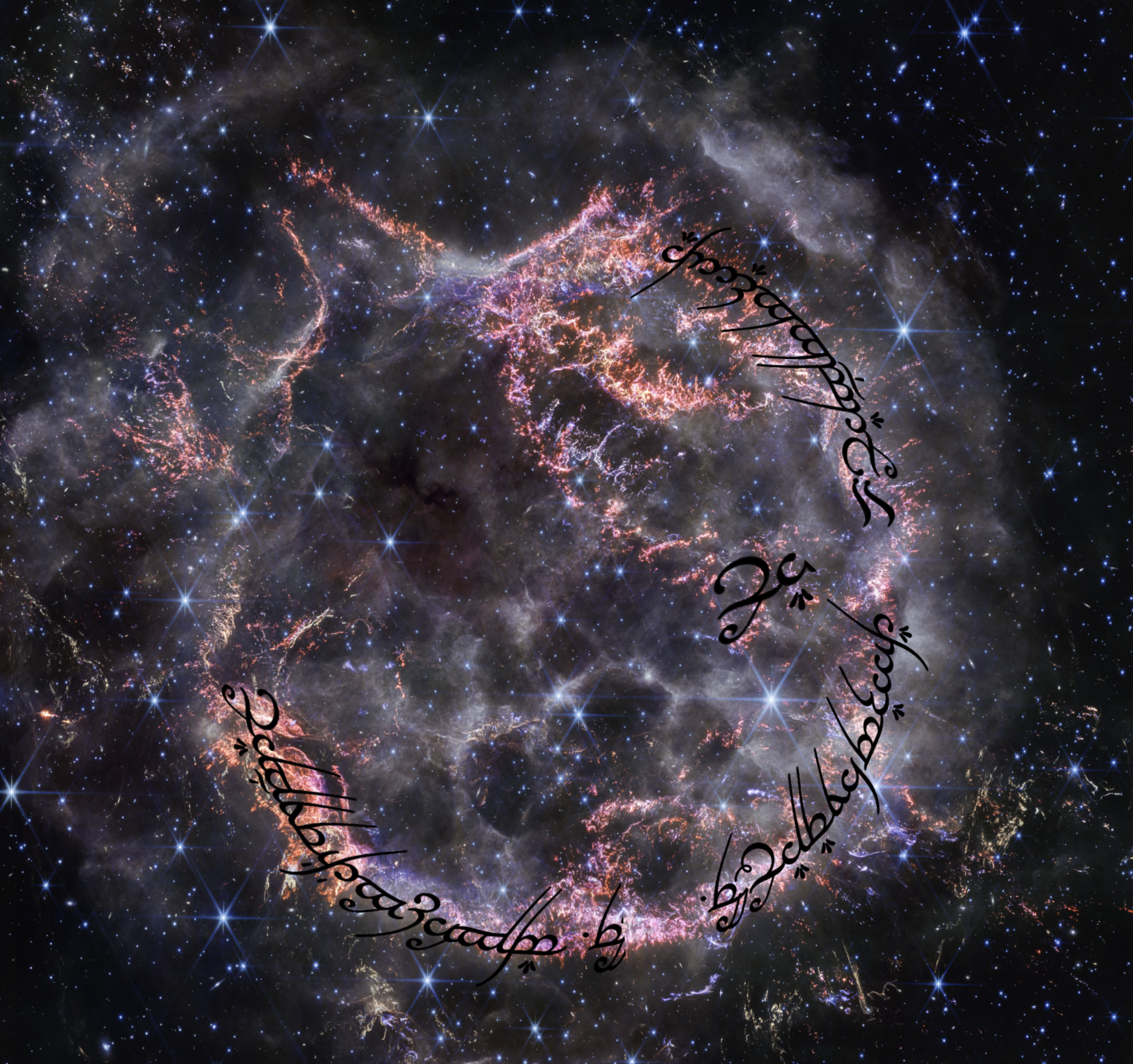
The fluid strokes of Tolkien’s Elven scripts are clearly foreshadowed in the plumes of this cosmic canvas.
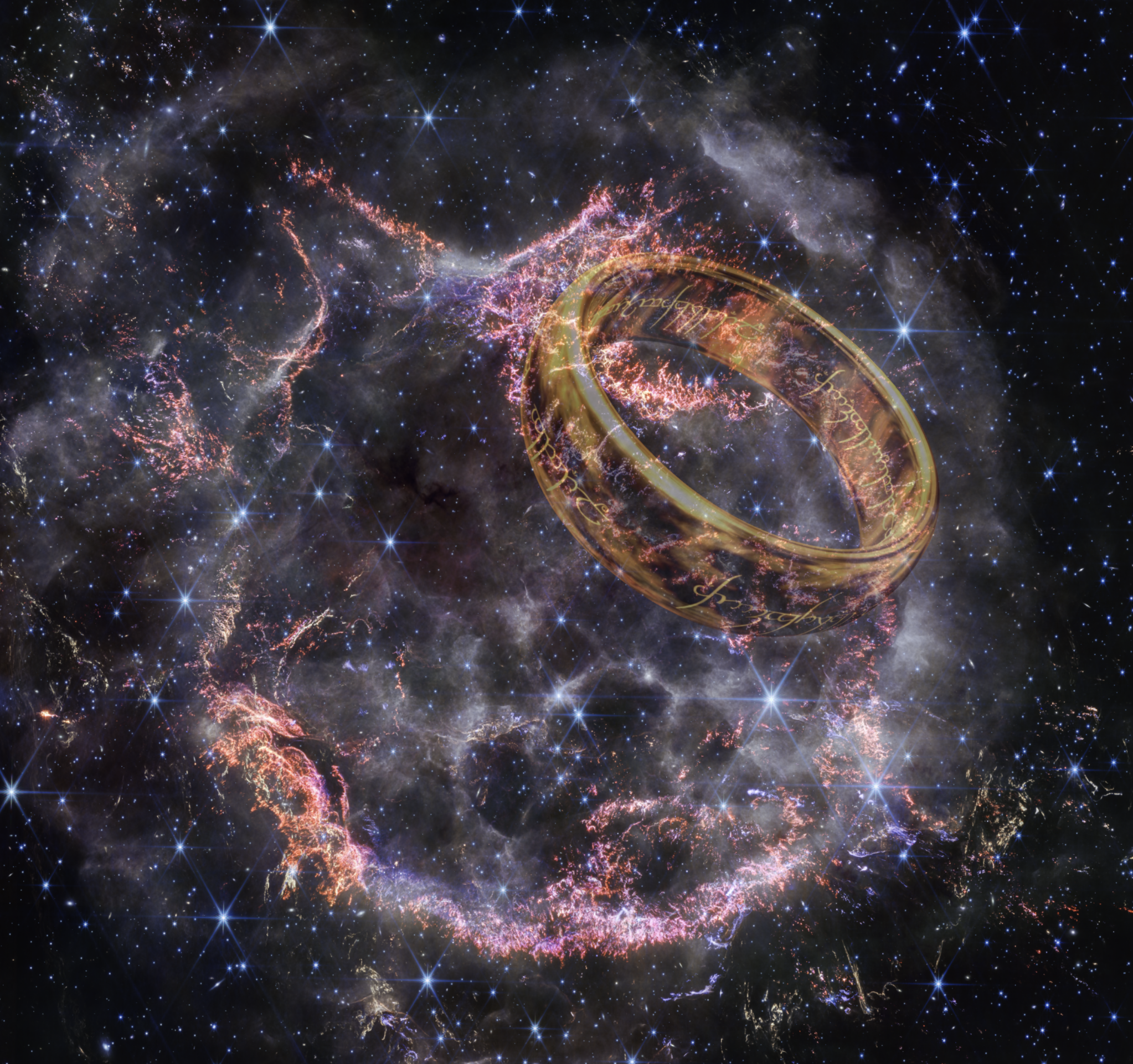
This image speaks fluently for itself.
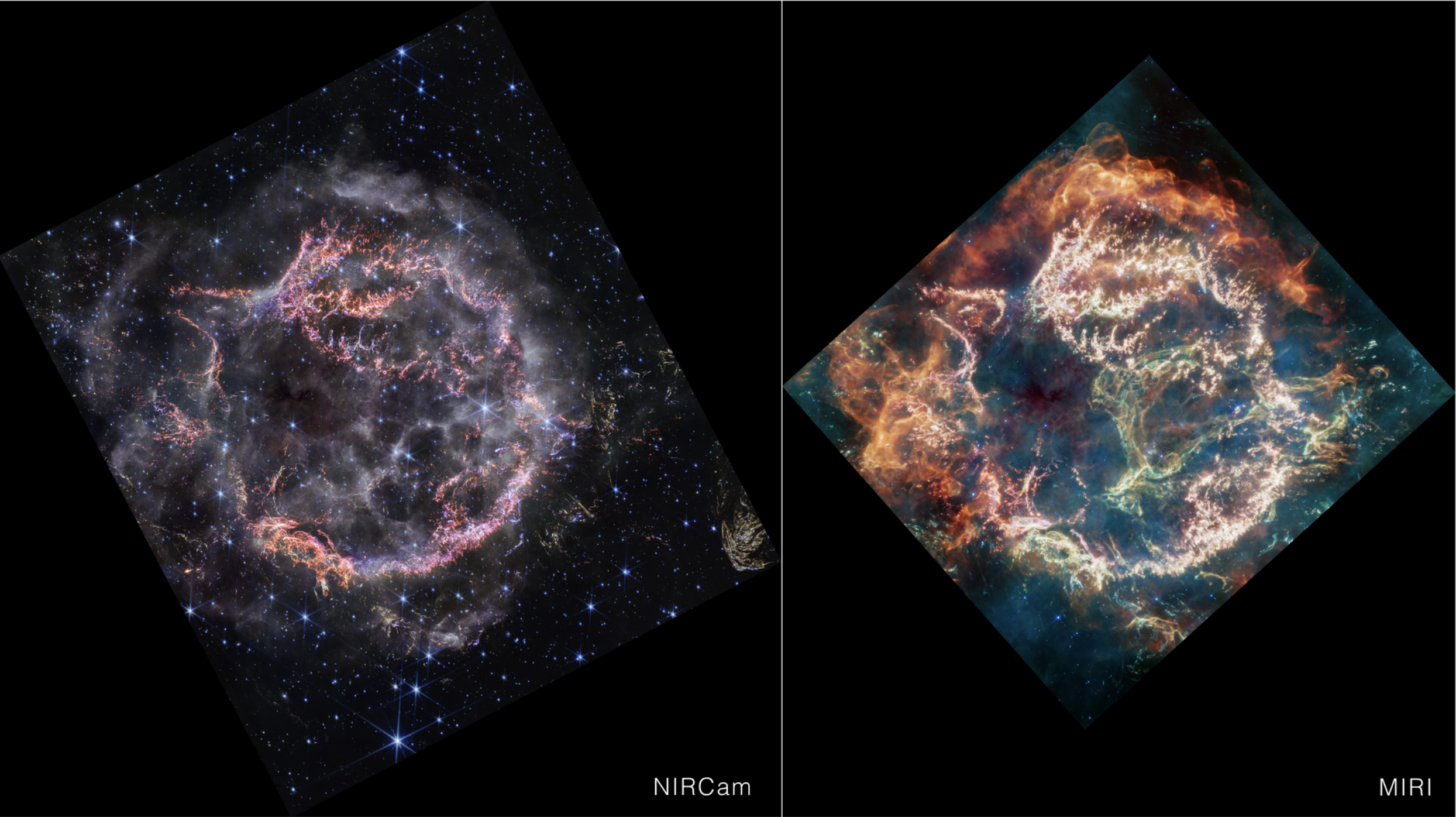
This pair of images from NASA contrasts the Near-Infrared and Mid-Infrared observations. It is quite possible the second influenced J.R.R. Tolkien’s perceptualization of Sauron’s eye. (Admit it, you see the dramatic similarities.)
We may never learn how Tolkien was able vividly see the details of Cassiopeia A with the earthbound telescopes accessible eighty years ago. Nevertheless, the evidence provided herein is irrefutable.
It seems fitting, when pondering the majesty of the stars as echoed in a masterpiece of literary subcreation, to close with an observation by Tolkien’s friend, C.S. Lewis. In an early letter to a close friend, Lewis described the wonder he experienced in reading Dante’s Paradise.
Here Lewis lyrically shares an experience of spiritual ecstasy which, this writer humbly suggests, can be shared by many, as we stand in awe of the majestic intricacy of the universe our Creator has fashioned.
[I read] Aristotle’s Ethics all morning, walk after lunch, and then Dante’s Paradiso for the rest of the day. The latter has really opened a new world to me. I don’t know whether it is really very different from the Inferno [Owen Barfield] says it’s as different as chalk from cheese – heaven from hell, would be more appropriate!) or whether I was specially receptive, but it certainly seemed to me that I had never seen at all what Dante was like before.
Unfortunately the impression is one so unlike anything else that I can hardly describe it for your benefit – a sort of mixture of intense, even crabbed, complexity in language and thought with (what seems impossible) at the very same time a feeling of spacious gliding movement, like a slow dance, or like flying. It is like the stars – endless mathematical subtility of orb, cycle, epicycle and ecliptic, unthinkable & unpicturable, & yet at the same time the freedom and liquidity of empty space and the triumphant certainty of movement.
I should describe it as feeling more important than any poetry I have ever read. . . . Its blend of complexity and beauty is very like Catholic theology – wheel within wheel, but wheels of glory, and the One radiated through the Many (The Letters of C.S. Lewis to Arthur Greeves).
Perhaps it was one of these very wheels – or rings – that Tolkien observed so many years ago in the heavens?
* For those who are interested in fonts for your computers, you can download Tolkien-inspired typefaces here.
 Mere Inkling Press
Don’t think I’ve ever read a more accurate description of reading “Paradiso” than this one by Lewis. Thanks for sharing.
As for the ring/elvish script AND Sauron’s eye preternaturally evident in Cas A, it’s truly uncanny, Tolkien’s vision (and yours) outdistancing the astronomers of his time.🙂
Merry Christmas to you and yours, Rob! 🎄
Uncanny is the word! Yes, Lewis’ epiphany when reading Paradiso is illuminating.
You have a blessed celebration of the Nativity as well, Dora.
A very interesting read.
And to think that when I was majoring in journalism the prof of a creative writing class I took told me it would be best if I “stuck to nonfiction.”
A very interesting whimsical look at this truly spectacular JWST picture. I hope you don’t mind if I provide some astronomical context to the picture so that we can all appreciate just how amazing the JWST truly is.
The light from the supernova explosion of which Cas A is the remnant (the shrapnel from the exploded star) is estimated to have first reached Earth c. 1690 CE, although it does not correspond to any verified historical supernova observation. Since there is no verified observation of the supernova event itself, the actual discovery was of the supernova remnant, Cas A. This was first done by Martin Ryle and Francis Graham-Smith using a radio telescope array, in 1947 : https://www.nature.com/articles/162462a0 . Radio waves are light waves that are invisible to the human eye. The James Webb Space Telescope images reproduced here are in infrared wavelengths, another form of light that is also invisible to the human eye. The first visible light (optical) observations of Cas A were in 1950 https://www.science.org/doi/10.1126/science.1158538 . Images of Cas A prior to the JWST image lacked sufficient resolution to see the minute details that allow us to imagine that we see Elvish script here. JWST truly is revolutionizing our view of the universe!
One of my personal favorite Tolkienian astronomical Inkblot tests is the Hubble Space telescope view of the circumstellar disk of Fomalhaut as the Eye of Sauron: https://weta.org/watch/shows/pbs-space-time/eye-sauron-reveals-forming-solar-system .
– KL
Thank you, Dr. Larsen, for the additional background on Cas A and your link to the delightful video on Fomalhaut. I suspect that it actually could be the residue of Sauron’s Eye.
Hi Rob,
Amazing and beautIful! I bet with less light pollution 80 years ago, Tolkien could see so much more. Hope all is good.
Thanks, Gary
Gary Avants Forbear Productions * *garyavants66@gmail.com garyavants66@gmail.com
You, my brilliant astronomical friend, have likely hit upon the true explanation for its accessibility to the inimitable author!
Light pollution in many ways has hindered the average person from seeing star and the cosmos.
Gary Avants Forbear Productions * *garyavants66@gmail.com garyavants66@gmail.com
Pingback: Tolkien Gleanings #157 « The Spyders of Burslem