 Happy Thanksgiving. I extend this wish and my goodwill to all readers of Mere Inkling, whatever your nationality.
I recognize that many countries have similar days, during which the population pauses to offer thanks to God for all of their blessings. Whatever its name, a nationwide recognition that we owe gratitude to God’s divine provision is a good thing.
I was thinking today, as I often do, about our years in the United Kingdom, and the hospitality of St. Paul’s Cathedral in London. Each year they open their doors on Thanksgiving as hosts to a wonderful service for “expatriates.”
Although Thanksgiving is a civil, rather than ecclesial celebration, it revolves around prayer. Simple logic says without Someone to “thank,” there could be no thanksgiving.
However, on the civic or “patriotic” side of the ceremony, we expect to see military honor guards and sing various familiar anthems.
And St. Paul’s offers a gracious welcome. Since Britain is “ahead” of the United States in terms of the clock, I actually saw photographs from today’s service already posted to their website. While online, I also saw something I didn’t recall from my visits there. It’s likely I saw it in the nineties, but I found it inspirational to read about the American Memorial Chapel.
St Paul’s Cathedral has a long-standing connection with the American people. At the east end of the Cathedral behind the High Altar is the American Memorial Chapel.
This part of the building was destroyed during the Blitz of World War II and as part of the post-war restoration it was decided that the people of Britain should commemorate the 28,000 Americans who were killed on their way to, or stationed in, the UK during the Second World War. Their names are recorded in the 500-page roll of honour encased behind the high altar. This was presented by General Eisenhower in 1951 and a page of the book is turned every day.
The American Chapel was designed by Stephen Dykes Bower and constructed by Godfrey Allen, Surveyor to the Fabric 1931-1956. The images that adorn its wood, metalwork and stained glass include depictions of the flora and fauna of North America and references to historical events. The three chapel windows date from 1960. They feature themes of service and sacrifice, while the insignia around the edges represent the American states and the US armed forces. The limewood panelling incorporates a rocket—a tribute to America’s achievements in space.
In a 1952 letter Lewis illustrates a post-war British opinion about Americans. Many Europeans—Lewis included—had been extremely grateful to the United States for massive amounts of aid sent there to assist with rebuilding. Most American’s are shocked to learn that in many parts of Europe, rationing continued long after the war. (It ceased in 1946 in American, and 1954 in the United Kingdom.)
As you say, we shall no doubt have large numbers of Americans in England for the Coronation, and some of them may not be a good advertisement for your country; but it is an odd thing that I have noticed, that since the war, the type of American visitor we have had is much nicer on the whole than that which came to us between the wars.
I suppose it is that, owing to the drop in sterling, we are now getting the Americans of modest means. And it has been my experience that the rich of any country are usually the least attractive specimens of the nation.
Curiously, Lewis had second thoughts about how his words might be read, and he added his own footnote to the paragraph.
There are very important exceptions. Also, on further thought, I don’t believe much in “French, American, or English people.” There are only individuals really.
In a world that often seems increasingly hostile, it’s encouraging to see the goodwill shared by some members of the international community.
And that is one treasure for which I am very thankful today.
_____
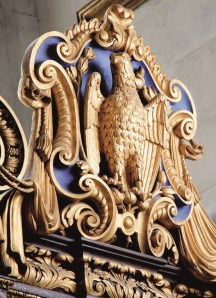
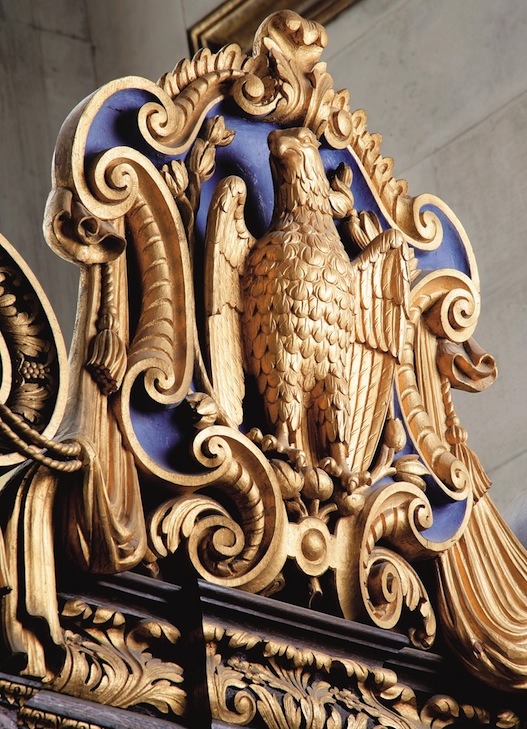
The photograph above features the bald eagle above the American Memorial Chapel altar in St. Paul’s Cathedral.

 Mere Inkling Press