A More Peaceful Time

It seems like a dream, when I recall a college course I took where Jews and Muslims peacefully discussed the turbulent history of the Middle East. And how we discussed that sad story in a cordial, and even sympathetic, manner.

The contrast between that day and 2023 – when people cannot even agree that tiny infants should not suffer for the sins of their parents – is mind-bending.

We assume that all people desire peace. Would that it were so. In his essay “First and Second Things,” C.S. Lewis offers a timely insight.

As far as peace (which is one ingredient in our idea of civilization) is concerned, I think many would now agree that a foreign policy dominated by desire for peace is one of the many roads that lead to war.

I was an undergrad at the University of Washington in the mid-1970s, when I saw a graduate level course with a fascinating title: “Wars that have Shaped the History of the Middle East.” My high school friend and I “begged” the professor to allow us into the class. He cautioned us that he would have the same requirements for us as he did for everyone else; there would be no mercy extended if we failed to meet the syllabus’ demands.

“No problem,” we said . . . although, being young procrastinators, at the end of the quarter we foolishly required a couple of all-nighters to complete our comprehensive term papers.

We, both Christians, were the only undergraduates in the small class. Our professor was Jewish, as were two of the students. One of these, was Israeli. He was, in fact, a veteran of the recent Yom Kippur War, during which he had served as the commander of a tank. I don’t recall which front on which he fought, but when you look at a map of Israel, it’s clear that every part of that small nation is a potential combat zone.

The remaining members of the class consisted of three Muslim students. One was American and a second was Iranian (back when the Shah was still in power). The third Islamic member of the class taught at a Seattle community college. He was Palestinian. And not merely Palestinian – his family was displaced during the 1948 Arab-Israeli War, which is referred to by the Israelis as the War of Independence.

You can imagine that with a group like that, opinions were deeply entrenched. Yet, although the preexisting opinions were indeed fixed, the individuals were not obstinate. Conversations were civil. Disagreements were conducted with reason rather than emotion. And, most surprisingly of all, we were able to socialize together at the end of the course.

It was a different world, apparently. It’s challenging to conceive of partisans today being capable of treating others with such respect. The last half century has marked a steep decline in the humanity of humanity.

Anti-Semitism is a Curse

It is strange to ponder how we’ve come to define antisemitism, confining it to anti-Jewish sentiment. After all, the word Semite refers to all people who speak a Semitic language, including Arabs.

Etymologically, Semite “comes via Latin from Greek Sēm ‘Shem,’ son of Noah in the Bible, from whom these people were traditionally supposed to be descended.”

If you are interested in an excellent article titled “C.S. Lewis’s Anti-Anti-Semitism in The Great Divorce,” simply follow the link embedded here.

Israel’s Wars

There has been no shortage of blood shed on the land the Romans called Judea and Arabia Petraea. And the history of the past seventy-five years have been violent indeed. For a description of all of the wars and military operations involving Israel, see this website.

We students each had to select one of the Middle Eastern regional wars to research in depth. We also had to make a detailed presentation and lead the discussion based on general readings completed by everyone.

As soon as I saw that requirement in the syllabus, my mind was mired in confusion over which of Israel’s wars would be the least controversial. Fortunately, as I read further I discovered that the purview of the course did not begin with the end of the Palestine Mandate, which was administered by Britain. Due to the influence of the Ottoman Empire, which had overshadowed the region until the end of the First World War, the professor elected to begin the course with the relatively nonconfrontational consideration of the Crimean War. I was the first student to raise my hand and voice my preference.

During the Palestine Mandate, C.S. Lewis had a number of former students serving in the Levant. In a 1940 letter to his brother Warnie, he describes a pleasant visit from one of these who went on to serve in a political capacity throughout the region for several more decades. This statesman refers to a fellow student who would go on to teach at East Anglia University.

I had a visit one night last week from Pirie-Gordon back from leave from Palestine, where (and in Egypt and Turkey) he says everything is “as good as gold.” The last riot was quelled by the cavalry regiment in which Rivière serves . . . In fact as P.G. said “I raised the riot and Rivière quelled it.”

I wonder how the members of the class would relate to one another if we were reunited for a discussion of what has transpired since 1975. With members of the American government at each other’s throats on our nation’s response to Hamas’ war, I doubt our discussions would be as respectful as they were back in the twentieth century. Still, conversations – even painful ones – need to happen if people are ever to get along with one another. That’s true not only for nations, but also for neighbors, and families.

I recommend two things to move us in the right direction. Honest communication, where we do a lot of listening. And prayer. The fact we do so poorly with the first, makes the second all that more essential.

A World Without Evil

illustration of a sheep with wolf shadow

A world without evil. Most people long for it. Some people pray for it. A few people are fooled into believing they have discovered it.

The good news is that one day evil will be eradicated, and redeemed humanity will enjoy the unmarred splendor of the world the Lord originally desired for us.

Until then, evil is ever-present. It existed before its entrance into our perfect world when our first parents disobeyed God in the Garden. The repercussions of that celestial rebellion continue to echo.

Some, however, are capable of deluding themselves into believing they can experience some sort of perfection. That is at the heart of many cults.

Their false messiahs persuade followers that they are part of such communities. In order to do so, they often move their people far from the “contaminating” influence of other people. In addition to Jonestown in Guyana, there have been utopian-turned-deadly villages in a places like Waco (Branch Davidians) and San Diego (Heaven’s Gate). More recently we’ve seen eleven children rescued from a Taos compound where they were being groomed to become “school shooters.”

Rolling Stone (no conservative publication) reports, “those drawn to these idealistic communities typically enter with the best of intentions. ‘It’s abnormal for young people not to want to make the world a better place . . .’”

The 1840s was a heyday of American utopian communities—more than 80 were founded in that decade alone, including the Brook Farm Community, which existed in Massachusetts from 1841 to 1847, Fruitlands, formed in 1843, and the Oneida Community, which lasted from 1848 to 1880.

Even the open-minded Rolling Stone notes that innocuous communes can grow dangerous. After all, virtually every cult begins with the promise of some version of utopia on earth. And if they don’t turn violent, they eventually peter out and fade away once they realize earthly utopia is a dream.

Caterers of Evil

One does not need to scurry off to a cultic campground to encounter evil. It comes to us uninvited.

I am pondering evil’s intrusions after reading about a naïve American couple who, while bicycling around the world, were killed by an Islamic terrorist in Tajikistan.

It’s a sad story, but ironic due to their misperception of reality.  One had proudly written, “You read the papers and you’re led to believe that the world is a big, scary place. People, the narrative goes, are not to be trusted.”

The idealistic biker once named his scooter after his mentor, the French philosopher, Rousseau. Like Rousseau, he believed in the innate goodness of humanity and presumably in the jettisoning of Christian revelation as an arbiter of truth. This victim of terrorism went so far as to write, “Evil is a make-believe concept we’ve invented to deal with the complexities of fellow humans holding values and beliefs and perspectives different than our own.”

As one British theologian explains Rousseau’s position:

Of course, he does not entirely deny human fallibility, error and capacity for evil. But he treats it as inessential: something that can be understood and moved away from—through trust in the wisdom of the human heart.

The Problem

It is a good thing to remember that many (likely most) people have goodwill towards their neighbors. But minimizing the fact that there are millions of human predators is a dangerous denial.

With 4-6% of American men meeting psychiatric criteria for antisocial behavior, along with 1% of women, it’s a scarier world than even many cynics realize. (While most of the men are mere sociopaths, 1% of the population may actually be classic psychopaths.)

Talk about Naïve—and Ultimately Pessimistic

Last year Cory Doctorow, a celebrated Canadian-British writer penned an absurd article defending utopian thinking. He courageously, but foolishly, ignored traditional idealistic ground and argued that even disasters can have utopian endings.

In a diatribe against the prominent role of dystopias in modern literature, he argues that if we only had a positive view of humanity, we could avoid the collapse of society. “The belief in other people’s predatory nature is the cause of dystopia.”

Doctorow plays it safe by discussing short-term difficulties, without societal collapse. The point of most dystopian stories, however, is exploring what happens once we have exhausted the extra provisions we can share with others when store shelves are permanently emptied.

The idealistic notion is that the power of positive thinking will get us through any potential destructive force. He sounds quite optimistic, until the closing paragraph reveals his self-professed “techno-agnostic” pessimism.

Disasters are part of the universe’s great unwinding, the fundamental perversity of inanimate matter’s remorseless disordering.

Evil Does Exist

Contrary to the notion that “evil is a make-believe concept,” wise people recognize its reality. C.S. Lewis explains the existence of evil quite succinctly in Mere Christianity.

And free will is what has made evil possible. Why, then, did God give them free will? Because free will, though it makes evil possible, is also the only thing that makes possible any love or goodness or joy worth having.

For this reason, God allows the existence of evil for a season. In the end, it will be swept far away from the new heavens and the new earth into a dustbin called Hell.

It’s possible a Christian reading this column may feel some sort of pride in being on the “good” side of the equation. Because of this, we must remember it is only by the grace of God that there is anything praiseworthy about us. Let us reflect on C.S. Lewis’ caution about how we must keep our eyes focused on our Lord, lest we too become corrupt.

If the Divine call does not make us better, it will make us very much worse. Of all bad men religious bad men are the worst. Of all created beings the wickedest is one who originally stood in the immediate presence of God. (Reflections on the Psalms)

Finally, although evil does indeed exist, we should not fear it or dwell upon it. Yet it is important that we be forewarned, so that we do not become vulnerable to destructive situations or people. Holding ourselves apart, while keeping our eyes open. As Jesus advises:

“Behold, I am sending you out as sheep in the midst of wolves, so be wise as serpents and innocent as doves.” (Matthew 10:16)

Pacifism as an Enemy of Peace 

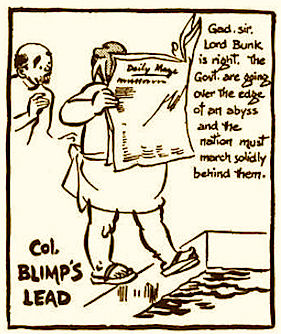
blimp 01The literary careers of C.S. Lewis and George Orwell overlapped in some interesting ways.* Today we will consider a rather odd British personality mentioned by each of them in wartime essays, Colonel Blimp.

Colonel Blimp was a cartoon figure, inspired by a conversation between two military officers who were arguing that “cavalry” officers should continue to wear spurs even when they migrated into tanks.**

At one time the cartoon was so popular that Lewis wrote:

It may well be that the future historian, asked to point to the most characteristic expression of the English temper in the period between the two wars, will reply without hesitation, “Colonel Blimp.” (“Blimpophobia”).

The good colonel echoes similar foolish notions as he blusters about in a caricature of pompous military commanders. Blimp is retired, but harangues all within earshot about the wisest course for the nation.

Orwell wrote derisively of the military and imperialistic middle class, that he called “the Blimps.” He drew the label from the “colonel with his bull neck and diminutive brain, like a dinosaur.” (“The Lion and the Unicorn”).***

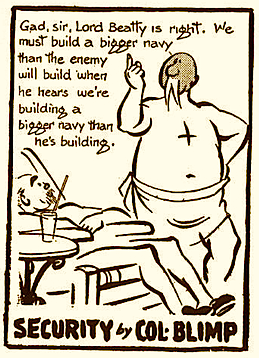
blimp 02The cartoon above illustrates how Colonel Blimp is certain he has the solution to winning the arms race. The frame to the right shows that he believes his wisdom extends beyond the military to politics in general.

Timely Advice from C.S. Lewis

In “Blimpophobia,” Lewis offers advice which proves apropos for our modern age. Today, as fanatical barbarians seek to destroy civilization, enlightened nations and individuals must be vigilant.

One dimension of that vigilance involves walking the fine line between unbridled nationalism and self-absorbed pacifism. When he wrote, Lewis was worried about the anti-war sentiment that threatened to undermine Britain’s response to the Nazis.

Lewis, a wounded combat veteran of the Great War, recognized the truth of the Colonel Blimp caricature. He said something veterans recognize even more clearly than civilians. There is an overabundance of preening and stupidity in the military.

The infection of a whole people with Blimpophobia would have been impossible but for one fact—the fact that seven out of every ten men who served in the last war, emerged from it hating the regular army much more than they hated the Germans. How mild and intermittent was our dislike of “Jerry” compared with our settled detestation of the Brass Hat, the Adjutant, the Sergeant-Major, the regular Sister, and the hospital Matron!

Now that I know more (both about hatred and about the army) I look back with horror on my own state of mind at the moment when I was demobilized. I am afraid I regarded a Brass Hat and a Military Policeman as creatures quite outside the human family.

Still, he said we cannot allow that sad truth to cause us to deny the requirement to maintain a strong defense. “A nation convulsed with Blimpophobia will refuse to take necessary precautions and will therefore encourage her enemies to attack her.”

C.S. Lewis warned his countrymen of the dangers military-phobia during the Second World War. And—among the war-weary nations of the free world battling jihadism—we are wise to heed his wise words today.

The future of civilization depends on the answer to the question, “Can a democracy be persuaded to remain armed in peacetime?” If the answer to that question is No, then democracy will be destroyed in the end. But “to remain armed” here means “to remain effectively armed”. A strong navy, a strong air force, and a reasonable army are the essentials. If they cannot be had without conscription, then conscription must be endured. (C.S. Lewis, “Blimpophobia”).

_____

* In “A Literary Phobia,” I compared some advice they offered to writers. The counsel in question sounds similar on the surface, but actually differs. In “Orwellian Advice,” I contrast the two authors in much greater detail.

** Blimp’s creator, David Low, resided in London but was actually a New Zealander.

*** You can read Orwell’s 1941 essay, “The Lion and the Unicorn,” here.

Inkling Chivalry

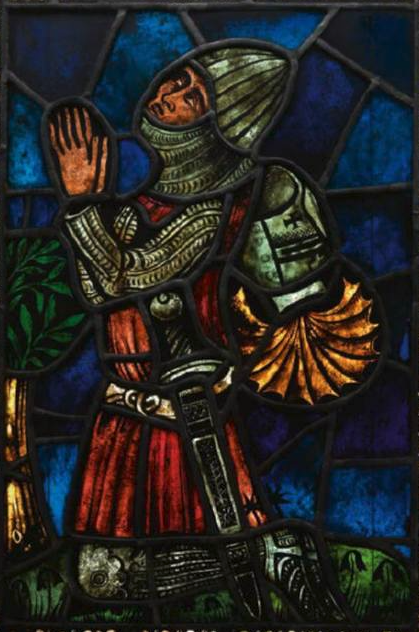
praying knightJ.R.R. Tolkien and C.S. Lewis practiced what they preached.

While most people are content to sit back while others battle for just causes. Sadly, cowardice appears to outweigh bravery in our modern age. We have, Lewis says, “having grown up among the ruins of the chivalrous tradition . . .” (“The Necessity of Chivalry”).

Lewis and Tolkien, by contrast, were genuine heroes. Peaceful academics by nature, each of them responded to their nation’s call to defend their homeland against the Huns.

In the world of the modern university—inhospitable to those who would defend the veracity of the Scriptures—each man counted the cost, and willingly bore the ridicule of skeptics and secularists.

Not only were these two Inklings paragons of courage, they engaged in their battles with a code of chivalry. Neither desired the destruction of their foes. Instead, they sought the preservation of truth, justice, peace and mercy.

Chivalry is a concept alien to the modern era. In an age when there is so little mercy and forgiveness, it seems a more and more archaic notion each day.

Yet, chivalry is not dead.

Both of these men not only modeled the virtue, they imbued their works with its spirit. The heroes of Middle Earth and Narnia are chivalrous almost to a fault. And the spiritual heirs of both fictional domains, still yearn to be chivalrous in their own lives.

So, precisely what is it? As Lewis begins his essay on the subject, he writes, “The word chivalry has meant at different times a good many different things—from heavy cavalry to giving a woman a seat in a train.”

Lewis considers the “double demand it makes on human nature” through an exploration of the Middle Ages.

The knight is a man of blood and iron, a man familiar with the sight of smashed faces and the ragged stumps of lopped-off limbs; he is also a demure, almost a maidenlike, guest in hall, a gentle, modest, unobtrusive man. He is not a compromise or happy mean between ferocity and meekness; he is fierce to the nth and meek to the nth.

Gentle toward the innocent and vulnerable. Relentless versus evil.

What, you may ask, is the relevance of this ideal to the modern world? It is terribly relevant. It may or may not be practicable—the Middle Ages notoriously failed to obey it—but it is certainly practical; practical as the fact that men in a desert must find water or die.

We live in a violent world, and the beheading of even children suggest things are growing worse. So, more than ever, Lewis tells us, we need chivalrous people like Lancelot, who combined these conflicting qualities. We need gentle men, like Lewis and Tolkien, who are willing to lay aside their books to face the specter of war on the front lines.

Lewis forcefully describes the three divisions of humanity bereft of chivalry.

If we cannot produce Launcelots, humanity falls into two sections—those who can deal in blood and iron but cannot be “meek in hall”, and those who are “meek in hall” but useless in battle—for the third class, who are both brutal in peace and cowardly in war, need not here be discussed. When this dissociation of the two halves of Launcelot occurs, history becomes a horribly simple affair.

Lewis wrote the essay during the Second World War. He and others among the Inklings had stood in the gap during the “war to end all wars.” Now he was observing a glimmer of hope in the witness of a successive generation doing its part.

Launcelot is not yet irrecoverable. To some of us this war brought a glorious surprise in the discovery that after twenty years of cynicism and cocktails the heroic virtues were still unimpaired in the younger generation and ready for exercise the moment they were called upon.

In the face of the contemporary ferocity of global terrorism, we see many young men and women following their example. Surely, they are a minority among the population, but we are all deeply fortunate they exist.

Our prayers should accompany those of all nationalities who are courageous enough to face the blade of modern barbarians. And our prayer should be that they are not merely brave, but also meek.