
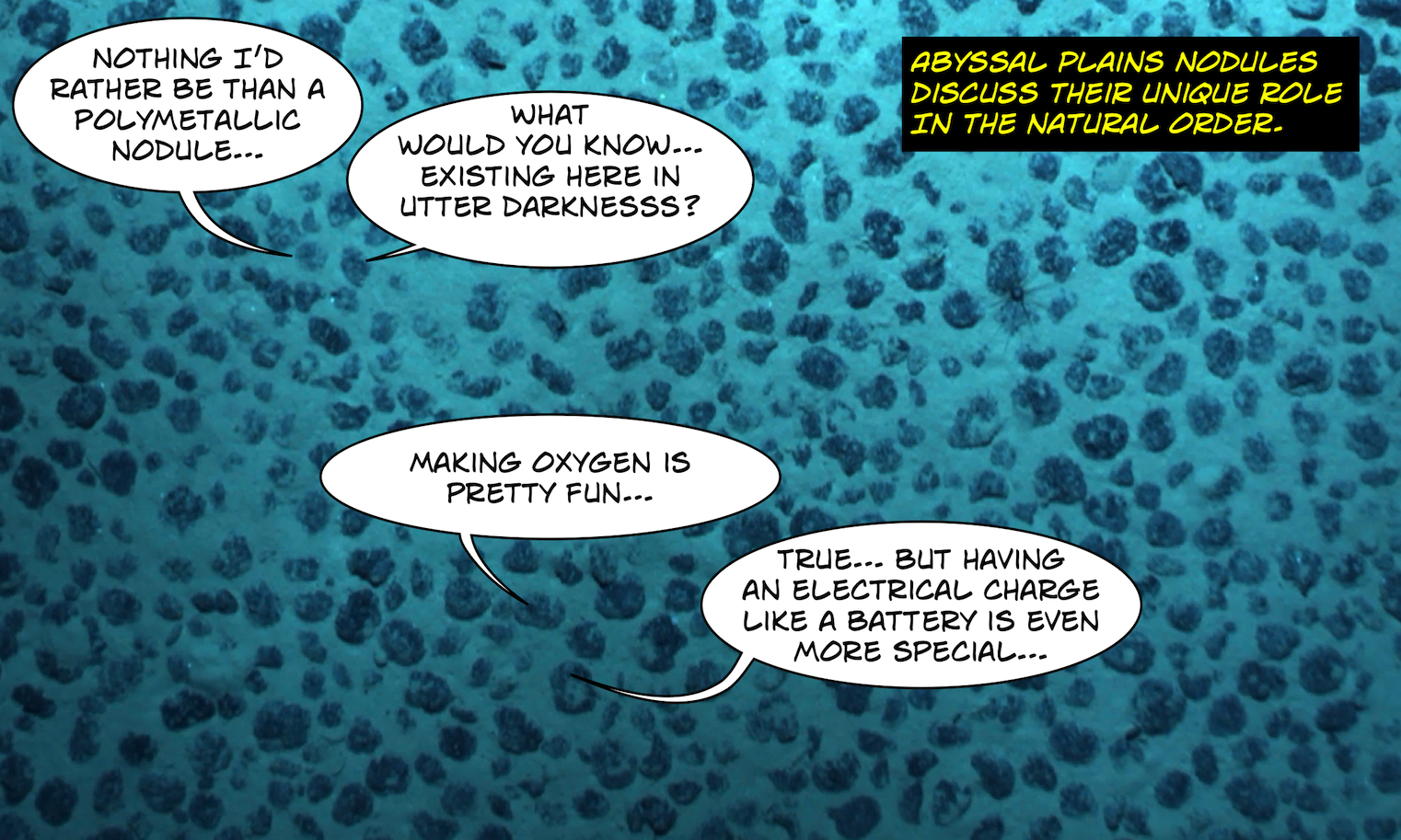
Most of us have a basic affinity for oxygen. And, air quality being what it is in many places, it is probably good news that there is a newly discovered source on the bottom of the sea.
This morning I asked my ten year old grandson what I should blog about. I said it could be even something like a new discovery (since C.S. Lewis was such a renaissance man that I can find some link to diverse subjects in his writings).
Since it’s summer, and school’s on hiatus, I was surprised when he said something of which I was unaware. “I think they found oxygen coming from some minerals in the ocean.” Odd, I thought, but since he often surprises me with his knowledge, I checked it out.
It’s true. Not only does the ocean produce huge amounts of oxygen via algae and the like, but they have recently discovered a source of “dark oxygen.” According to Smithsonian Magazine,
Twelve thousand feet under the ocean surface is a world of eternal midnight. No sunlight can penetrate to this depth to promote photosynthesis, so no plants are producing oxygen there.
Yet, the life-supporting gas is abundant in this darkness-cloaked region, thanks to an unlikely oxygen factory: potato-sized, “battery rocks” on the seafloor.
Those eager to learn more about this wonder can read the entire study, “Evidence of Dark Oxygen Production at the Abyssal Seafloor” for free in Nature Geoscience.
The necessity of ready access to oxygen is obvious to everyone who knows basic biology. Actually, it isn’t the oxygen molecules [O], which we require, it is actually dioxygen [O2]. We also recognize our primary partners in this gloriously balanced process of exchange (where we trade off our carbon dioxide [CO2] in exchange for the O2) are the various plants God has distributed throughout our world.
Curiously, oxygen only makes up a small portion of our atmosphere. According to the National Institute of Medicine,
The composition of environmental air is approximately 78% nitrogen, 21% oxygen, 1% argon, and trace percentages of other gases, such as carbon dioxide, neon, methane, helium, krypton, hydrogen, xenon, ozone, nitrogen dioxide, iodine, carbon monoxide, and ammonia.
I’m no scientist, but personal experience with pneumonia, and with training in a military Hypobaric (Altitude) Chamber, have taught me not to take the availability of oxygen for granted.
This fact was reinforced for C.S. Lewis during the final days of his life, as is true for many people. American Nathan Comfort Starr (1896-1981) was an Arthurian scholar. He would later write an Introduction and Commentary for Lewis’ Till We Have Faces in the Religious Dimension in Literature series. Shortly before Lewis’ death, Starr asked if he might be up to a visit from a friend. Lewis’ response evidenced a peaceful resignation to his own passing.
Term will never again begin for me. Last July I was thought to be dying, oxygen-tent and Last Unction and everything en règle.
I am now retired and immobilised on one floor of this house. But glad to be visited (an hour or so) if such an extinct volcano as I now am is worth visiting (4 September 1963).
In Out of the Silent Planet, the first volume of C.S. Lewis’ space trilogy, the protagonist travels to the planet Malacandra. Philologist Edwin Ransom is kidnapped before the voyage and his captors refuse to answer any of his questions.
“Don’t talk,” he said. “We have discussed all that is necessary. The ship does not carry oxygen enough for any unnecessary exertion; not even for talking.”
After landing, Ransom escapes and flees as far as his air lasts in the planet’s thin atmosphere. Nearing the end, a member of one of the intelligent species (Hnau) inhabiting Malacandra, rescues him. Presumably other races also sometimes require supplemental oxygen.
Stretching back into the cave, it took from the wall what looked like a cup. Then Ransom saw that it was attached to a length of flexible tube. The sorn put it into his hands.
“Smell on this,” it said. “The hrossa also need it when they pass this way.” Ransom inhaled and was instantly refreshed. His painful shortness of breath was eased and the tension of chest and temples was relaxed. . . .
“Oxygen?” he asked; but naturally the English word meant nothing to the sorn.
Oxygen is a precious gift to us from our Creator. So too is the scholar and atheist-turned-apologist, C.S. Lewis.
Just as the revelations of natural creation are ceaselessly amazing, the lessons learned from C.S. Lewis’ life and works continue to inspire others. And, sometimes a little child’s awareness of recent news will lead others into new knowledge.

 Mere Inkling Press