“An army marches on its stomach.”* Military leaders have long recognized that it is difficult to arouse soldiers weakened by deprivation. Sadly, though, even a king of Israel could be foolish enough to ignore that and order his soldiers to fast before a battle.
While logisticians rarely receive the accolades of their peers who serve directly in combat, they have always been vital members of successful military ventures.
While they are concerned with securing and transporting all requirements, such as ammunition and medical supplies, there is a single necessary requirement for all campaigns. Without sustenance, soldiers will desert the flag and even the most steadfast will fall.
Nutritional value is the first priority. Palatability has historically been a distant afterthought. This has given rise to innumerable jokes made by veterans about the “combat rations” provided to them. While these “menus” have vastly improved in recent years, they remain fodder for much humor.
And even the most delicious food choices become monotonous when they are limited to a small range. In 2002, I visited a remote military detachment supplied with adequate pallets of Meals Ready to Eat, but begging for variety. They had hundreds of meals available, but only two or three different meal options! Civilians, in contrast, can readily purchase a far wider range of entrees.
During the Second World War, the United States invested major efforts in making the combat meals more appealing. Various candies found their way into K-rations, in addition to necessities like toilet paper and cigarettes. In a comprehensive overview of the history of rations, the U.S. Army Quartermaster Foundation points to the main reason for complaint during WWII.
Like other unpopular items, misuse was a contributing factor to the waning popularity of the K ration. Although designed to be used for a period of two or three days only, the ration occasionally subsisted troops for weeks on end. . . . Continued use reduced the acceptability and diminished the value of the ration.
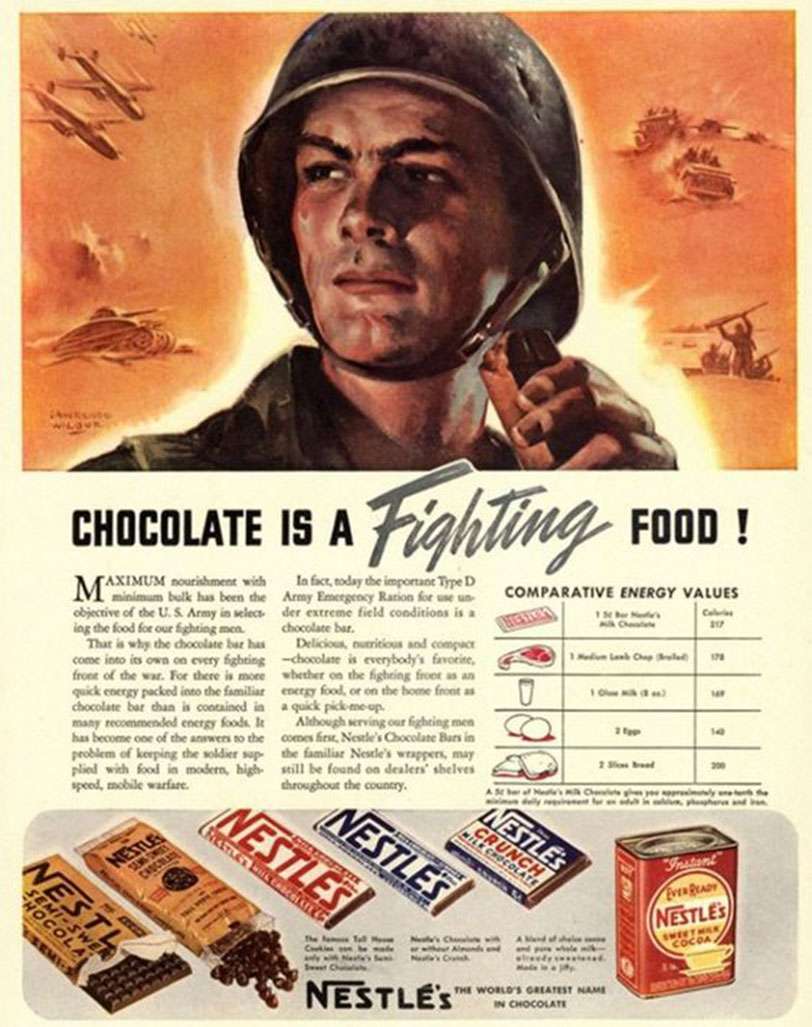
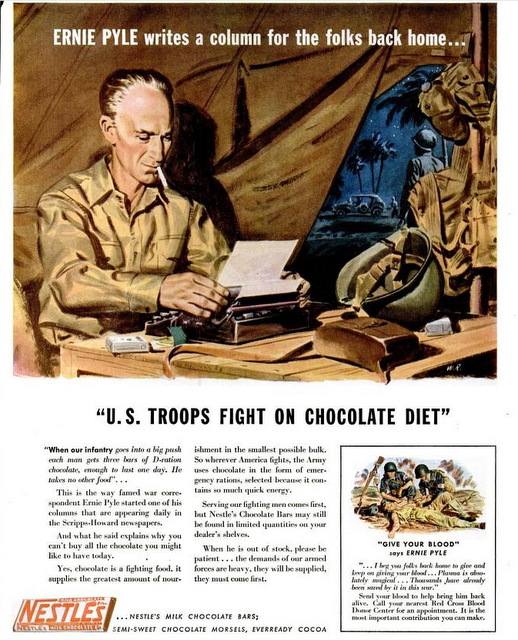
Adding confectionaries to rations made the meals more welcome. Chocolate was always a favorite, but the initial American versions left much to be desired.
My research was, in fact, prompted by a recent post on “Chocolate in WWII” in Pacific Paratrooper. (It is one of the very best military blogs on the internet.) They describe how the military approached a major American confectioner with a simple list of requirements (the last one is best appreciated by older veterans).
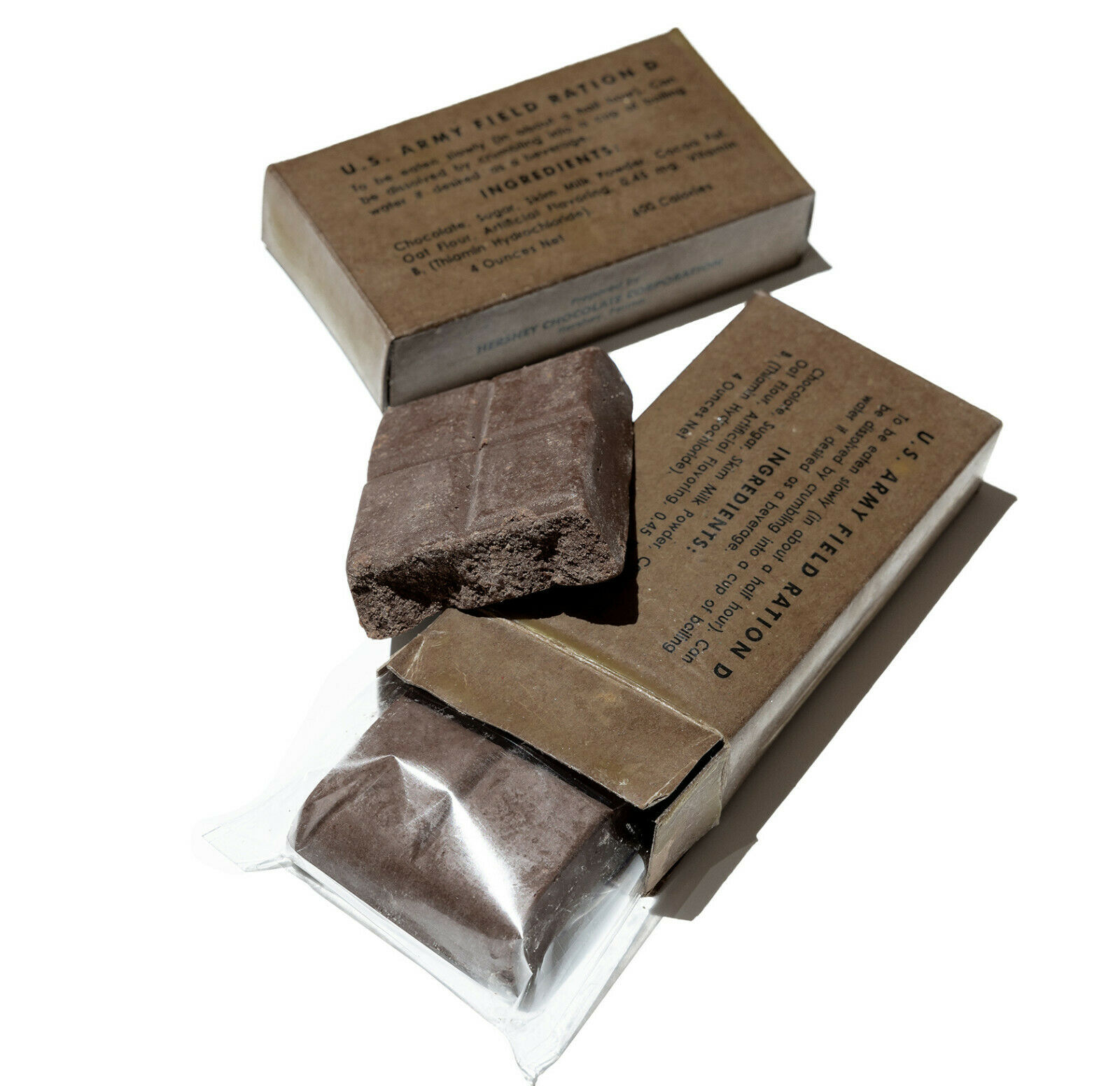
The Hershey Chocolate company was approached back in 1937 about creating a specially designed bar just for U.S. Army emergency rations. According to Hershey’s chief chemist, Sam Hinkle, the U.S. government had just four requests about their new chocolate bars: (1) they had to weigh 4 ounces; (2) be high in energy; (3) withstand high temperatures; (4) “taste a little better than a boiled potato.”
Sadly, many “who tried it said they would rather have eaten the boiled potato.” Well, it was the thought that counted, right?
There is a legend that during the war a German officer was confronted with American desserts and determined that the abundant resources of the United States signaled doom for the Nazi cause. The story likely has a fictional origin.
In the 1965 film Battle of the Bulge, Wehrmacht Colonel Hessler, shows his commanding general a treasure confiscated from American soldiers.
Hessler: “General, before you go, may I show you something?”
General: “What is it?”
Hessler: “A chocolate cake.”
Kohler: “Well?”
Hessler: “It was taken from a captured American private. It’s still fresh. If you will look at the wrapping, general, you will see it comes from Boston.”
Kohler: “And?”
Hessler: “General, do you realize what this means? It means that the Americans have fuel and planes to fly cake across the Atlantic Ocean. They have no conception of defeat.”
C.S. Lewis & Rations
Military rations during the First World War were more primitive than those provided twenty years later. One difference for the British is that they were granted a half gill of rum (or a pint of porter) each day.
This alcohol distribution was at the discretion of the commanding general, which meant that it was not available in the trenches. This was in the spirit of the American “General Order Number 1,” which typically applies to alcohol, and sometimes prohibits its presence throughout an entire theater. (I can personally attest to the ability of some elements, such as Special Ops, to circumvent such restrictions.)
C.S. Lewis wrote with some frequency about the rationing endured by the British public, during and after the world wars.⁑
Unfortunately, I’ve only uncovered one Lewisian reference to his own experience with military cuisine. In a 1917 letter to his father, he reveals that meals were not always appealing, even during training, prior to deploying to the war zone.
First of all came the week at Warwick, which was a nightmare. I was billeted with five others in the house of an undertaker and memorial sculptor. We had three beds between six of us, there was of course no bath, and the feeding was execrable.
The little back yard full of tomb stones, which we christened ‘the quadrangle,’ was infinitely preferable to the tiny dining room with its horse hair sofa and family photos.
When all six of us sat down to meals there together, there was scarcely room to eat, let alone swing the traditional cat round. Altogether it was a memorable experience.
A Hobbit, a Wardrobe, and a Great War describes how WWI affected C.S. Lewis and J.R.R. Tolkien. After relating a passage following Miraz’s defeat of Caspian’s force, when the momentarily defeated were “a gloomy company that huddled under the dripping trees to eat their scanty supper,” the author observes:
The military blunders, the fruitless acts of bravery, the bone-chilling rain, the meager rations: there were many days and nights just like these along the Western Front. Imaginary beasts aside, such scenes could have been lifted from the journal of any front-line soldier.
Like Tolkien, though, Lewis includes these images not for their own sake, but to provide the matrix for the moral and spiritual development of his characters . . .
Rations in Ukraine
Although the eyes of the world are riveted today on the war in Ukraine, there are currently 110 armed conflicts being monitored by the Geneva Academy. However, since Ukraine is in the news daily, it is worth noting both modern armies are employing military rations.
Apparently, Ukrainian troops have great Meals Ready to Eat (MREs). “Most importantly, when making, eating, or even talking about the food, the men seem to be genuinely happy.” The MRE link in this paragraph contains the details, including the note that “among the contents, you’ll find a small packet of dried apricots and a dark chocolate bar.”
There is also a vendor on ebay who sells what are purported to be captured Russian supplies, including a confiscated chocolate bar. The candy appears to be conventionally purchased, but could be part of an illicit chocolate conspiracy finding its way to the Russians from Latvia. “The Russian confectionery company ‘Pobeda’ ПОБЕДА has been producing chocolates, truffles, waffles and other types of sweets for more than six years in Ventspils, via a Latvian subsidiary.”
A month ago in Russia, “Pobeda” received thanks from an organization called the “Battle Brotherhood” for the fact that since the beginning of the Ukrainian war, the company has sent at least 15 tonnes of its products to Russian soldiers.
Chocolate does indeed appear to fuel armies. For a fascinating article on how chocolate can also be used to promote propaganda, check out this Ukrainian site.
Russian propaganda continues to dehumanize Ukrainians with the help of outright fakes.
Another “proof” of our apparent bloodthirstiness was the image of a chocolate bar with a remarkable name “Death of Alyoshka.” A portrait of a boy in a helmet with a mourning ribbon is placed on the wrapper of the confectionery. Propagandists claim that Ukrainians wish Russian children dead.
Become an MRE Connoisseur
If you are curious about the contents of various international MREs that are available for purchase by civilians, visit MREmountain, which began “in 2017 when people discovered the hobby of trying army rations.”
Most veterans, I suspect, would find the “hobby” of eating military rations rather peculiar. But then again, you can check out the French options, which the site labels “The best MRE in the world.” Only there, I imagine, could one discover “meals not found in any other MRE like Kebob Meatballs, Duck Confit, Deer Pate, Wild Boar.”
And, of course, France’s 24-hour ration also includes chocolat müesli, chocolate biscuits, five snack bars (at least one of which is pure chocolate), and a hot cacao packet. Yummy. It appears that les Français also consider chocolate to be a staple of modern soldiers.
* This quotation has been attributed to Napoleon and Frederick the Great. Whatever its modern origin, it is obvious starvation and its frequent companion, disease, have crippled as many armies as blade and shot.
C.S. Lewis understood better than most the spiritual warfare that rages, unseen for the most part, around all human beings.
And, as veterans of the bloody trenches of the First World War, Lewis and his good friend J.R.R. Tolkien had learned more than they desired about the tactics and sheer violence of combat.
Many of those wartime lessons translated directly into a spiritual context. However, I recently realized how poorly the concept of immobile trenches relates to our challenge to take up our crosses and follow our Savior.
You see, the Christian life is many things, but there is one thing discipleship never is – static. As theologian Tilemann Heshusius (1527-1588) wrote: “Christian soldiers always either advance or retreat.”
In battle there is nearly always an ebb and a flow, as forces advance on one front and temporarily shift back on another. In his essay “The World’s Last Night,” C.S. Lewis observes “In battle men save their lives sometimes by advancing and sometimes by retreating.” The same is true for the Christian life in general. We are either advancing, or falling back. Our relationship with God is not stagnant.
The New Testament includes many military metaphors and allusions, intended to equip us for victory in our spiritual battles.
The Apostle Paul refers to believers as “fellow soldiers.” In a letter to a young pastor, he extols the model of the soldier, who keeps his focus on the mission.
Share in suffering as a good soldier of Christ Jesus. No soldier gets entangled in civilian pursuits, since his aim is to please the one who enlisted him.
Then there is the familiar passage which uses the image of the “whole armor of God” to describe in detail how Christians are to be prepared for faithful service. You can read the entire passage here.
These military accoutrements are necessary because “we do not wrestle against flesh and blood, but against the rulers, against the authorities, against the cosmic powers over this present darkness, against the spiritual forces of evil in the heavenly places” (Ephesians 6:12).
This is the reason one aspect of the Christian Church’s nature has been described as the “Church Militant.” This describes the Church battling evil while awaiting Christ’s return, for the Final Judgment, when it will become the “Church Triumphant.” The former is the context for familiar hymns such as “Onward Christian Soldiers,” composed by a prolific Anglican priest in the nineteenth century.
Onward, Christian soldiers, marching as to war, With the cross of Jesus going on before!
Christ, the royal Master, leads against the foe; Forward into battle, see his banner go! . . .
At the sign of triumph Satan’s host doth flee; On, then, Christian soldiers, on to victory!
Hell’s foundations quiver at the shout of praise; Brothers, lift your voices, loud your anthems raise.
The WWI trenches are the archetype of static, immobile frontlines. Disease festered, and morale decayed like the muck sucking at the soldiers’ boots. As recognized by sixteenth century theologians and C.S. Lewis alike, wars are rarely won simply by maintaining a defensive position. Movement is an essential element of warfare.
Hopefully more of that movement consists of advances against the enemy, than retreats. But we will consider that aspect of spiritual war in our next post.
Until Then
Those interested in learning more about military strategy, particularly as explored by another veteran of the War to End All Wars, Sir B.H. Liddell Hart,* like Lewis and Tolkien, returned home to Britain from the front lines, as a casualty. (Britannica states more than a third of the British forces became casualties, in contrast to 76% of Russians, 73% of French, and 8% of Americans.)
Liddell Hart’s wisdom extends beyond the battlefield itself.
The downfall of civilized states tends to come not from the direct assaults of foes, but from internal decay combined with the consequences of exhaustion in war (“The Objective in War,” a lecture delivered in 1952 to the United States Naval War College).
J.R.R. Tolkien and C.S. Lewis practiced what they preached.
While most people are content to sit back while others battle for just causes. Sadly, cowardice appears to outweigh bravery in our modern age. We have, Lewis says, “having grown up among the ruins of the chivalrous tradition . . .” (“The Necessity of Chivalry”).
Lewis and Tolkien, by contrast, were genuine heroes. Peaceful academics by nature, each of them responded to their nation’s call to defend their homeland against the Huns.
In the world of the modern university—inhospitable to those who would defend the veracity of the Scriptures—each man counted the cost, and willingly bore the ridicule of skeptics and secularists.
Not only were these two Inklings paragons of courage, they engaged in their battles with a code of chivalry. Neither desired the destruction of their foes. Instead, they sought the preservation of truth, justice, peace and mercy.
Chivalry is a concept alien to the modern era. In an age when there is so little mercy and forgiveness, it seems a more and more archaic notion each day.
Yet, chivalry is not dead.
Both of these men not only modeled the virtue, they imbued their works with its spirit. The heroes of Middle Earth and Narnia are chivalrous almost to a fault. And the spiritual heirs of both fictional domains, still yearn to be chivalrous in their own lives.
So, precisely what is it? As Lewis begins his essay on the subject, he writes, “The word chivalry has meant at different times a good many different things—from heavy cavalry to giving a woman a seat in a train.”
Lewis considers the “double demand it makes on human nature” through an exploration of the Middle Ages.
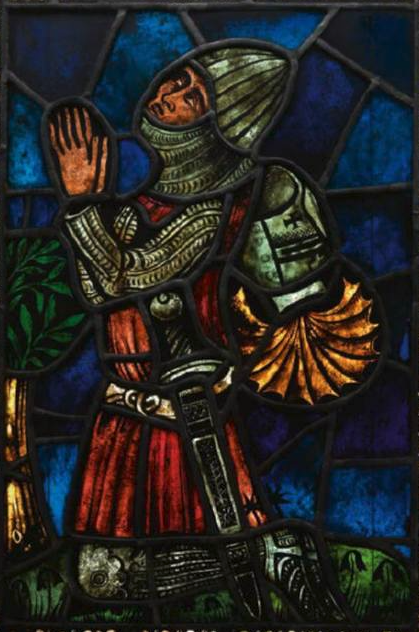
The knight is a man of blood and iron, a man familiar with the sight of smashed faces and the ragged stumps of lopped-off limbs; he is also a demure, almost a maidenlike, guest in hall, a gentle, modest, unobtrusive man. He is not a compromise or happy mean between ferocity and meekness; he is fierce to the nth and meek to the nth.
Gentle toward the innocent and vulnerable. Relentless versus evil.
What, you may ask, is the relevance of this ideal to the modern world? It is terribly relevant. It may or may not be practicable—the Middle Ages notoriously failed to obey it—but it is certainly practical; practical as the fact that men in a desert must find water or die.
We live in a violent world, and the beheading of even children suggest things are growing worse. So, more than ever, Lewis tells us, we need chivalrous people like Lancelot, who combined these conflicting qualities. We need gentle men, like Lewis and Tolkien, who are willing to lay aside their books to face the specter of war on the front lines.
Lewis forcefully describes the three divisions of humanity bereft of chivalry.
If we cannot produce Launcelots, humanity falls into two sections—those who can deal in blood and iron but cannot be “meek in hall”, and those who are “meek in hall” but useless in battle—for the third class, who are both brutal in peace and cowardly in war, need not here be discussed. When this dissociation of the two halves of Launcelot occurs, history becomes a horribly simple affair.
Lewis wrote the essay during the Second World War. He and others among the Inklings had stood in the gap during the “war to end all wars.” Now he was observing a glimmer of hope in the witness of a successive generation doing its part.
Launcelot is not yet irrecoverable. To some of us this war brought a glorious surprise in the discovery that after twenty years of cynicism and cocktails the heroic virtues were still unimpaired in the younger generation and ready for exercise the moment they were called upon.
In the face of the contemporary ferocity of global terrorism, we see many young men and women following their example. Surely, they are a minority among the population, but we are all deeply fortunate they exist.
Our prayers should accompany those of all nationalities who are courageous enough to face the blade of modern barbarians. And our prayer should be that they are not merely brave, but also meek.

 Mere Inkling Press