C.S. Lewis & Mining Minds

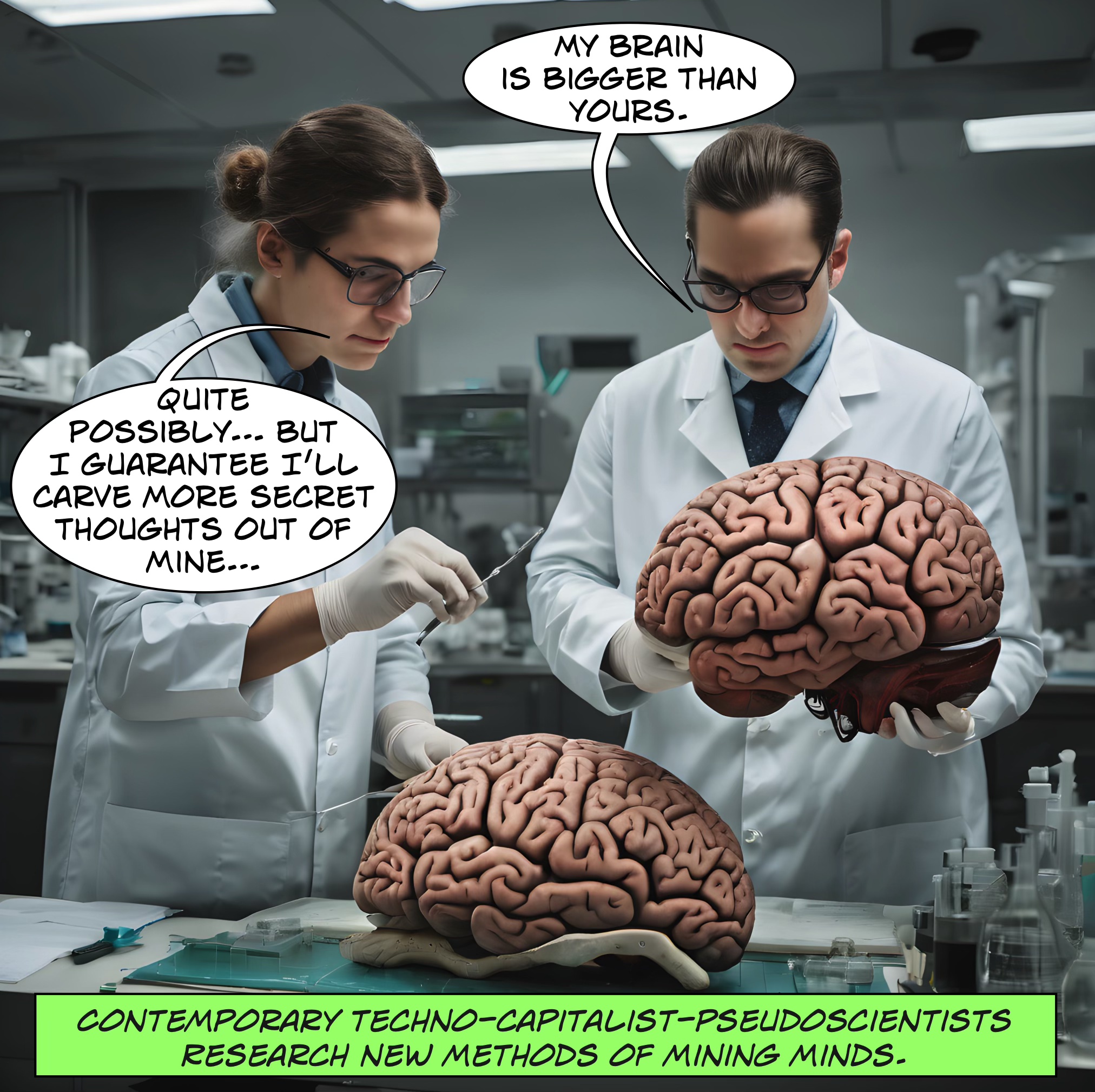
When we are young, it is common for us to think of “brain” and “mind” as synonyms. Today, (potentially nefarious) scientific advances are probing the brain, to gain commercially beneficial access to the mind.

What would C.S. Lewis think? Perhaps his 1955 comment about commercialism provides a hint?

I wish we didn’t live in a world where buying and selling things (especially selling) seems to have become almost more important than either producing or using them.

Seventy years later it is strange to apply this economic principle to the ineffable nature of the mind. And it’s even more odd to apply Lewis’ observation to this situation. He would definitely consider using one’s brain more important than marketing it.

As a young man, C.S. Lewis used the word “brain” when referring to dredging up pleasant memories of past holidays. Even in 1921 he realized that memories are capable of adding a resplendent glow to past experiences.

I still feel that the real value of such a holiday is still to come, in the images and ideas which we have put down to mature in the cellarage of our brains, thence to come up with a continually improving bouquet.

Already the hills are getting higher, the grass greener, and the sea bluer than they really were; and thanks to the deceptive working of happy memory our poorest stopping places will become haunts of impossible pleasure and Epicurean repast.

It is certainly no accident one neurologist calls the relationship between brain and mind “the enchanted loom.”

So, why is it that we began with a question about the commercial incentive to secure the “brain data” of willing – and unsuspecting – people? 

Well, it turns out that since “tech companies [already] collect brain data that could be used to infer our thoughts,” it is “vital we get legal protections right” (MIT Technology Review).

Two months ago, California amended their Consumer Privacy statute to include neural data. It quite appropriately immediately follows the protection of “a consumer’s genetic data.) According to the MIT report:

The law prevents companies from selling or sharing a person’s data and requires them to make efforts to deidentify the data. It also gives consumers the right to know what information is collected and the right to delete it.

Which is crucial because:

Brain data is precious. It’s not the same as thought, but it can be used to work out how we’re thinking and feeling, and reveal our innermost preferences and desires (emphasis in original).

Brain Versus Mind

Before proceeding, let’s clarify the difference between the brain and the mind. The brain is a physical organ which controls our autonomous (typically unconscious) bodily functions such as our heart rate and digestion. It also controls our movements and, to a degree, our emotions. 

The mind, on the other hand, is not physical. It cannot be seen or touched, due to its intangible nature. It can, however, be examined and manipulated, which is another subject I have addressed elsewhere.

The mind is involved with thinking and deciding actions. When they are physical actions, such as whether to indulge in a second helping of dessert, the physical actions involved in that indulgence are relayed by the brain to the appropriate muscles required to perform the act.

The mind is commonly equated with our consciousness. As such, it exists in that realm where we can make moral evaluations and arrive at good decisions, even when they may be against our own self-interest.

Here is a simple illustration of the difference. The brain enables a body (person) to rise and possess the balance to walk along a winding path. The mind allows the person to determine which path is the noble or life-affirming option among the innumerable paths before us.

The brain can only assess a path in the physical sense, through vision, balance, etc. The mind comprehends that “path” means far more than physical orientation.

In C.S. Lewis’ address “Transposition,” he discusses his concept of how simpler concepts and knowledge are sometimes forced to attempt to convey greater knowledge. This can only be accomplished imperfectly. Britain’s monthly The Critic offers an excellent discussion of how transposition illuminates Lewis’ “philosophy of the mind.”

A transposition occurs, he argues, when a richer set of conceptual categories must necessarily be represented by a poorer set of conceptual categories.

In his essay “Is Theology Poetry?” Lewis describes how the mind transcends the physical limitations of the brain itself.

If minds are wholly dependent on brains, and brains on bio-chemistry, and bio-chemistry (in the long run) on the meaningless flux of the atoms, I cannot understand how the thought of those minds should have any more significance than the sound of the wind in the trees.

I might summarize this by declaring “we are more than our brains.” Atheists, sadly, will disagree. They acknowledge our accomplishments may leave behind some ephemeral residue, but once that brain perishes due to the lack of oxygen, everything that is/was us, evaporates, never to exist again. 

As the leader of the Church in Jerusalem wrote, without Christ and the promise of the resurrection, what hope exists? 

What is your life? For you are a mist that appears for a little time and then vanishes. (James 4).

And this returns us to the question of precisely what these mind scientists are after. Knowing more about the brain is valuable, so that we might prevent and treat the diseases which assail it. 

But far more valuable, I suspect, is a window into the mind. So we might discover keys to how we exercise the miracle of thought.

Knowing fallen humanity’s propensity to abuse science and technology, forgive me if I remain a bit leery of experiments such as this. And, for those who may be tempted to get involved with developing technologies and allow their brains/minds to be probed for a pittance, I encourage you to ponder the ramifications a little longer.

C.S. Lewis Bonus Material

The quotation above from “Is Theology Poetry?” may have whetted your curiosity about the broader context of the sentence. For those who are interested, read on. [Personal note: I absolutely love his phrase “mythical cosmology derived from science…”]

When I accept Theology I may find difficulties, at this point or that, in harmonising it with some particular truths which are imbedded in the mythical cosmology derived from science. But I can get in, or allow for, science as a whole.

Granted that Reason is prior to matter and that the light of that primal Reason illuminates finite minds. I can understand how men should come, by observation and inference, to know a lot about the universe they live in. 

If, on the other hand, I swallow the scientific cosmology as a whole, then not only can I not fit in Christianity, but I cannot even fit in science.

If minds are wholly dependent on brains, and brains on bio-chemistry, and bio-chemistry (in the long run) on the meaningless flux of the atoms, I cannot understand how the thought of those minds should have any more significance than the sound of the wind in the trees.

And this is to me the final test. This is how I distinguish dreaming and waking. When I am awake I can, in some degree, account for and study my dream. The dragon that pursued me last night can be fitted into my waking world.

I know that there are such things as dreams: I know that I had eaten an indigestible dinner: I know that a man of my reading might be expected to dream of dragons.

But while in the nightmare I could not have fitted in my waking experience. The waking world is judged more real because it can thus contain the dreaming world: the dreaming world is judged less real because it cannot contain the waking one.

For the same reason I am certain that in passing from the scientific point of view to the theological, I have passed from dream to waking. Christian theology can fit in science, art, morality, and the sub-Christian religious. The scientific point of view cannot fit in any of these things, not even science itself (“Is Theology Poetry?”).

Those who wish to read more about C.S. Lewis’ thoughts on Transposition and the mind are invited to read the following excerpt, in its fuller context.

. . . Transposition occurs whenever the higher reproduces itself in the lower. Thus, to digress for a moment, it seems to me very likely that the real relation between mind and body is one of Transposition.

We are certain that, in this life at any rate, thought is intimately connected with the brain. The theory that thought therefore is merely a movement in the brain is, in my opinion, nonsense; for if so, that theory itself would be merely a movement, an event among atoms, which may have speed and direction but of which it would be meaningless to use the words “true” or “false.”

. . . We now see that if the spiritual is richer than the natural (as no one who believes in its existence would deny) then this is exactly what we should expect. And the sceptic’s conclusion that the so-called spiritual is really derived from the natural, that it is a mirage or projection or imaginary extension of the natural, is also exactly what we should expect; for, as we have seen, this is the mistake which an observer who knew only the lower medium would be bound to make in every case of Transposition.

The brutal man never can by analysis find anything but lust in love; the Flatlander never can find anything but flat shapes in a picture; physiology never can find anything in thought except twitchings of the grey matter.

It is no good browbeating the critic who approaches a Transposition from below. On the evidence available to him his conclusion is the only one possible. . . .

I have tried to stress throughout the inevitableness of the error made about every transposition by one who approaches it from the lower medium only. The strength of such a critic lies in the words “merely” or “nothing but.” He sees all the facts but not the meaning.

Quite truly, therefore, he claims to have seen all the facts. There is nothing else there; except the meaning. He is therefore, as regards the matter in hand, in the position of an animal.

You will have noticed that most dogs cannot understand pointing. You point to a bit of food on the floor: the dog, instead of looking at the floor, sniffs at your finger. A finger is a finger to him, and that is all. His world is all fact and no meaning. And in a period when factual realism is dominant we shall find people deliberately inducing upon themselves this doglike mind (“Transposition”).
How Precious, Is Memory

What would you do if tomorrow you awoke never again able to remember the births of your three children? Never to remember your marriage or your college years? How would you rebuild your life with children and a husband you no longer knew?

In Out of the Silent Planet, C.S. Lewis described a fundamental expectation we possess – “Every day in a life fills the whole life with expectation and memory.” this makes the fragility of the human brain and mind all the more sad.

The question above sounds like the plot to some novel or film, but this was a real life experience for Marcy Gregg. She has written a detailed account of the amazing story in Blank Canvas, and an account of the experience is available online at Focus on the Family

Before you rush to read it, though, I would like to share a few thoughts about memory. Today, increasing life expectancies make senility and dementia far too familiar to families. Dismissing such disorders related to causes such as brain injuries or drug abuse, we still hear of so many cases of Alzheimer’s and other neurodegenerative diseases. Many of us have been touched by this pain, as it has destroyed the lives of people we love. 

Happily, there are growing options for residences equipped with skilled nursing care trained especially for “memory care.” The problem, of course, is not just the availability, but also the significant cost. AARP reported that in 2021, “the average memory care monthly rent is $6,935 in the U.S.”

That’s significantly more than assisted living, which averages $5,380 a month, but a lot less than the $10,562 average monthly cost of a nursing home.

Since we identify our personhood so heavily with our minds, we do not like to think about things like the multiple types of amnesia. Some are terrible, and one is nearly universal. WebMD includes six in their list. The woman above experienced anterograde amnesia which they describe as the loss of “your ability to recall events that happened just before the event that caused your amnesia.” Fortunately, though not the case for Marcy, they add, “usually this affects recently made memories, not those from years ago.‌”

One form of amnesia listed by WebMD may come as a surprise to you, as it did to me. It is referred to as infantile or childhood amnesia. It describes how our young brains were not yet developed well enough to consolidate and store memories for retrieval. Many of us lack early memories, and rely on stories and media to fill in that long gap in our lives.‌

A brief article from the University of Queensland describes how “memories aren’t stored in just one part of the brain.” Differing types are stored “across different, interconnected brain regions.”

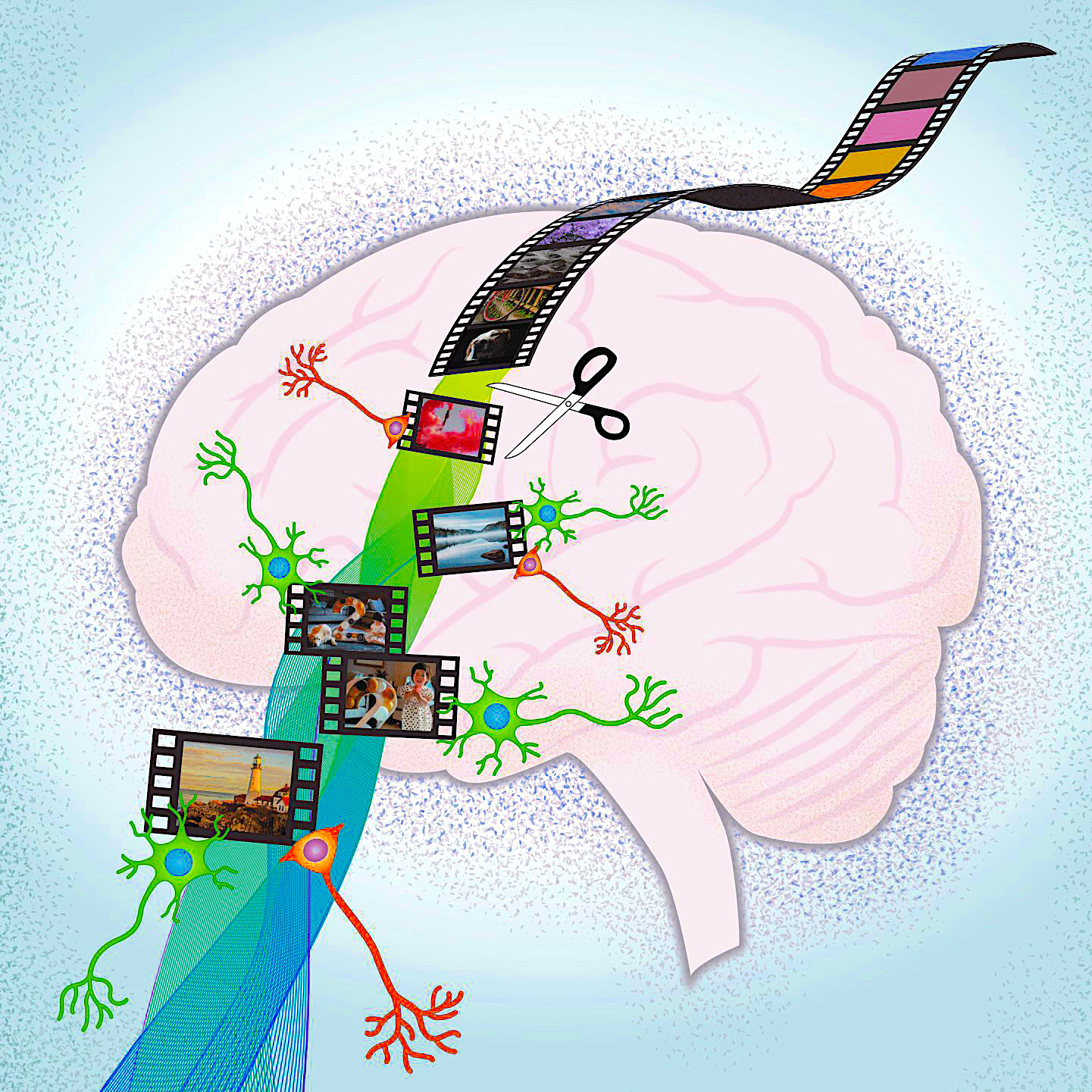
Cedars-Sinai has “discovered two types of brain cells that play a key role in creating memories.”

“One of the reasons we can’t offer significant help for somebody who suffers from a memory disorder is that we don’t know enough about how the memory system works,” said [a] senior author of the study, adding that memory is foundational to us as human beings.

Human experience is continuous, but psychologists believe, based on observations of people’s behavior, that memories are divided by the brain into distinct events, a concept known as event segmentation.

Forgetfulness is, for most who live long enough, an unavoidable aspect of aging. But it may not be quite so bad as it appears to us, as C.S. Lewis related in a letter written several years before his death.

About forgetting things. Dr. Johnson* said “If, on leaving the company, a young man cannot remember where he has left his hat, it is nothing. But when an old man forgets, everyone says, Ah, his memory is going.”

So with ourselves. We have always been forgetting things: but now, when we do so, we attribute it to our age.

Why, it was years ago that, on finishing my work before lunch, I stopped myself only just in time from putting my cigarette-end into my spectacle case and throwing my spectacles into the fire!

Forgetfulness is a common part of human experience, but clinical amnesia is something altogether different.

Tragically, some suffer from anterograde amnesia. One of the saintly matrons at our church carries this cross, assisted by her loving daughter and son-in-law. This cruel disease prevents the retention of new memories. While it is often linked with geriatric considerations, and can affect all of one’s memories, this article from the National Library of Medicine describes a particularly tragic case in which a child “had an abrupt onset of amnesia due to a respiratory arrest at the age of 8 years.”

Cases such as this move Christians to prayer, and many others to despair. While miracles do happen, they are rarer than we desire. Ultimately the Christian hope is in a Lord who keeps his promises, and one of these is that he will come again and will take us to himself, so that where he is, we may be also (John 14). And, in heaven, we will receive a new body like Christ’s resurrection body (Philippians 3).


* Samuel Johnson (1709-1784), a prolific and influential English writer, was often referred to simply as “Dr. Johnson.” Many volumes of the good doctor’s writings are available as free downloads from Internet Archive. For example, volume 7 of the 1810 collection, includes the following essay discussing human shallowness. He begins by contemplating the ability of animals to remember and to anticipate the future.

The Idler
Numb. 24. Saturday, September 30, 1758.

When man sees one of the inferiour creatures perched upon a tree, or basking in the sunshine, without any apparent endeavour or pursuit, he often asks himself or his companion, On what that animal can be supposed to be thinking?

Of this question, since neither bird nor beast can answer it, we must be content to live without the resolution. We know not how much the brutes recollect of the past, or anticipate of the future; what power they have of comparing and preferring; or whether their faculties may not rest in motionless indifference, till they are moved by the presence of their proper object, or stimulated to act by corporal sensations.

I am the less inclined to these superfluous inquiries, because I have always been able to find sufficient matter for curiosity in my own species. It is useless to go far in quest of that which may be found at home; a very narrow circle of observation will supply a sufficient number of men and women, who might be asked, with equal propriety, On what they can be thinking?

It is reasonable to believe, that thought, like every thing else, has its causes and effects; that, it must proceed from something known, done, or suffered; and must produce some action or event. Yet how great is the number of those in whose minds no source of thought has ever been opened, in whose life no consequence of thought is ever discovered; who have learned nothing upon which they can reflect; who have neither seen nor felt any thing which could leave its traces on the memory; who neither foresee nor desire any change of their condition, and have therefore neither fear, hope, nor design, and yet are supposed to be thinking beings.

To every act a subject is required. He that thinks must think upon something. But tell me, ye that pierce deepest into nature, ye that take the widest surveys of life, inform me, kind shades of Malbranche [Nicolas Malebranche] and of [John] Locke, what that something can be, which excites and continues thoughts in maiden aunts with small fortunes; in younger brothers that live upon annuities; in traders retired from business; in soldiers absent from their regiments; or in widows, that have no children?

Life is commonly considered as either active or contemplative; but surely this division, how long soever it has been received, is inadequate and fallacious. There are mortals whose life is certainly not active, for they do neither good nor evil; and whose life cannot be properly called contemplative, for they never attend either to the conduct of men, or the works of nature, but rise in the morning, look round them till night: in careless stupidity, go to bed and sleep, and rise again in the morning.

Johnson’s essay continues with a discussion of the soul and its distinction from the mental processes themselves. Obviously, he is not considering the subject of amnesia, but he reminds us never to become too doctrinaire, since that “supposes what cannot be proved, that the nature of mind is properly defined.” 

His purpose in the essay is not to discuss the abilities of the brain but, at least in part, to critique those who choose to be unthinking. Those who spend not a moment in reflection or contemplation.

I encourage you to read the entire essay, as it demonstrates Johnson’s brilliance. I close this extended “footnote” with a passage in his concluding section which keenly describes our common human experience with memory.

We every day do something which we forget when it is done, and know to have been done only by consequence. The waking hours are not denied to have been passed in thought; yet he that shall endeavour to recollect on one day the ideas of the former, will only turn the eye of reflection upon vacancy; he will find, that the greater part is irrevocably vanished, and wonder how the moments could come and go, and leave so little behind them.

Using Your Entire Brain

Brain1
Have you ever wondered just how much of your own brain you effectively use?

Unfortunately, the percentage of our brains harnessed for daily work remains a bit of a mystery, based upon unproven theories.

One thing is certain though—the frequently repeated notion that human beings only utilize 10% of their brains is nonsense. Despite the fact that this myth has never been supported by scientists, it has gained a proverbial life of its own.

Though an alluring idea, the “10 percent myth” is so wrong it is almost laughable, says neurologist Barry Gordon at Johns Hopkins School of Medicine . . .*

Another neurologist adds another interesting perspective.

Although it’s true that at any given moment all of the brain’s regions are not concurrently firing, brain researchers using imaging technology have shown that, like the body’s muscles, most are continually active over a 24-hour period. “Evidence would show over a day you use 100 percent of the brain,” says John Henley, a neurologist at the Mayo Clinic . . .

Which Half Runs the Show?

Assuming you use nearly all of the gray and white matter stuffed in your cranium, there is another question that begs an answer. Which hemisphere is dominant?

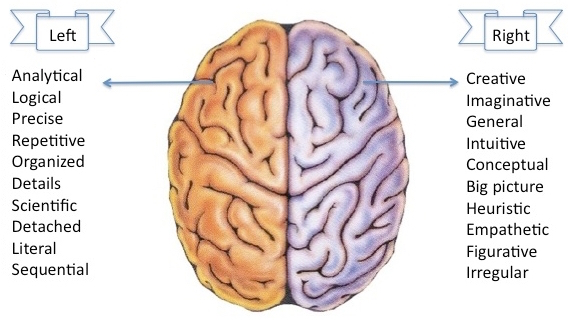
Medical scientists have identified numerous mental functions with particular regions of the brain. As the illustration above suggests, because of that the human mind relies on different hemispheres for different activities.

Most of us have already determined whether we are “right-brained” or “left-brained.” And, since we often know ourselves rather well, we’re probably correct in our assessment.

Still, there are some online tests capable of answering the question of just how well balanced we are in using whatever portion of our minds to which we have access. I recently took two of the assessment instruments and learned that I am a reasonably balanced individual.

You just may be more balanced than you think. Not that “balanced” is better than having one or the other side dominant. In fact, it feels a bit like being a “jack of all trades.”

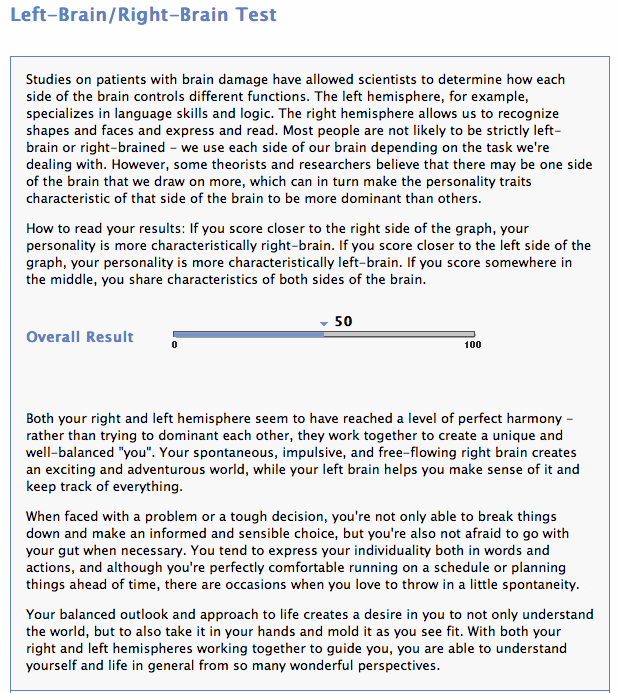
Brain 2The first test—available for you to take here—gave me the wonderful news that my “right and left hemispheres seem to have reached a level of perfect harmony.”

It sounds almost like attaining Nirvana, if one believes in such things.

It was amazing what they were able to discern about my deepest being with twelve simple questions.

Brain 3

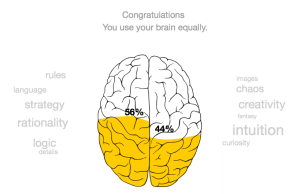
The second test—available here—gave me the following result. It reveals the mental equilibrium I have achieved with this informative graphic.

I really enjoyed the image (yellow is my second favorite color) . . . until I realized the uncolored portions of my brain suggested they were dormant. (I suspect the very fact that I’m concerned about the possibility implies it might be true.)

Lewis on the Human Mind

C.S. Lewis wrote about many aspects of human nature. That included, of course, the least understood organ, the brain. In the following passage from a 1921 letter, he describes the way our memories possess the power to transform the realities of the past.

I still feel that the real value of such a holiday is still to come, in the images and ideas which we have put down to mature in the cellarage [cellar or basement] of our brains, thence to come up with a continually improving bouquet.

Already the hills are getting higher, the grass greener, and the sea bluer than they really were; and thanks to the deceptive working of happy memory our poorest stopping places will become haunts of impossible pleasure and Epicurean repast.

The following argument is found in 1944’s “Is Theology Poetry?” His thoughts on how the human brain supports the existence of a Creator are well worth considering.

When I accept Theology I may find difficulties, at this point or that, in harmonising it with some particular truths which are imbedded in the mythical cosmology derived from science. But I can get in, or allow for, science as a whole. Granted that Reason is prior to matter and that the light of that primal Reason illuminates finite minds. I can understand how men should come, by observation and inference, to know a lot about the universe they live in.

If, on the other hand, I swallow the scientific cosmology as a whole, then not only can I not fit in Christianity, but I cannot even fit in science. If minds are wholly dependent on brains, and brains on bio-chemistry, and bio-chemistry (in the long run) on the meaningless flux of the atoms, I cannot understand how the thought of those minds should have any more significance than the sound of the wind in the trees.

And this is to me the final test.

This is how I distinguish dreaming and waking. When I am awake I can, in some degree, account for and study my dream. The dragon that pursued me last night can be fitted into my waking world. I know that there are such things as dreams: I know that I had eaten an indigestible dinner: I know that a man of my reading might be expected to dream of dragons. But while in the nightmare I could not have fitted in my waking experience. The waking world is judged more real because it can thus contain the dreaming world: the dreaming world is judged less real because it cannot contain the waking one.

For the same reason I am certain that in passing from the scientific point of view to the theological, I have passed from dream to waking. Christian theology can fit in science, art, morality, and the sub-Christian religious. The scientific point of view cannot fit in any of these things, not even science itself.

Even with my limited mind, which too often seems to run on only six of its eight cylinders, I recognize the wisdom of Lewis’ contrast between dreaming and waking. He is brilliant.

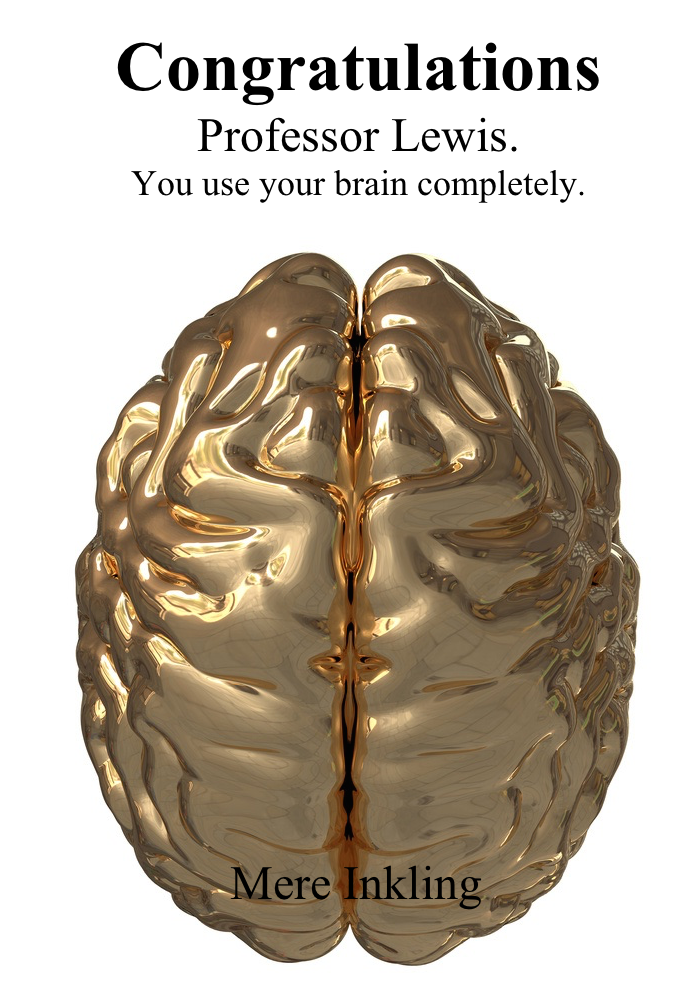
I imagine that our favorite Oxford dean’s online results might have looked something like this.

Lewis Brain

_____

* This quotation, and the one which follows it, come from Scientific American.

I have blogged in the past about the human brain. You might find one of the following posts interesting:

Engage Brain

Distant Fathers

Mensa & C.S. Lewis

Malapropistic Entertainment