
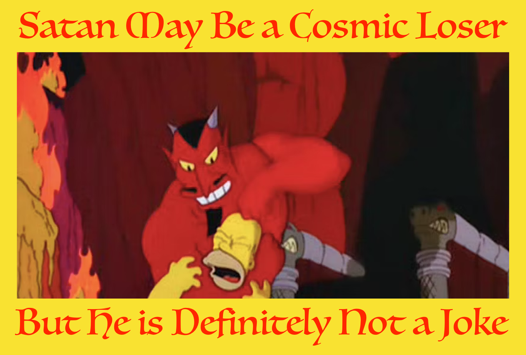
Satan is powerless versus Christians, especially those who know he exists. Yet, vis-à-vis unbelievers, he “prowls around like [an invisible] lion, seeking someone to devour” (1 Peter 5). Christian “immunity” to Lucifer’s power, if not his temptations, is due to the indwelling presence of God’s Holy Spirit.
Still, for every human being, whatever their personal belief, the Devil is no mere cartoon, with whom to be trifled. I discussed this briefly in my previous post, “Only God Can Create,” which you might want to read before continuing here.
As for humanity’s vulnerability to the Devil’s influence, the consensus in paradoxically-labeled “enlightened” cultures is that he doesn’t even exist. Sadly, this cosmic lie even tricks self-described “Christians.”
This illusion plays directly into his purposes, as C.S. Lewis described in The Screwtape Letters. Screwtape, a senior demon, instructs his protégée Wormwood in the preferred method of dispelling human wariness about Evil.
The fact that “devils” are predominantly comic figures in the modern imagination will help you. If any faint suspicion of your existence begins to arise in his mind, suggest to him a picture of something in red tights, and persuade him that since he cannot believe in that (it is an old textbook method of confusing them) he therefore cannot believe in you.
Ironically, the populations of less Westernized cultures possess some immunity to this deception. Even in their traditional religions, there is a keen awareness of the existence of evil presences. In the words of The African Study Bible, “we Africans understand instinctively the stories of angelic visitations, spiritual warfare, and demonic oppression that are in the Bible.”
Christians believe in God, not the Devil. While the Scriptures attest to the personal identity of this fallen angel, acknowledgment of his existence is not salvific (i.e. it is not essential to salvation). Thus, C.S. Lewis is correct in his 1944 essay “Answers to Questions on Christianity” when he writes:
No reference to the Devil or devils is included in any Christian Creeds, and it is quite possible to be a Christian without believing in them. I do believe such beings exist, but that is my own affair.
Supposing there to be such beings, the degree to which humans were conscious of their presence would presumably vary very much. I mean, the more a man was in the Devil’s power, the less he would be aware of it, on the principle that a man is still fairly sober as long as he knows he’s drunk. It is the people who are fully awake and trying hard to be good who would be most aware of the Devil. It is when you start arming against Hitler that you first realize your country is full of Nazi agents.
Of course, they don’t want you to believe in the Devil. If devils exist, their first aim is to give you an anaesthetic – to put you off your guard. Only if that fails, do you become aware of them.
On the Matter of Creative Power
Only God can create. That was the core message of our previous discussion. C.S. Lewis recognized, as do biblically-grounded believers, that Satan is merely a sinful, fallen being, little different from humanity in that regard. This truth shatters the pagan philosophy of dualism, or the misguided notion that two equal and opposite forces (e.g. good and evil) exist in some sort of equilibrium.
In “The Seeing Eye,” C.S. Lewis described the way in which God is beyond his creation.
Looking for God – or Heaven – by exploring space is like reading or seeing all Shakespeare’s plays in the hope that you will find Shakespeare as one of the characters . . . Shakespeare is in one sense present at every moment in every play. But he is never present in the same way as Falstaff or Lady Macbeth. . . .
If there were an idiot who thought plays existed on their own, without an author . . . our belief in Shakespeare would not be much affected by his saying, quite truly, that he had studied all the plays and never found Shakespeare in them. . . .
My point is that, if God does exist, He is related to the universe more as an author is related to a play than as one object in the universe is related to another. If God created the universe, He created space-time, which is to the universe as the metre is to a poem or the key is to music.
To look for Him as one item within the framework which He Himself invented is nonsensical. If God – such a God as any adult religion believes in – exists, mere movement in space will never bring you any nearer to Him or any farther from Him than you are at this very moment. You can neither reach Him nor avoid Him by travelling to Alpha Centauri or even to other galaxies.
Mark Twain’s Divinized Satan
I had intended to mention Samuel Clemens in my previous article, as one who advanced the assertion that Satan possesses creative ability. Whether Twain regarded the Devil as an actual entity is certainly debatable. What is undeniable, however, is his devoted defense of Lucifer.
As Twain famously wrote in his autobiographical writings, “But who prays for Satan? Who, in eighteen centuries, has had the common humanity to pray for the one sinner that needed it most?”
Mark Twain was (in)famous for his atheism, or his agnostic antipathy of the Christian understanding of our Creator. Not content to disbelieve, Samuel Clemens actively worked to undermine Christian faith. One of his books, Letters from the Earth, had to be printed posthumously, due its irreverent (or blasphemous) nature.
It bears a superficial resemblance to C.S. Lewis’ amazing Screwtape Letters – insofar as both fictional works present themselves as demonic correspondence.
The similarity ends there. While Lewis provides keen insight into Evil’s tactics in wreaking havoc in human lives, Twain’s letters present Satan in a positive, even noble, light.
Letters from the Earth is only one of Mark Twain’s anti-Christian works. The Mysterious Stranger is one of his most bizarre. It evidences his long-term preoccupation with Satan, in that it was composed (in various versions) between 1897 and 1908.
The first serious rendition, The Chronicle of Young Satan, was completed in 1900. I mention it here because there is a scene in which the Devil “creates” a miniature world. Obviously it errs in attributing to Lucifer the power to create life – but to its credit, it does reveal Satan as a capricious, vain, cruel, and compassionless lord.
In 1985 a claymation film was released titled The Adventures of Mark Twain. It features the mock scene from Chronicle of Young Satan. It is quite disturbing. However, if one is curious about the subject, and wishes to be forearmed regarding such deceptions, you can view the excerpt here.
Especially for those who do choose to view Twain’s portrayal of the Devil in his fictional “youth,” I desire to end our current discussion on a positive note.
Claymation was also the medium for a long-lived Christian television series. Davey & Goliath, the story of a regular kid and his dog, ran between 1964 and 1975. Many of the episodes can be seen here.
And finally (and forever), we can celebrate with C.S. Lewis the wonder that this world we currently inhabit will not be God’s sole creation. In fact, because of Jesus’ redemptive sacrifice, we can look forward to a new cosmos, untainted by sin.
The New Testament writers speak as if Christ’s achievement in rising from the dead was the first event of its kind in the whole history of the universe. He is the “first fruits”, the “pioneer of life”.
He has forced open a door that has been locked since the death of the first man. He has met, fought, and beaten the King of Death. Everything is different because He has done so. This is the beginning of the New Creation: a new chapter in cosmic history has opened (Miracles).
 Mere Inkling Press