Not Another Funeral

threeFollowers of Mere Inkling will recall that my father passed away last month. Yesterday found our family attending the funeral of our last surviving uncle. My mother was not a superstitious person. Nevertheless, whenever two deaths occurred near the same time, she used to almost reflexively say, “deaths come in threes.”

You may have heard that adage yourself. It’s apparently been around some time, and is occasionally applied to catastrophes in general. However it is used, it is merely a superstition. And, like most such things, if you diligently search for evidence to support it, you can frequently discover some.

I assume that some Christians may even be vulnerable to believing in credulous notions, but this would be a particularly bizarre one for them to affirm since (in terms of biblical numerology) the number three is anything but eerie. Three, after all, represents the Persons of the Trinity.

Of course, many may regard the study of biblical numerology to be a variant of superstition itself. I suppose that depends on the traits you attribute to them. For example, if they are signs of meaning—e.g. completeness such as twelve for the twelve tribes of Israel or four for the writers of the Gospels—there is little controversy.

However, if the numbers themselves are perceived as being imbued with some sort of mystical nature or power, the percentage of scoffers would likely increase. Nevertheless, the ancient Chinese culture, with its billions of members, are keenly attuned to “lucky” and “unlucky” numbers. Good are two and eight, which are homophones for the words “easy/bright” and “prosper/wealth.” Bad are four and six, which are pronounced similarly to “death” and “drop/decline.”

In The Screwtape Letters, C.S. Lewis has the senior demonic tempter advising his protégé about the value of superstitions in numbing human beings to the Truth. In the context of a letter advising how to encourage cowardice in a soldier, he writes:

The main point is that precautions have a tendency to increase fear. The precautions publicly enjoined on your patient, however, soon become a matter of routine and this effect disappears. What you must do is to keep running in his mind (side by side with the conscious intention of doing his duty) the vague idea of all sorts of things he can do or not do, inside the framework of the duty, which seem to make him a little safer. Get his mind off the simple rule (‘I’ve got to stay here and do so-and-so’) into a series of imaginary life lines (‘If A happened—though I very much hope it won’t—I could do B—and if the worst came to the worst, I could always do C’). Superstitions, if not recognised as such, can be awakened.

The point is to keep him feeling that he has something, other than the Enemy and courage the Enemy supplies, to fall back on, so that what was intended to be a total commitment to duty becomes honeycombed all through with little unconscious reservations. By building up a series of imaginary expedients to prevent ‘the worst coming to the worst’ you may produce, at that level of his will which he is not aware of, a determination that the worst shall not come to the worst. Then, at the moment of real terror, rush it out into his nerves and muscles and you may get the fatal act done before he knows what you’re about. For remember, the act of cowardice is all that matters; the emotion of fear is, in itself, no sin and, though we enjoy it, does us no good.

I strive to leave as little room in my life for superstition as possible. Whenever I become aware of it, I immediately seek to weed it out. Life in our fallen world, with my own sinful nature, is difficult enough without adding the burden of carrying superstitions.

Thus, I’m reflecting on our family’s two recent funerals . . . without anticipating another

On Burying One’s Father

marine flagI just buried my father yesterday. Well, not literally, since the service was held in a chapel at the cemetery, but my family and I said goodbye to him in a traditional Christian service. Because he was a combat veteran Marine Corps sergeant major, he received also very impressive military honors at graveside.

It was quite nice. Although he had passed rather quickly, and completely unexpectedly, he had lived a long and full life. That sounds cliché, but during his 84 years he had a successful career in the Corps, enjoyed a long and peaceful retirement, was blessed with a loving and faithful wife, and found great joy in his three children, nine grandchildren and ten great-grandchildren.

Best of all, though, after what some would call a rather misspent youth, he became a good man . . . and ended his days with faith in Christ and with virtues such as repentance, forgiveness and charity evident in his life.

As the day of the funeral was approaching, I recalled one of Jesus’ conversations with several prospective disciples.

As they were going along the road, someone said to [Jesus], “I will follow you wherever you go.” And Jesus said to him, “Foxes have holes, and birds of the air have nests, but the Son of Man has nowhere to lay his head.” To another [Jesus] said, “Follow me.” But he said, “Lord, let me first go and bury my father.” And Jesus said to him, “Leave the dead to bury their own dead. But as for you, go and proclaim the kingdom of God.” (Luke 9:57-60, ESV).

To some, Jesus’ words here sound harsh. However, the Messiah was not encouraging people to cease honoring their parents. After all, that would be in direct disobedience to the Commandments God delivered to us through Moses. No, Jesus affirmed our call to respect and care for our parents. What he was condemning was the excuses we make to delay accepting his invitation to follow him.

While we might offer a truly important reason for our procrastination, we often push back the spiritual “season” of our life with far more lame reasoning. “I’ll settle down after I get married, but right now I just need some time to “enjoy” life.” or “I’ll start going to church once I have kids and they can benefit from it.”

On Sundays we rarely think twice about disobeying another of the Commandments by ignoring the Sabbath and not preserving it’s holiness. Years ago Keith Green wrote a song “Asleep in the Light,” which featured the convicting lyrics:

How can you be so dead

When you’ve been so well fed

Jesus rose from the grave

And you, you can’t even get out of bed.

Most of us live long enough to suffer the loss of a parent. It’s something, perhaps, that you don’t really understand until you experience it yourself. Even then it’s difficult to console others by saying we’ve shared their loss. After all, every relationship is unique, and each human being processes grief in a unique manner.

C.S. Lewis knew well what it was like to lose his parents. His beloved mother died when he was quite young. In Surprised by Joy, he describes the pain. With my mother’s death all settled happiness, all that was tranquil and reliable, disappeared from my life. There was to be much fun, many pleasures, many stabs of Joy; but no more of the old security. It was sea and islands now; the great continent had sunk like Atlantis.

Alas, Lewis does not describe his father’s passing in his too-brief autobiography. What he does say, reminds me of my own father’s vast reservoir of humor and encouragement as his health waned. Lewis simply writes: “My father’s death, with all the fortitude (even playfulness) which he displayed in his last illness, does not really come into the story I am telling.”

Many of you who have lost your parents can empathize with me, and with the journey I am facing as I adjust to life without either of my parents. Because I loved them, I miss them. And the love makes the pain worth it. Besides, as Paul reminded young Christians in his first letter to the Church in Thessalonica, we “do not grieve as other do who have no hope.” Our hope is secure, resting in the very One who said, “I am the resurrection and the life.”

Avoid Living in Fear

nuclear blast

Nuclear war. It’s an extremely unpleasant subject, and its grim specter still haunts the world. Oddly, though—even as we anticipate the day when Iran’s lunatic Mullah’s develop them and North Korea’s deranged generals learn how to deliver them—the world is in a sort of “nuclear hiatus” at this very moment.

The Mutual Assured Destruction apparently worked, as the former Soviet Union and the United States decided against nuclear suicide. At the present moment the three world powers show little appetite for total war, so today’s children don’t have to learn the Civil Defense precautions that kept an earlier generation safe.

I was one of those young Americans indoctrinated in the sophisticated “duck and cover” method of nuclear blast survival. This video provides a nostalgic look at the paramilitary training we received. (A link to the full training film appears below.)

C.S. Lewis lived during the height of nuclear paranoia. Yet he retained his composed Northern Irish demeanor as he reflected on the threat. In an essay entitled “On Living in an Atomic Age” he wisely advised:

If we are all going to be destroyed by an atomic bomb, let that bomb when it comes find us doing sensible and human things—praying, working, teaching, reading, listening to music, bathing the children, playing tennis, chatting to our friends over a pint and a game of darts—not huddled together like frightened sheep and thinking about bombs. They may break our bodies (any microbe can do that) but they need not dominate our minds.

In his essay “Is Progress Possible,” Lewis addresses those who used the uncertainty of the future as an excuse for making irresponsible life choices. His words ring just as true today, when so many youth turn to nihilism and self-destructive behaviors.

As a Christian I take it for granted that human history will some day end; and I am offering Omniscience no advice as to the best date for that consummation. I am more concerned by what the Bomb is doing already. One meets young people who make the threat of it a reason for poisoning every pleasure and evading every duty in the present. Didn’t they know that, Bomb or no Bomb, all men die (many in horrible ways)? There’s no good moping and sulking about it.

If only remaining safe in this fallen world was as simple as dropping to the ground and sheltering one’s head. It isn’t, of course, but we need not live our lives under the shadow of fear.

Returning to “On Living in an Atomic Age,” Lewis adroitly places the entire menace—and all perils to human life—in their proper perspective. It may not be the most comforting words we will ever read, but they are certainly true.

In one way we think a great deal too much of the atomic bomb. “How are we to live in an atomic age?” I am tempted to reply: “Why, as you would have lived in the sixteenth century when the plague visited London almost every year, or as you would have lived in a Viking age when raiders from Scandinavia might land and cut your throat any night; or indeed, as you are already living in an age of cancer, an age of syphilis, an age of paralysis, an age of air raids, an age of railway accidents, an age of motor accidents.”

In other words, do not let us begin by exaggerating the novelty of our situation. Believe me, dear sir or madam, you and all whom you love were already sentenced to death before the atomic bomb was invented: and quite a high percentage of us were going to die in unpleasant ways. We had, indeed, one very great advantage over our ancestors—anaesthetics; but we have that still. It is perfectly ridiculous to go about whimpering and drawing long faces because the scientists have added one more chance of painful and premature death to a world which already bristled with such chances and in which death itself was not a chance at all, but a certainty.

_____

You can watch the entire “Stop and Drop” Civil Defense Video here.

Avoiding Fantasy Clichés

We’re all familiar with that classic paradigm of suspenseful introductions: “It was a dark and stormy night.” While this is not intrinsically poor writing, it has been parroted and ridiculed for so long as a lightweight cliché, that the author’s name has become a byword for writing “purple prose.”

In the same way, there are certain plotlines or story devices that are overused, particularly in genre literature. For example, J.R.R. Tolkien’s genius in creating Middle Earth cannot be exaggerated. Yet, since his epic, dwarves, elves and orcs innumerable have been written about in chronicles ad nauseum by lesser poets. Many of Tolkien’s inventions seem rather tired when repeated by contemporary writers for the hundredth time. (Hundred thousandth time, if you count fan fiction.)

This literary dilemma has led to the creation of “The Fantasy Novelist’s Exam,” designed to be taken by aspiring authors before submitting their manuscripts for publication. (The link for the exam will be found below.)

The purpose of the test is to determine how derivative your storytelling is. If you use too many of the listed elements, you are in danger of composing a parody rather than a masterpiece. Some of the questions posed in the exam are astute, many are glib, and most are humorous. Here’s a sampling, with my responses (speculative, of course, since I haven’t written any fantasy proper).

Is your main character the heir to the throne but doesn’t know it?

How about an anonymous member of minor nobility?

Do inns in your book exist solely so your main characters can have brawl?

I never visit bars, but isn’t hosting altercations a primary purpose of all drinking establishments?

Do you think you know how feudalism worked but really don’t?

Ah, a conundrum. If I know I don’t really know . . .

Do any of your female characters exist solely to be captured and rescued?

You mean they have another role they can perform? (Wait, I’m just joking!)

Do you think that “mead” is just a fancy name for “beer?”

My Viking ancestors would never forgive me if I did!

Do you think horses can gallop all day long without rest?

I wasn’t raised on a ranch, but I’m not that stupid.

Is this the first book in a planned trilogy?

Whoops.

As you see, the questions are fun to read, but there’s one that bothered me a bit. Well, not the question itself. It’s innocent enough. But it alludes to a particular scene in The Lord of the Rings films which I find stunning—in the original sense of the word. It strikes me viscerally, almost leaving me breathless.

Do you really think it frequently takes more than one arrow in the chest to kill a man?

Generally, no . . . but if that hero is Boromir, most certainly!

The Death of Boromir

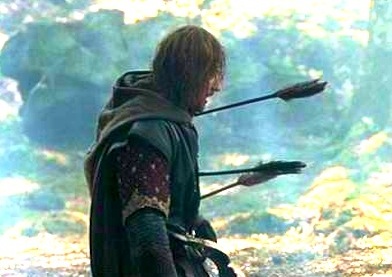
One of the most moving scenes in The Lord of the Rings involves the death of Boromir as he sacrifices his life in a futile battle to allow the hobbits time to escape the Uruk-hai. It’s impact is magnified by the fact that it immediately follows Boromir’s near-betrayal, under the corrupting influence of the Ring.

The irony is that this spectacular scene is not described in detail in Tolkien’s book. It is a tribute to director Peter Jackson’s cinematic brilliance. This is the original telling:

Even as [Aragorn] gazed his quick ears caught sounds in the woodlands below, on the west side of the River. He stiffened. There were cries, and among them, to his horror, he could distinguish the harsh voices of Orcs. Then suddenly with a deep-throated call a great horn blew, and the blasts of it smote the hills and echoed in the hollows, rising in a mighty shout above the roaring of the falls.

“The horn of Boromir!” he cried. “He is in need!” He sprang down the steps and away, leaping down the path. “Alas! An ill fate is on me this day, and all that I do goes amiss. Where is Sam?”

As he ran the cries came louder, but fainter now and desperately the horn was blowing. Fierce and shrill rose the yells of the Orcs, and suddenly the horn-calls ceased. Aragorn raced down the last slope, but before he could reach the hill’s foot, the sounds died away; and as he turned to the left and ran towards them they retreated, until at last he could hear them no more. Drawing his bright sword and crying Elendil! Elendil! he crashed through the trees.

A mile, maybe, from Parth Galen in a little glade not far from the lake he found Boromir. He was sitting with his back to a great tree, as if he was resting. But Aragorn saw that he was pierced with many black-feathered arrows; his sword was still in his hand, but it was broken near the hilt; his horn cloven in two was at his side. Many Orcs lay slain, piled all about him and at his feet.

Aragorn knelt beside him. Boromir opened his eyes and strove to speak. At last slow words came. “I tried to take the Ring from Frodo” he said. “I am sorry. I have paid.” His glance strayed to his fallen enemies; twenty at least lay there. “They have gone: the Halflings: the Orcs have taken them. I think they are not dead. Orcs bound them.” He paused and his eyes closed wearily. After a moment he spoke again. “Farewell, Aragorn! Go to Minas Tirith and save my people! I have failed.”

“No!” said Aragorn, taking his hand and kissing his brow. “You have conquered. Few have gained such a victory. Be at peace! Minas Tirith shall not fall!” Boromir smiled.

“Which way did they go? Was Frodo there?” said Aragorn.

But Boromir did not speak again.

“Alas!” said Aragorn. “Thus passes the heir of Denethor, Lord of the Tower of Guard! This is a bitter end. Now the Company is all in ruin. It is I that have failed. Vain was Gandalf’s trust in me. What shall I do now? Boromir has laid it on me to go to Minas Tirith, and my heart desires it; but where are the Ring and the Bearer? How shall I find them and save the Quest from disaster?”

He knelt for a while, bent with weeping, still clasping Boromir’s hand. So it was that Legolas and Gimli found him. (Lord of the Rings, Book III Chapter 1).

So, we understand that while a single arrow might slay a common warrior, it could well take a quiver full to lay low a champion such as this.

___

If you would like to review “The Fantasy Novelist’s Exam,” simply follow this link.

The Brevity of Life

O Lord, make me know my end and what is the measure of my days; let me know how fleeting I am! Behold, you have made my days a few handbreadths,
and my lifetime is as nothing before you. Surely all mankind stands as a mere breath! Surely a man goes about as a shadow! (Psalm 39:4-6, ESV).

I was reminded this week of that terrible cloud that hangs over all humanity . . . the brevity of our lives.

The Psalmist David lived a long life. Yet, during it he experienced great trials, some of which he failed. In this Psalm, he describes the vast gap between God and his creation.

Even human beings, created in the Lord’s very image so that we might worship him and live in fellowship with him for all time . . . even we human beings, because of sin, are destined to perish. We all die.* It is one of very few certainties that exist; as Benjamin Franklin famously wrote: “In this world nothing can be said to be certain, except death and taxes.”

The Bible can sound almost depressing when touching on the theme of life’s swift passage. But if we begin to despair, we have entirely missed the purpose of these verses. They are simply there to remind us of our utter dependence on God.

We must not trust in the pagan wishful thinking of the “immortality of the soul,” apart from its Creator. Nor should we deny God’s presence and surrender to the belief that there is no existence beyond this life. The latter is a particularly sad “religion,” or worldview. And like all beliefs, it requires “faith” (trust) to believe there is no afterlife. C.S. Lewis described that fact in a 1956 epistle included in Letters to Children.

People do find it hard to keep on feeling as if you believed in the next life: but then it is just as hard to keep on feeling as if you believed you were going to be nothing after death. I know this because in the old days before I was a Christian, I used to try.

The message of the Scriptures is not for us to bemoan the fact that we will die, and that our days in this world are brief. On the contrary, God’s word paints this picture vividly, with the sharp colors of reality (rather than numbing pastels of euphemisms) because it is vital that we understand how this life is merely a prelude to the life that follows.

I began this post by saying I’d recently been reminded of death’s immanence. Last year I had written a brief letter to Calvin Miller, the anointed author I quoted in my previous meditation. He graciously responded. Well, it dawned on me that he might enjoy reading my comments about The Philippian Fragment, so I wrote him again four days ago. I had not heard back, and eagerly awaited his reaction . . . only to learn yesterday that Dr. Miller had passed away two days after I wrote to him.

While I was saddened (on behalf of his family and fans) to hear of his death, I recognize that he is already experiencing a more abundant and true life this very moment, than any he could ever know here. Still, I wish I’d written to him just a few days earlier, since I’m curious what he might have thought about my modest words on the subject of compassionate ministry.

Since we began with a Psalm of David despairing about the brevity of human life, it is fitting to end with another song penned by the same royal composer. Once again he acknowledged the shortness of our lives. But here, he makes it very clear that due to God’s immeasurable love for his children, we have an “everlasting” destiny, which will never end. His children by faith, who have trusted in his only begotten Son, already possess the gift of eternal life. And we will experience it fully after the resurrection, when we have discarded this fallen shell and been clothed in our new body.

As for man, his days are like grass; he flourishes like a flower of the field; for the wind passes over it, and it is gone, and its place knows it no more. But the steadfast love of the Lord is from everlasting to everlasting on those who fear him, and his righteousness to children’s children, to those who keep his covenant and remember to do his commandments. The Lord has established his throne in the heavens, and his kingdom rules over all. (Psalm 103:15-19, ESV).

* For theological clarification, it is possible for God to raise someone to heaven without dying (e.g. Elijah), and those who are still living when Christ returns in the Parousia, will not have to experience physical death.

Charting Our Life Course

In our last conversation we considered the fact that life is a journey. And during this journey which encompasses our very existence, we follow a variety of paths.

Not all of the paths lead to “happy endings.” I almost wrote “fairy tale endings,” but then I recalled that some old folk tales conclude in a rather grim fashion.

Signposts stand as sentinels at the junctions. “Take this path to self-fulfillment.” “Follow this lane to explore forbidden pleasures.” “This way leads to power.” They offer promises aplenty, but their veracity is not guaranteed. In fact, the more outlandish the claims, the more suspect they become to the wise.

Speaking of wisdom, some of the most powerful words in the Book of Proverbs relate to this notion of choosing paths cautiously. Wisdom and Folly are personified as two women. One offers life-enriching knowledge and insight. The other proffers more carnal and transitory wares.

My son, keep my words


    and treasure up my commandments with you . . .

Say to wisdom, “You are my sister,”


    and call insight your intimate friend,

to keep you from the forbidden woman,


    from the adulteress with her smooth words.

. . . and I have seen among the simple,


    I have perceived among the youths,


    a young man lacking sense,

passing along the street near her corner,


    taking the road to her house . . .

And behold, the woman meets him,


     dressed as a prostitute, wily of heart.

She is loud and wayward;


     her feet do not stay at home;

now in the street, now in the market,


    and at every corner she lies in wait. . . .

I have spread my couch with coverings,


    colored linens from Egyptian linen;

I have perfumed my bed with myrrh,


    aloes, and cinnamon.

Come, let us take our fill of love till morning;


    let us delight ourselves with love.

For my husband is not at home;


    he has gone on a long journey . . .

With much seductive speech she persuades him;


    with her smooth talk she compels him.

All at once he follows her,


    as an ox goes to the slaughter,

or as a stag is caught fast

    till an arrow pierces its liver;

as a bird rushes into a snare;


    he does not know that it will cost him his life.

And now, O sons, listen to me,


    and be attentive to the words of my mouth.

Let not your heart turn aside to her ways;


    do not stray into her paths,

for many a victim has she laid low,


    and all her slain are a mighty throng.

Her house is the way to Sheol,


    going down to the chambers of death.

The power of this proverb is in its truth. I have actually known the seductresses (and seducers) described in these verses. Well, I’ve been acquainted with emanations of both female and male versions of Folly, since they are legion.

Despite the Lies, There is Still Hope

The key to journeying through life with the fewest deadly detours is to rely on a trustworthy guide. A compass, so to speak. A map or handbook that soundly advises which paths to take, and what precipices to avoid.

Of course, if we would rather take the risk, we can rely on human ignorance (is West to my right or my left?) . . . or worldly counsel (let us take our fill . . .).

The Bible lays out the safe and proven path. What’s more, our Savior—who calls himself “The Way,”—promises to accompany us on the journey itself.

One of C.S. Lewis’ least read books is entitled The Pilgrim’s Regress. It is modeled on the classic Pilgrim’s Progress, written by John Bunyan in 1678. The Pilgrim’s Regress was Lewis’ first published work of prose fiction. His protagonist goes through a period of disbelief, mirroring Lewis’ own. It is well worth the read, although, perhaps, it is best preceded by a reading of Bunyan’s original work.

Toward the end of his allegory, Lewis brilliantly describes the course of travel for many who sojourn for a season in foreign (unbelieving) realms. The traveler learns that all who earnestly seek the Truth ultimately find it in a single Source. I offer the following passage not as a “spoiler,” but to illustrate the importance of following the right path—and to entice you to consider reading The Pilgrim’s Regress.

“What do you see?” said the Guide.

“They are the very same shape as that summit of the Eastern Mountain which we called the Landlord’s castle when we saw it from Puritania.”

“They are not only the same shape. They are the same.”

“How can that be?” said John with a sinking heart, “for those mountains were in the extreme East, and we have been travelling West ever since we left home.”

“But the world is round,” said the Guide, “and you have come nearly round it. The Island is the Mountains: or, if you will, the Island is the other side of the Mountains, and not, in truth, an Island at all.”

“And how do we go on from here?”

The Guide looked at him as a merciful man looks on an animal he must hurt.

“The way to go on,” he said at last, “is to go back. There are no ships. The only way is to go East again and cross the brook.”

“What must be must be,” said John. “I deserve no better. You meant that I have been wasting my labour all my life, and I have gone half-round the world to reach what Uncle George reached in a mile or so.”

“Who knows what your uncle has reached, except the Landlord? Who knows what you would have reached if you had crossed the brook without ever leaving home? You may be sure the Landlord has brought you the shortest way: though I confess it would look an odd journey on a map.”

On Death’s Specter

Death is an unpleasant subject. And the knowledge that each of us is destined to face our own, has the potential to overshadow the countless joys this life offers.

Virtually everyone reading this has lost a loved one to death . . . and some reading this may have been informed by doctors that their own days may be limited. If you find yourself counting down in years, months, or weeks, may God strengthen you and pour upon you an overflowing portion of his divine peace. The Scriptures refer to God’s peace in circumstances of great personal trial as a “peace which passes understanding.” And that is precisely what I pray he provides for you.

Those of us who are Christians find ourselves in a bit of a tension. We believe in Jesus’ resurrection, and his promise to raise us to new life as well. So, in that sense death is a defeated “enemy.” It no longer has the final word. In fact, passing through the portal of death actually allows us to enter into the presence of the Lord! Nevertheless, we dread the prospect of dying. Too seldom do people pass peacefully in their sleep.

C.S. Lewis experienced an illness which brought him near to death. Yet he recovered . . . with mixed feelings. Five weeks before his death he wrote to his friend Arthur Greeves:

Tho’ I am by no means unhappy I can’t help feeling it was rather a pity I did revive in July. I mean, having been glided so painlessly up to the Gate it seems hard to have it shut in one’s face and know that the whole process must some day be gone thro’ again, and perhaps far less pleasantly! Poor Lazarus! But God knows best.

The reason we should no longer fear death is because it has no power over those whose sins have been borne by the Messiah. Those who have not experienced this grace may rightfully fear the day of accounting that awaits humanity. Jesus invites all people—even the most sinful and vile people we can imagine—to yield to him and trade their inheritance of death for his righteousness and the gift of eternal life.

That means there is nothing that you have done that is so evil God cannot forgive it. Simply ask him to.

One way this experience of salvation is described in the Bible is as a resurrection. Jesus said to one of his disciples, “I am the resurrection and the life ‘Whoever believes in me, though he die, yet shall he live, and everyone who lives and believes in me shall never die.’” (John 11:25). Jesus is distinguishing between the two deaths. Physical, where this finite body fails . . . and spiritual death, where those who have ignored God’s mercy spend eternity separated from it.

Another aspect of this transformation is found in the fact that through conversion we die to the power of sin over us, and participate (even in this physical life) in Christ’s resurrected life. (Baptism is a “sign” of this, as the immersion is “burial” and rising from the waters is rebirth.) As Paul of Tarsus assures believers: “For if we live, we live to the Lord, and if we die, we die to the Lord. So then, whether we live or whether we die, we are the Lord’s.” (Romans 14:8).

C.S. Lewis bluntly put it this way: “Die before you die. There is no chance after that.” (Till We Have Faces).

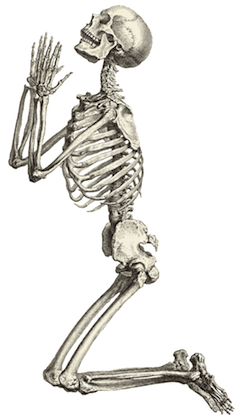
Which brings us to the peculiar image above. It comes from some classical text and whenever I’ve encountered it over the years, I’ve always considered it rather odd that the illustrator decided to portray this skeleton in the posture of prayer. It’s actually a bit disconcerting, since death and decay have nothing to do with our Lord who is the way, the truth and the life.

If we haven’t said our prayers in this mortal life, as Lewis reminds us, we will lack the voice and opportunity to do so in the next.

Besides, knowing Christ is not something with benefits only in the next life. Walking through life in his light makes our days here all the more pleasant and joyful. As I look back on my own life I recognize numerous ways in which his hand directed my path. Had I lived for my own selfish appetites the person I would be today would little resemble the Christian me. Thank God that he delivered me from becoming that man.

Pets in Heaven?

One of my favorite features in the Wittenburg Door of the 1980s was a running account of “Dogs Who Know the Lord.” Having witnessed more Christlike traits in some pets than I’ve seen in many human lives, I considered the tongue in cheek title a definite possibility.

This week we bid farewell to a gentle and loving border collie who had been part of our family for more than a decade. She lived a long and full life, and like her our previous border collie, she enjoyed her family and the outdoors (both gifts of God) right up until the end. (Both had been “rescued” by us.) Then, when Tanner and Lady were each over 15 years old, simply remained on their blankets when the day arrived that they knew they had not the strength to rise.

There are two kinds of people. Pet lovers, and those whose hearts are desensitized to their affections. The latter group has already stopped reading this post. But pet lovers, yes you, can empathize with my family’s current grief. You understand our loss because you’ve suffered the same pain. And, some of you may even pause to say a short prayer for us.

As a pastor, I’ve had numerous conversations with people about the question of whether or not we’ll see our pets in heaven. It’s a provocative subject, and the fact that such questions persist is a tribute to the significance of these animals in our lives.

Contrary to what some would allege, posing questions about this matter does not trivialize faith; it reveals how our restored relationship with our Creator affects every dimension of our existence.

We cannot know, of course, the answer to the question. That’s something that those who respond with a snide “of course not!” should take care to realize.

Over the years my own views on this have broadened, and far from seeing the deliverance (i.e. not “salvation”) of animals as something unlikely . . . I now consider it likely that we will be greeted by our beloved pets in the new creation. Here are some reasons I consider this a definite possibility:

  1. First, it is true that Jesus died to redeem (save) human beings (not animals).
  2. Animals are “innocent” sufferers of humanity’s disobedience and fall.
  3. Some animals are uniquely precious and beloved by God’s children.
  4. Their presence in heaven would enhance our joy.
  5. The same God who created them would have no difficulty re-creating or restoring them.
  6. If the lion and the lamb will lie together in harmony, why should there not be room for our much-loved pets to frolic alongside them?

And, lest you consider the words above merely the sentimental ramblings of a grieving man, I take comfort in the fact that C.S. Lewis too regarded this as a possibility. In a 1962 letter, he wrote:

. . . in The Problem of Pain I ventured the supposal—it could be nothing more—that as we are raised in Christ, so at least some animals are raised in us. Who knows, indeed, but that a great deal even of the inanimate creation is raised in the redeemed souls who have, during this life, taken its beauty into themselves? That may be the way in which the “new heaven and the new earth” are formed. Of course we can only guess and wonder. But these particular guesses arise in me, I trust, from taking seriously the resurrection of the body.