Seeking the Living

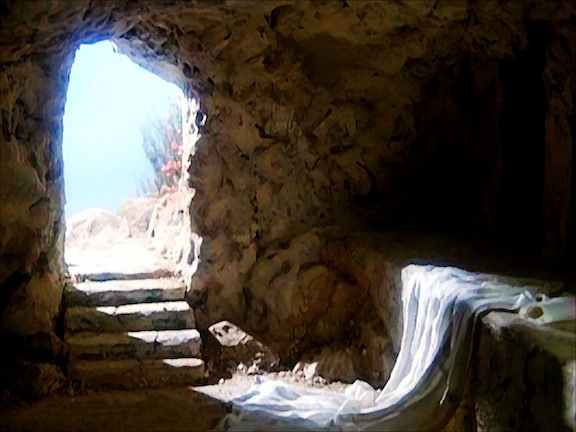
tombOne of the readings at our celebration of the Resurrection, this Easter morning, came from the Gospel according to Saint Luke. It included the powerful words of the angels waiting beside the empty tomb. To Mary Magdalene and the other women who had arrived to complete the ceremonial preparations for Jesus’ burial, they said: “Why do you seek the living among the dead?”

That’s precisely what separates Christianity from every other religious faith; for two millennia, Jesus’ disciples have followed a resurrected and living Lord.

This is what non-Christians are ultimately unable to fathom. Christianity is far more than the adoption of a particular lifestyle. It is infinitely more than a cognitive acquiescence a set of doctrines. It is nothing less than a dynamic, living relationship with our Creator through his only begotten Son.

Many regard Jesus as a great teacher from an ancient epoch—whose words are worthy of preserving. This is a good thing . . . but it’s not Christianity.

Many consider Jesus the model of a noble life—and strive to emulate his compassion and humility. This too is a good thing . . . but it’s not Christianity.

Many regard Jesus as an object of superstition—and they spout religious jargon while living hypocritical lives utterly devoted to their carnal appetites. This is not a good thing . . . and it’s most certainly not Christianity.

C.S. Lewis refers to this inherent inability to “persuade” an unbeliever to see beyond Christianity as a creedal profession or even a simple lifestyle and comprehend it as a relationship.

Our opponents, then, have a perfect right to dispute with us about the grounds of our original assent. But they must not accuse us of sheer insanity if, after the assent has been given, our adherence to it is no longer proportioned to every fluctuation of the apparent evidence. They cannot of course be expected to know on what assurance feeds, and how it revives and is always rising from its ashes.

They cannot be expected to see how the quality of the object which we think we are beginning to know by acquaintance drives us to the view that if this were a delusion then we should have to say that the universe had produced no real thing of comparable value and that all explanations of the delusion seemed somehow less important than the thing explained.

That is knowledge we cannot communicate. But they can see how the assent, of necessity, moves us from the logic of speculative thought into what might perhaps be called the logic of personal relations. What would, up till then, have been variations simply of opinion become variations of conduct by a person to a Person. Credere Deum esse turns into Credere in Deum. And Deum here is this God, the increasingly knowable Lord. (C.S. Lewis, “On Obstinacy in Belief”).

Ultimately, inviting others to share the joy and peace that we disciples of Jesus know—undeserving as all of us are—is not about persuasion. It is about introducing them to Jesus.

It’s about echoing the words of the angels in that Judean cemetery. “Don’t seek Jesus among the dead. He is risen and living, and he offers eternal life to all who call upon his name.”


Theological Training

I’m proud I graduated from a well-respected seminary. And I’m proud of following that Master of Divinity degree with an advanced Master of Theology degree in Patristics. And that’s precisely the problem . . . I’m proud.

As a Christian, I recognize that pride is one of the most destructive and insidious sins. As a pastor and chaplain, I have seen all too frequently how pride expressly targets members of the clergy. Our vulnerability to the temptation to be proud is one of the common chinks in the armor of the ordained.

C.S. Lewis recognized this fact. In A Severe Mercy, he wrote:

I think there is a great deal to be said for having one’s deepest spiritual interest distinct from one’s ordinary duty as a student or professional man. St. Paul’s job was tent-making. When the two coincide I shd. have thought there was a danger lest the natural interest in one’s job and the pleasures of gratified ambition might be mistaken for spiritual progress and spiritual consolation; and I think clergymen sometimes fall into this trap. . . .

In fact, the change [to a Christian ministry] might do good or harm. I’ve always been glad myself that Theology is not the thing I earn my living by. On the whole, I’d advise you to get on with your tent-making. The performance of a duty will probably teach you quite as much about God as academic Theology wd. do. Mind, I’m not certain: but that is the view I incline to.

Lewis understood that “advancement” in ecclesiastical contexts can mask the inner heart and be mistaken as a form of holiness when it is in actuality vanity. I was reminded of this weakness in clerical armor recently, when I read a tribute to a Chinese Christian whose name is little known beyond his homeland. Dr. Sun Yi-yin, known in America as “Freddie Sun,” died in August at the age of 76. A professor of Geology, he lost his faculty position for failing to deny Christ.

Like thousands of other Christians living under the atheist regime, he was imprisoned for his work in establishing churches and Bible schools. He raised the funds to start no fewer than 154 of these training centers, and was key to the equipping of approximately 60,000 underground pastors and teachers. The “underground” Church in China is distinguished from the government-controlled “Three-Self Patriotic Movement.”

For his labors, Sun endured a decade in a Chinese labor camp. (His wife, Dorothy Chang, was also imprisoned. Rather than reducing his faith, during his sojourn in the harshest of conditions, Sun experienced a personal revival and his zeal increased.

His story is amazing, but here is the aspect that hit the mark in the center of my conscience. In his autobiography, The Man in the Fiery Furnace, Sun described his imprisonment as his “seminary” experience: “Instead of learning homiletics, hermeneutics, Greek, and Hebrew, I was being taught the greater lessons of obedience, submission, forgiveness, love, endurance, and patience.”

Now, I am grateful that God has preserved me from the “fiery furnace,” but I do long to experience the fruit of the spirit that Sun so richly harvested in prison. While not dismissing the importance of the classical subjects of homiletics and hermeneutics, as the Apostle says, “If I speak in the tongues of men and of angels, but have not love, I am a noisy gong or a clanging cymbal. And if I have prophetic powers, and understand all mysteries and all knowledge, and if I have all faith, so as to remove mountains, but have not love, I am nothing. If I give away all I have, and if I deliver up my body to be burned, but have not love, I gain nothing.” (I Corinthians 13:1-3, ESV).

In The Problem of Pain, Lewis’ treatise on suffering, he addresses how God can redeem terrible things such as unjust punishments. For those desiring to understand how an omnipotent God can allow evil to occur, Lewis’ presentation is quite helpful. And, the life example of Dr. Sun provides a superb example of its validity.

I advance six propositions necessary to complete our account of human suffering which do not arise out of one another and must therefore be given in an arbitrary order. 1. There is a paradox about tribulation in Christianity. Blessed are the poor, but by ‘judgement’ (i.e., social justice) and alms we are to remove poverty wherever possible. Blessed are we when persecuted, but we may avoid persecution by flying from city to city, and may pray to be spared it, as Our Lord prayed in Gethsemane.

But if suffering is good, ought it not to be pursued rather than avoided? I answer that suffering is not good in itself. What is good in any painful experience is, for the sufferer, his submission to the will of God, and, for the spectators, the compassion aroused and the acts of mercy to which it leads. In the fallen and partially redeemed universe we may distinguish (1) the simple good descending from God, (2) the simple evil produced by rebellious creatures, and (3) the exploitation of that evil by God for His redemptive purpose, which produces (4) the complex good to which accepted suffering and repented sin contribute.

Now the fact that God can make complex good out of simple evil does not excuse—though by mercy it may save—those who do the simple evil. And this distinction is central. Offences must come, but woe to those by whom they come; sins do cause grace to abound, but we must not make that an excuse for continuing to sin. The crucifixion itself is the best, as well as the worst, of all historical events, but the role of Judas remains simply evil.

I thank God for the life and testimony of Sun. I pray God will reap an abundance of believers in China, and elsewhere, due to his faithfulness. And I thank God for using Sun’s words to cause me to stop in the midst of my busy activities and take the time to examine my own heart and motives.

Searching for Water

Have you ever been truly, deeply thirsty? Parched all the way from your lips to your loins . . . scorched like a desiccated crustacean who didn’t quite scurry back to the retreating tides quickly enough.

If you have, you know how savory—how gloriously life giving—a simple drink of water can be. In fact, when you experience thirst like this and take that first quenching swallow, there is nothing else like it in the world.

In those rare moments of dire yearning and satisfaction, we understand how water is utterly vital to life. All the treasures and honors of this world would be meaningless, if they were intended to substitute for that most basic human necessity.

I was pondering the importance of water as I examined the photograph above. The Mars rover Curiosity took it. NASA considers the outcrop here to be the edge “of an ancient streambed.” Rounded rocks, which would presumably have been shaped as they tumbled along “vigorous” creeks or rivers, support that notion. The quest transpiring across our solar system this very hour is nothing less than a search for evidence of life on that arid planet

Water, of course, is necessary to life “as we know it.” Thus the vast significance of the discovery.

Jesus of Nazareth was talking one day with a woman of Samaria. He brashly said of the water she was drawing from a well that dated back to the days of the Patriarch Jacob: “Everyone who drinks of this water will be thirsty again, but whoever drinks of the water that I will give him will never be thirsty again. The water that I will give him will become in him a spring of water welling up to eternal life.”

Because we are inescapably bound to water, it carries tremendous power as a simile or metaphor. C.S. Lewis used it quite effectively in the following passage. In it, he is discussing the true value of performing religious exercises, even when they do not bring us joy or a conscious sense of renewal. As usual, Lewis uses vivid imagery to communicate profound truth.

When we carry out our “religious duties” we are like
people digging channels in a waterless land, in order that when at last the water comes, it may find them ready. . . . There are happy moments, even now, when a trickle creeps along the dry beds; and happy souls to whom this happens often. (C.S. Lewis, Reflections on the Psalms).

I’m saddened by the number of people (especially those with a family legacy of faith) who succumb to the secular philosophies of our materialistic world. They surrender to the world’s hedonistic proclamation that personal happiness is the greatest good! They are ultimately destined to find their souls withered and wasted by the waterless doctrines they embrace.

The worst part of it all is that the water is right in front of us all, offered freely to each of us. We don’t need to commission any expensive interplanetary projects to seek it out. We don’t need to try to be “good enough” to deserve it. All we need do is accept the gift, priceless though it is.

The Single Source of All Good

“There is but one good; that is God. Everything else is good when it looks to Him and bad when it turns from Him.” (C.S. Lewis, The Great Divorce).

I believe this thesis. I don’t expect agnostics and humanists to, though. Still, I believe the statement is true, even for them. Consider my explanation below.

What Lewis is saying is that God is the Source of all good. In the Scriptures, in fact, some of the attributes of God can be viewed as so intimately a part of his divine nature that the particular virtue is, in its purity, a facet of the Lord’s identity. Thus God the Father and God the Son are said to truly be: Love, Light, and Truth.

Christians are inclined to attribute any good fruit we see as coming from the Source of good. Thus, when secularists do something inarguably good or altruistic, we have no problem attributing its inspiration to God. Yes, they may see through the glass dimly, and may for example recognize only the beauty of nature or the magnificence of the cosmos. But these are God’s handiwork, and so we return to where we began.

It is actually the second portion of this quotation that most intrigues me. “Everything else is . . . bad when it turns from Him.”

I suppose I can illustrate this truth more effectively than I can explain it.

Patriotism is a good thing. It results in cohesive communities where individuals are willing to make sacrifices on behalf of their fellow citizens. Focus is on the common welfare. However, run amuck, patriotism can become a deformed thing. The Third Reich united and inspired a weak and demoralized nation, but at a bloody price.

Love of Family is a good thing. Most of us experience the joy of this fact. However, carried to obsessive bounds, it can result in horrendous acts. Not a week passes without the news relaying accounts of parents murdering their own children in the face of a divorce, incarceration or some other form of separation. In their depraved minds, the thought of not being together warped into something uglier than death itself.

Human Freedom is a good thing. If that weren’t so, God wouldn’t have created us with free will. It allows human to say “yes” to him and live in a relationship with our Creator as his children rather than as mindless automata. But, apart from God, is there any question that this most wonderful gift becomes a curse? Proof overflows from the pages of our newspapers.

So, Lewis reminds us that the things of this world possess no intrinsic good. When things such as generosity, courage, and creativity are imbued with a divine element, only then do they become capable of being truly good.

The strongest challenge to this belief comes in the notion that even those who do not acknowledge God are capable of doing things we all consider “good.” As I said above, Christians have no problem celebrating selfless acts of their unbelieving neighbors. The reason for this is actually quite simple. Even though secular humanitarian efforts do not look to God, since they are altruistic, they consciously look away from self. In other words, they are not intentionally turning away from God, but, ignorant of his presence, they still transcend selfish or carnal interests. And, insofar as they are free of these sinful considerations, they possess the capacity for actions rightly deemed “good.”

Ultimately I believe this is due to the truth that all women and men are created in the image of our God. Whether we acknowledge it or not, the echoes of that truth resound throughout our being.

C.S. Lewis on Xmas

Advent has begun! As the Christian Church celebrates its “New Year,” it’s fun to look at C.S. Lewis’ essay, “Xmas and Christmas: A Lost Chapter from Herodotus.” He describes the predicament of secularized western civilization. Reversing the spelling of “Britain,” Lewis points out how a new holiday has displaced a profound holy-day.

In the middle of winter when fogs and rains most abound, [the Niatirbians] have a great festival called Exmas, and for 50 days they prepare for it (in the manner which is called,) in their barbarian speech, the Exmas Rush.

When the day of the festival comes, most of the citizens, being exhausted from the (frenzies of the) Rush, lie in bed till noon. But in the evening they eat five times as much as on other days, and crowning themselves with crowns of paper, they become intoxicated. And on the day after Exmas, they are very grave, being internally disordered by the supper and the drinking and the reckoning of how much they have spent on gifts and on the wine.

A few among the Niatirbians have also a festival, separate and to themselves, called Crissmas, which is on the same day as Exmas. And those who keep Crissmas, doing the opposite to the majority of Niatirbians, rise early on that day with shining faces and go before sunrise to certain temples where they partake of a sacred feast.

But as for what Hecataeus says, that Exmas and Crissmas are the same, this is not credible. It is not likely that men, even being barbarians, should suffer so many and so great things (as those involved in the Exmas Rush), in honor of a god they do not believe in.

Niatirb might just as well be the Setats Detinu. We see the same signs all around us. One shocking fact is how the secular seasonal movies now do not even feel compelled to offer the slightest nod to the true meaning of the season. Santa, for many, has utterly eclipsed the Babe in the manger. And “Christ” has literally been crossed out of Xmas.

May this entertaining portrait remind each of us of the true significance of the approaching season. And, may God also use the season of Advent to prepare our individual hearts to receive the most priceless and precious Christmas gift ever given.

Alone—With God

“In prayer God shows himself to us. That he answers prayers is a corollary—not necessarily the most important one—from that revelation.” (C.S. Lewis, “The Efficacy of Prayer”)

Most people think of prayer primarily as a (frequently formal) conversation in which we appeal to God for particular blessings—followed by his response with a “yes,” “no,” or “not yet.” The formulation might look like this: Human Petition = Divine Response.

While prayer truly is a conversation with our Creator . . . this simplistic view is incomplete. In focusing on the answer, it misses out on the holy awe of being in the presence of God itself. C.S. Lewis grasps this precious truth. “In prayer God shows Himself to us.”

I was chatting with my grandson the other day. He’s home on leave from his assignment at Kadena Air Base in Okinawa. Andrew was describing how his Christian lifestyle has isolated him from many of his fellow airmen. They sometimes ridicule him for his chastity and can’t fathom his choice not to squander his time at the club.

But Andrew also shared with me how the ostracism has positively impacted his spiritual life. He’s discovered deep joy in spending time alone with the Lord. He’s active in church worship too, of course, but he also enjoys his time alone. And that is a spiritual epiphany for a gregarious young man who is intensely social by nature.

He shared with me this verse from a song by a contemporary Christian band we both enjoy:

“Loneliness and solitude are two things not to get confused ’cause I spend my solitude with You.” (Reliant K, Lyrics from “Therapy”)

I hear in these words an echo of Lewis’ insight. As Christians, we are never alone. And sometimes in “solitude” we experience the most amazing intimacy a human being can ever know.

Addendum:

True . . . God is ever with us. As Saint John Chrysostom, Patriarch of Constantinople, said: “Quietude in solitude is no small teacher of virtue.”

Stained Glass Fiasco

It’s shocking, what you come across on the internet. You see many things that were never meant to be. I place this stained glass window of Mr. T in that category.

Yes, I recognize that he is a Christian, and his gold (24 carat) cross is prominently displayed. But still . . .

I was surfing in search of a good portrayal of Saint Martin of Tours. Not quite sure how the most distinctive member of the A-Team appeared in the list.

At least it provides an excellent reminder that a person should be prepared for the unexpected whenever they enter the worldwide web. (It’s not likened to a spider’s domain without reason.)

Addendum:

I realize that you are not comparing Mr. Tureaud to an arachnid, but you really should be much more careful in how you jump from thought to thought.

Sharing Surnames

“‘It isn’t Narnia, you know,’ sobbed Lucy. ‘It’s you. We shan’t meet you there [again]. And how can we live, never meeting you?’

‘But you shall meet me, dear one,’ said Aslan.

‘Are—are you there too, Sir?’ said Edmund.

‘I am,’ said Aslan. ‘But there I have another name. You must learn to know me by that name. This was the very reason why you were brought to Narnia, that by knowing me here for a little, you may know me better there.’”

C.S. Lewis, The Voyage of the Dawn Treader

 Names are precious, and the way that others who share your name bring to it honor or dishonor is important. As Ecclesiastes says, “A good name is better than precious ointment . . .”

I may be more sensitive to this truth than most people, because I grew up with a modestly (in)famous name. Fewer people recognize the link today, since the Burt Lancaster film that publicized the Birdman of Alcatraz is rarely aired. When I was a kid, it seemed to be run annually, like the Wizard of Oz, and I invariably could count on someone making the name connection every time it ran.

Actually, it wasn’t all that bad. Lancaster’s portrayal of the compassionate inmate was extremely sympathetic. The connection didn’t bother me much. Well, not until I read about the genuine Robert Stroud. Not quite as appealing a human being. Enough said.

Anya Stroud, WarriorIf you conduct some web searches on variations of your family name, you’ll be surprised what you find. I recently came across a fictional “relative” named Anya Stroud. She looks like someone you’d like to have at your side in an apocalyptic battle, doesn’t she? I understand she is a resident of just such a violent world, in the game system she inhabits.

Returning though to the real world . . . what we do with our name means a great deal to others who share it, especially to our family. Perhaps most of all, to our descendants. Much better for them to look back upon an honorable and godly ancestor rather than a vile example of unredeemed humanity.

And there is another aspect to guarding our name. One of the names followers of Jesus are known by is “Christian.” This is the most precious name we can hold. It is because of this name we can approach our Creator and call him “Father.”

This is a name we should strive to protect and make praiseworthy. We should not however try to earn it, since that’s impossible. It’s a name given simply as a gift, to all who believe Jesus is the Christ, the Messiah promised to be our Redeemer.

Addendum:

Parents are blessed when their children bring honor to their name. So too our Father in heaven. In a world where many hypocrites appeal to his name to defraud and mislead others, it is good to be reminded that our calling as disciples is to live in a manner that conforms to God’s command: “You shall therefore be holy, for I am holy.”

Journalism that Respects God

“I believe that the journalism which succeeds best—and best deserves success—fears God and honors Man.” (from “The Journalist’s Creed”)

These words were written more than a century ago by Walter Williams, founder of one of the world’s best-respected schools of journalism. How times have changed! Today the majority of journalists are not only ignorant of matters related to faith . . . they are hostile towards it.

Thirty-five years ago, when I earned a degree in the field, there was more of an apathy towards religion at my secular university. (Sadly, I hear about a similar listless mood on some Christian campuses today.)

Ironically, while Williams might anticipate the danger of a subjective sympathy for Christianity in the West, he would be surprised. Many journalists seem to despise Christianity even more strongly than they question other faiths. And they wear their derision on their proverbial sleeves.

The simple fact is that everyone possesses a worldview. And, strive as a person might, they cannot attain the abstract precipice of utter objectivity. Most, of course, don’t strive at all. They surrender to their disdain for God and all religious institutions. And it is evident in their writing.

If writers today followed this element of the Journalist’s Creed more conscientiously, we would enjoy a far more civil and informed dialog in our society.

Addendum: 

Don’t forget that as disciples of Jesus, we too need to remain civil and respectful. Never forget that God chose to make humanity in his own holy image.

No Child Unwanted

Certificates Bearing Their New NamesIt’s difficult for people who are products of Western civilization to comprehend the different view of the value of life held by many in our world.

An article today described a terrible practice in India, home to more than 1.2 billion human beings. Like many less developed nations, male children are often preferred to female offspring. Sons are viewed as a blessing and daughters (primarily due to dowries, in the case of India) are less welcome.

And because of that sad fact, it has become common for some families to name their innocent daughters Nakusha, which sounds rather pleasant, but means “unwanted.” It would be difficult to imagine an uglier name.

Recently a movement has arisen to rename girls cursed by their parents with this crippling birthright. Yesterday, in fact, just such a renaming ceremony was conducted in Satara District. The girls were allowed to choose their own name to replace the vile one that had shadowed their lives up to this point.

While there are millions of Christians in India, they have hardly made an impact on the Hindu worldview that dominates the land. It is inconceivable that in a Christian land (i.e. one rooted in the biblical documents and principles like most nations in the West), that children would be named “Unwanted.”

On the contrary, children are esteemed in the Christian context. Listen to these gracious words of Jesus the Christ:

At that time the disciples came to Jesus, saying, “Who is the greatest in the kingdom of heaven?” And calling to him a child, he put him in the midst of them and said, “Truly, I say to you, unless you turn and become like children, you will never enter the kingdom of heaven. Whoever humbles himself like this child is the greatest in the kingdom of heaven.

“Whoever receives one such child in my name receives me, but whoever causes one of these little ones who believe in me to sin, it would be better for him to have a great millstone fastened around his neck and to be drowned in the depth of the sea.”

Let us say a prayer for each little girl and boy—in every land around the globe—who finds themselves unwanted by their family. And let’s support worthwhile agencies that work to rescue them.

Because every child is precious to God.

Addendum:

…and every child is precious to all of those who already know God as their Father, as well.