
C.S. Lewis was a champion of the historic version of the atonement wherein Jesus pays the price for our disobedience, and by his sacrificial death offers us eternal life though faith in him.
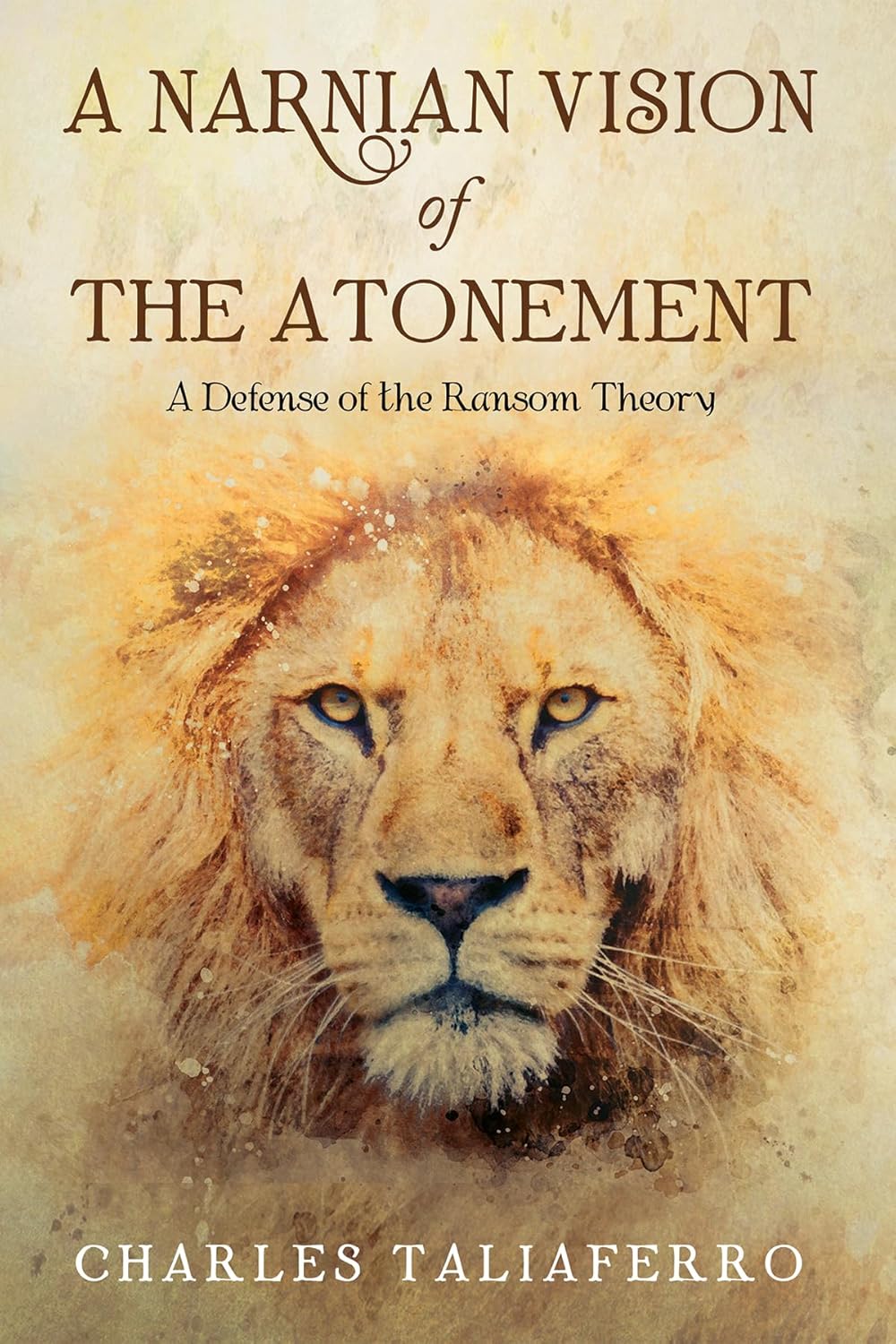
There is an excellent new book that is temporarily on sale for a mere three dollars in the Kindle format. (This low price is not due to its value, but to the occasional sales offered by publisher Wipf and Stock.) Check it out right now, because the sale ends on 24 September.
A Narnian Vision of the Atonement: A Defense of the Ransom Theory was written by Charles Taliaferro, Professor Emeritus of Philosophy at St. Olaf College.
I’m enjoying the volume right now, although “philosophy” per se is far from my passion. But Jesus of Nazareth is. And I am passionate, as well, about the work of Yeshua’s disciple, C.S. Lewis. And Jesus and Lewis are the central characters in Taliaferro’s book.
He makes the subject of doctrine and philosophy quite accessible. I find this especially beneficial in his chapter on “the Ransom Theory and Rival Accounts of the Atonement.” Whereas some theologians are dismissive of the earliest Christian view of the atonement, this volume argues that it is far from incompatible with modern emphases (e.g. the Exemplar Model).
Since the early medieval era (roughly, the eleventh century), theories of the atonement have been any version except the ransom theory. In this chapter we will consider a host of them. I will be painting with a broad brush, with minimal references, in an effort to favorably sketch these accounts.
Afterwards, I will suggest that these accounts are not only compatible with the ransom theory, the ransom theory can provide important support for these so-called rivals.
I strongly commend this volume – especially at this unbelievable price – to anyone interested in C.S. Lewis’ faith or even in basic historic Christianity.
I will close with a wonderful passage from a letter C.S. Lewis wrote in 1954. Discussing theodicy, why God allows the suffering of innocents, Lewis offers this profound insight, inspired by Hebrews 2:10, and, it seems to me, 2 Corinthians 12:9.
Do you know, the suffering of the innocent is less of a problem to me v. often than that of the wicked. It sounds absurd; but I’ve met so many innocent sufferers who seem to be gladly offering their pain to God in Christ as part of the Atonement, so patient, so meek, even so at peace, and so unselfish that we can hardly doubt they are being, as St. Paul says, “made perfect by suffering.”
On the other hand I meet selfish egoists in whom suffering seems to produce only resentment, hate, blasphemy, and more egoism. They are the real problem (11 November 1954).
The Atonement – the restoration of humanity’s proper relationship with our Creator – is the greatest of miracles. And, A Narnian Vision of the Atonement, can help us to better celebrate its wonders.
 Mere Inkling Press