Veterans Day: Joyous or Somber?

Much of the world commemorates Armistice Day, or as it has come to be known in the United States, Veterans Day. It is fitting to offer thanks for those who have gone to war to defend our freedoms, especially those who sacrificed their lives in that cause.

C.S. Lewis was a veteran of the “war to end all wars.” He was recuperating from severe battle wounds in an army hospital when WWI came to its conclusion. Just a few days after the Armistice, he wrote to his father:

As to the great news which is uppermost in our minds, I can only echo what you have already said. The man who can give way to mafficking [celebrating with boisterous public demonstrations] at such a time is more than indecent—he is mad. I remember five of us at Keble, and I am the only survivor: I think of Mr. Sutton, a widower with five sons, all of whom have gone. One cannot help wondering why.

Lewis knew what all veterans of war have learned. War is a terrible thing. It is something to be avoided whenever possible . . . but there are some things even worse than war. And in those circumstances, when war becomes the necessary lesser evil, it is never something to be celebrated. Innocents die in war. Innocence dies in war.

Yes, it is certainly good to express our appreciation to the veterans who have counted the cost and served in uniform. But we should do so with sober, deep and quiet gratitude.

Pornography Pays . . . and Costs

See No Evil

Some years ago I was a member of an “online” fiction critique group. It was secular, and few members worked with religious themes. I recall how one of the other writers bemoaned the fact that she had become “trapped” in a cycle of needing to write pornography. She said, “I can’t stop because it’s so easy to write and the market pays so well.” Now, I can’t attest to either of those statements . . . but her next sentence sure rang true.

“It simple to write and profitable . . . but writing this stuff makes me feel dirty.”

This impressed me. Even the theologically unenlightened mind (spirit/soul) recognizes the corrupting influence of immersing oneself in filth. God has written his (natural) law on the conscience of all those created in his image.

An article in today’s news brought this story to my mind. It appears a Roman Catholic publishing house has been found to include pornography in its frontlist. My first reaction is that this had to be a mistake, but the evidence seems quite significant.

The facts are simple. The press is in Germany and called Weltbild, and it’s second only to Amazon in book sales there. It publishes material most would deem pornographic. (The legal but vile industry calls itself “erotic” literature, but it’s eros-defiled.) While it’s sad enough that such material even exists, that’s not all. The more depressing issue is that Weltbild is owned in whole by the dioceses of the Roman Catholic Church in Germany.

Now, if you’re like me, you’ll want to give the church the benefit of the doubt. After all, you think, some unknown editor probably slipped a single title into their immense publishing list. I’m sure the senior people were never even aware of the mistake.

If you’re like me, you’d be mistaken. Turns out over 2,000 titles are found in their online store under the category of erotica. And, back in 2008 a group of concerned Catholics brought this matter to the attention to the attention of the bishops. In a seventy-page document.

What a tragedy.

But there is a lesson here. Those of us who call ourselves “Christian” should strive to maintain the highest possible standards. Associating ourselves with ugly things reflects poorly not only on us, but also on our Lord. This story is shameful, and I pray the leaders involved will repent of their error, no matter what the financial consequences may be. On the other hand, I too need to avoid shameful actions. And, whenever I do fall short of the Christian ideals which are my goal—I need to be swift to acknowledge my sin and seek to restore what has been lost.

Addendum:

Very true. Paul’s counsel to the church in Philippi remains timely. “Whatever is true, whatever is honorable, whatever is just, whatever is pure, whatever is lovely, whatever is commendable, if there is any excellence, if there is anything worthy of praise, think about these things.”

Sharing Surnames

“‘It isn’t Narnia, you know,’ sobbed Lucy. ‘It’s you. We shan’t meet you there [again]. And how can we live, never meeting you?’

‘But you shall meet me, dear one,’ said Aslan.

‘Are—are you there too, Sir?’ said Edmund.

‘I am,’ said Aslan. ‘But there I have another name. You must learn to know me by that name. This was the very reason why you were brought to Narnia, that by knowing me here for a little, you may know me better there.’”

C.S. Lewis, The Voyage of the Dawn Treader

 Names are precious, and the way that others who share your name bring to it honor or dishonor is important. As Ecclesiastes says, “A good name is better than precious ointment . . .”

I may be more sensitive to this truth than most people, because I grew up with a modestly (in)famous name. Fewer people recognize the link today, since the Burt Lancaster film that publicized the Birdman of Alcatraz is rarely aired. When I was a kid, it seemed to be run annually, like the Wizard of Oz, and I invariably could count on someone making the name connection every time it ran.

Actually, it wasn’t all that bad. Lancaster’s portrayal of the compassionate inmate was extremely sympathetic. The connection didn’t bother me much. Well, not until I read about the genuine Robert Stroud. Not quite as appealing a human being. Enough said.

Anya Stroud, WarriorIf you conduct some web searches on variations of your family name, you’ll be surprised what you find. I recently came across a fictional “relative” named Anya Stroud. She looks like someone you’d like to have at your side in an apocalyptic battle, doesn’t she? I understand she is a resident of just such a violent world, in the game system she inhabits.

Returning though to the real world . . . what we do with our name means a great deal to others who share it, especially to our family. Perhaps most of all, to our descendants. Much better for them to look back upon an honorable and godly ancestor rather than a vile example of unredeemed humanity.

And there is another aspect to guarding our name. One of the names followers of Jesus are known by is “Christian.” This is the most precious name we can hold. It is because of this name we can approach our Creator and call him “Father.”

This is a name we should strive to protect and make praiseworthy. We should not however try to earn it, since that’s impossible. It’s a name given simply as a gift, to all who believe Jesus is the Christ, the Messiah promised to be our Redeemer.

Addendum:

Parents are blessed when their children bring honor to their name. So too our Father in heaven. In a world where many hypocrites appeal to his name to defraud and mislead others, it is good to be reminded that our calling as disciples is to live in a manner that conforms to God’s command: “You shall therefore be holy, for I am holy.”


Journalism that Respects God

“I believe that the journalism which succeeds best—and best deserves success—fears God and honors Man.” (from “The Journalist’s Creed”)

These words were written more than a century ago by Walter Williams, founder of one of the world’s best-respected schools of journalism. How times have changed! Today the majority of journalists are not only ignorant of matters related to faith . . . they are hostile towards it.

Thirty-five years ago, when I earned a degree in the field, there was more of an apathy towards religion at my secular university. (Sadly, I hear about a similar listless mood on some Christian campuses today.)

Ironically, while Williams might anticipate the danger of a subjective sympathy for Christianity in the West, he would be surprised. Many journalists seem to despise Christianity even more strongly than they question other faiths. And they wear their derision on their proverbial sleeves.

The simple fact is that everyone possesses a worldview. And, strive as a person might, they cannot attain the abstract precipice of utter objectivity. Most, of course, don’t strive at all. They surrender to their disdain for God and all religious institutions. And it is evident in their writing.

If writers today followed this element of the Journalist’s Creed more conscientiously, we would enjoy a far more civil and informed dialog in our society.

Addendum: 

Don’t forget that as disciples of Jesus, we too need to remain civil and respectful. Never forget that God chose to make humanity in his own holy image.

No Child Unwanted

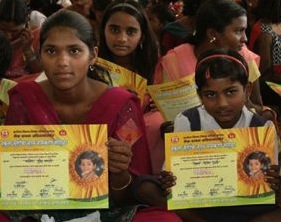
Certificates Bearing Their New NamesIt’s difficult for people who are products of Western civilization to comprehend the different view of the value of life held by many in our world.

An article today described a terrible practice in India, home to more than 1.2 billion human beings. Like many less developed nations, male children are often preferred to female offspring. Sons are viewed as a blessing and daughters (primarily due to dowries, in the case of India) are less welcome.

And because of that sad fact, it has become common for some families to name their innocent daughters Nakusha, which sounds rather pleasant, but means “unwanted.” It would be difficult to imagine an uglier name.

Recently a movement has arisen to rename girls cursed by their parents with this crippling birthright. Yesterday, in fact, just such a renaming ceremony was conducted in Satara District. The girls were allowed to choose their own name to replace the vile one that had shadowed their lives up to this point.

While there are millions of Christians in India, they have hardly made an impact on the Hindu worldview that dominates the land. It is inconceivable that in a Christian land (i.e. one rooted in the biblical documents and principles like most nations in the West), that children would be named “Unwanted.”

On the contrary, children are esteemed in the Christian context. Listen to these gracious words of Jesus the Christ:

At that time the disciples came to Jesus, saying, “Who is the greatest in the kingdom of heaven?” And calling to him a child, he put him in the midst of them and said, “Truly, I say to you, unless you turn and become like children, you will never enter the kingdom of heaven. Whoever humbles himself like this child is the greatest in the kingdom of heaven.

“Whoever receives one such child in my name receives me, but whoever causes one of these little ones who believe in me to sin, it would be better for him to have a great millstone fastened around his neck and to be drowned in the depth of the sea.”

Let us say a prayer for each little girl and boy—in every land around the globe—who finds themselves unwanted by their family. And let’s support worthwhile agencies that work to rescue them.

Because every child is precious to God.

Addendum:

…and every child is precious to all of those who already know God as their Father, as well.

Biblical Illiteracy

A person does not have to be religious to recognize the importance of the Ten Commandments on western civilization, literature and life. Even when one disregards their intrinsic merit, their literary significance remains. That said, it is important that those who consider themselves well educated should be acquainted with the message of this foundational document.

The statistics reveal a rather surprising picture. It turns out sixty percent of Americans cannot identify even half of the commandments. What I find stunning about that is the fact that since they are mostly prohibitions of destructive behavior, even the illiterate should be able to guess half of them. “Okay . . . we shouldn’t commit murder . . . steal from others . . . or lie about and slander others.” Pretty common sense, and we’re already over halfway there.

“Let’s see . . . the commandments are about God, so there’s probably one that says ‘worship the real God.’” Simple logic, and we’ve nearly arrived. Four out of the five and it wasn’t all that challenging. But how do we arrive at a fifth commandment? Here are two possible paths:

“Oh, doesn’t ‘religion’ believe that it’s sinful to cheat on your spouse . . . that’s probably on the list.”

or

“What’s that weird word the Bible uses about wanting stuff that belongs to others . . . oh yeah, ‘coverting’ or something like that . . . we’re not supposed to desire the possessions of others.”

Since our world has programmed us all with insatiable materialistic desires, it’s probably unlikely that someone would “guess” that coveting our neighbor’s property is wrong, so let’s substitute a more likely alternative.

“Christians get so worked up about swearing, especially when people curse using ‘God’ or ‘Jesus’ . . . so there’s probably something about that in the Ten Commandments.”

Congratulations, we’ve reached our goal of five.

As for the enumeration of the commandments—which varies among Jewish, Roman Catholic and Protestant communions—that’s a subject for another day.

Addendum:

Don’t forget the observance of this commandment which would transform our world: “Honor your father and mother” (this is the first commandment with a promise), “that it may go well with you and that you may live long in the land.”

Soldiering for Nine Decades?

Ninety Years in the French Army

Today’s edition of “Ripley’s Believe It or Not” included the peculiar remark about a French soldier who served ninety years in their army–all without a single promotion! Having served nearly a quarter of a century in uniform myself, I found it daunting to imagine nearly a century in the ranks.

A little research verified the fact. Jean Theurel (1699-1807) was a fusilier with the unbelievable record. And his service was uninterrupted, despite being severely wounded in battle twice. As for finishing his career as a private, it turns out that he had turned down many opportunities for promotion. Although he was lauded as the “oldest soldier in Europe,” it’s hard to imagine anyone else serving longer on a different continent. (Or wanting to, for that matter…)

Addendum: 

The Dashing Octogenarian This painting reveals a much more dignified portrayal of the veteran than does your illustrated version (which does not at all befit the proper decorum of a scriptorium).

Serving one’s country with integrity is an honorary thing. But better by far is following the Lord of Hosts and the Prince of Peace.

Follow Jesus, Die

The two go hand in hand.Yesterday Iran surrendered to international outcry and decided to retry one of their citizens condemned to death for the “crime” of being a Christian. Actually, the alleged crime is “converting” to Christianity—and Iran is not the only Muslim nation to make this a capital offense.
 
Pastor Youcef Nadarkhani was arrested two years ago, and has refused to deny his Savior, even when threatened with torture and death. Christians (and other non-Muslims) are by legal definition second- or third-class citizens in all countries governed by Shariah law.
This expressly religious legal system proves each day its incompatibility with democracy. Two days ago more than a score of Coptic Christians were murdered in Egypt, where they have virtually no legal recourse or protection. It is no wonder that countless Christians and enlightened Muslims have fled from the persecution imposed by these religious regimes.

In such nations Christians died yesterday, today and they will die again tomorrow—simply because they follow Jesus. And, after international attention has died away, there is no guaranteed Nadarkhani will ever be allowed to rejoin his family. His life may still be forfeited for his faith.

Please pray for the believers who live under constant threat of the sword.

Addendum:

It truly is a tragic matter, requiring our prayers. But let us not forget the words of the Church father Tertullian, another African saint. As he wrote: Sanguis martyrum semen christianorum. “The blood of the martyrs is the seed of the Church.”

Faith Makes Sense of Our Existence

“If we discover a desire within us that nothing in this world can satisfy, also we should begin to wonder if perhaps we were created for another world.” (C.S. Lewis, Mere Christianity).

It would be a sad thing if we existed only for this brief lifetime. And an awareness of this tragic fact rests like a dark cloud over human existence. Many atheists cling to this as a fundamental justification for their rejection of God. “Because of our awareness of our own mortality,” they argue, “people create gods to worship.”

Now, we Christians can acknowledge one aspect of their reasoning. It actually is reasonable to think that if there were no Creator, people would be inclined to invent something to explain the cosmos. We see evidence of this in the fact that when people reject the Son of God—they vainly strive to fill the vacuumleft in their spirits. Human beings share a deep spiritual emptiness (called by some a “God-shaped hole”). And while atheists use that fact to argue against faith . . . C.S. Lewis provides us with the true reason for the conundrum.

It is precisely because of our broken relationship with God—because we were created for a perfect world we no longer inhabit—that we have an innate yearning for the eternal which only God can satisfy. You and I were created to live in the presence of our Lord in a Garden richer than we could ever imagine. And those who trust Christ now will find that a place has been prepared for us in a glorious new home.

 †††

Our faithful commentatorComment: Amen. As the North African Church father Augustine of Hippo wrote: Crede, ut intelligas. “Seek not to understand that you may believe, but believe that you may understand.”

Prepare for Commentary

Your Mere Inkling

Following the last post by your humble scribe, the senior copyist of the Scriptorium insisted that from this point forward he be allowed to comment on each post as it is penned. His comment for the last post was:

“A gifted author could certainly have found a more suitable illustration for his column. While the one you chose does, indeed, correlate to the premise of your text, the image itself is mildly unsettling.”

Who am I to disagree with one who wore the tonsure two decades before I was even conceived? So, I have acquiesced to allowing him to review my future posts before they are actually “published” to the web. I understand this sounds a bit like censorship, but trust me–I will continue to write whatever I desire to write and allow his comments to fall out how they may. So, bear with me as we now anticipate occasional addenda from Brother Hieronymus . . . May his comments be few.

†††

Our CommentatorAddendum First:

I’m certain you would like that, but I recommend against hoping your dream will come to pass. I am not one to overlook my divinely appointed duties. By the way, gifted communicator, did you seriously require 163 words for your post?