Journalism that Respects God

“I believe that the journalism which succeeds best—and best deserves success—fears God and honors Man.” (from “The Journalist’s Creed”)
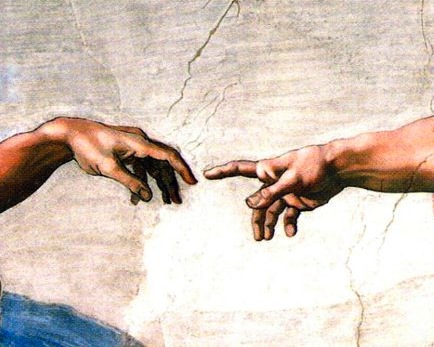
These words were written more than a century ago by Walter Williams, founder of one of the world’s best-respected schools of journalism. How times have changed! Today the majority of journalists are not only ignorant of matters related to faith . . . they are hostile towards it.

Thirty-five years ago, when I earned a degree in the field, there was more of an apathy towards religion at my secular university. (Sadly, I hear about a similar listless mood on some Christian campuses today.)

Ironically, while Williams might anticipate the danger of a subjective sympathy for Christianity in the West, he would be surprised. Many journalists seem to despise Christianity even more strongly than they question other faiths. And they wear their derision on their proverbial sleeves.

The simple fact is that everyone possesses a worldview. And, strive as a person might, they cannot attain the abstract precipice of utter objectivity. Most, of course, don’t strive at all. They surrender to their disdain for God and all religious institutions. And it is evident in their writing.

If writers today followed this element of the Journalist’s Creed more conscientiously, we would enjoy a far more civil and informed dialog in our society.

Addendum: 

Don’t forget that as disciples of Jesus, we too need to remain civil and respectful. Never forget that God chose to make humanity in his own holy image.

Biblical Illiteracy

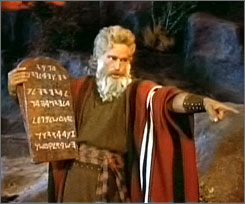
A person does not have to be religious to recognize the importance of the Ten Commandments on western civilization, literature and life. Even when one disregards their intrinsic merit, their literary significance remains. That said, it is important that those who consider themselves well educated should be acquainted with the message of this foundational document.

The statistics reveal a rather surprising picture. It turns out sixty percent of Americans cannot identify even half of the commandments. What I find stunning about that is the fact that since they are mostly prohibitions of destructive behavior, even the illiterate should be able to guess half of them. “Okay . . . we shouldn’t commit murder . . . steal from others . . . or lie about and slander others.” Pretty common sense, and we’re already over halfway there.

“Let’s see . . . the commandments are about God, so there’s probably one that says ‘worship the real God.’” Simple logic, and we’ve nearly arrived. Four out of the five and it wasn’t all that challenging. But how do we arrive at a fifth commandment? Here are two possible paths:

“Oh, doesn’t ‘religion’ believe that it’s sinful to cheat on your spouse . . . that’s probably on the list.”

or

“What’s that weird word the Bible uses about wanting stuff that belongs to others . . . oh yeah, ‘coverting’ or something like that . . . we’re not supposed to desire the possessions of others.”

Since our world has programmed us all with insatiable materialistic desires, it’s probably unlikely that someone would “guess” that coveting our neighbor’s property is wrong, so let’s substitute a more likely alternative.

“Christians get so worked up about swearing, especially when people curse using ‘God’ or ‘Jesus’ . . . so there’s probably something about that in the Ten Commandments.”

Congratulations, we’ve reached our goal of five.

As for the enumeration of the commandments—which varies among Jewish, Roman Catholic and Protestant communions—that’s a subject for another day.

Addendum:

Don’t forget the observance of this commandment which would transform our world: “Honor your father and mother” (this is the first commandment with a promise), “that it may go well with you and that you may live long in the land.”

Prepare for Commentary

Your Mere Inkling

Following the last post by your humble scribe, the senior copyist of the Scriptorium insisted that from this point forward he be allowed to comment on each post as it is penned. His comment for the last post was:

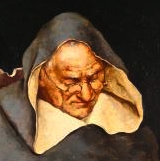
“A gifted author could certainly have found a more suitable illustration for his column. While the one you chose does, indeed, correlate to the premise of your text, the image itself is mildly unsettling.”

Who am I to disagree with one who wore the tonsure two decades before I was even conceived? So, I have acquiesced to allowing him to review my future posts before they are actually “published” to the web. I understand this sounds a bit like censorship, but trust me–I will continue to write whatever I desire to write and allow his comments to fall out how they may. So, bear with me as we now anticipate occasional addenda from Brother Hieronymus . . . May his comments be few.

†††

Our CommentatorAddendum First:

I’m certain you would like that, but I recommend against hoping your dream will come to pass. I am not one to overlook my divinely appointed duties. By the way, gifted communicator, did you seriously require 163 words for your post?

The Inadequacies of Language

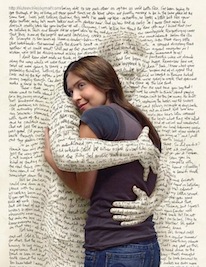
A rather unsettling but communicative image.“Language exists to communicate whatever it can communicate. Some things it communicates so badly that we never attempt to communicate them by words if any other medium is available.” (C.S. Lewis Studies In Words).

Human beings are extremely verbal creatures. It’s no accident that even most sign language used by the deaf community is based on gestures being the equivalent of given words. I suspect this lexical dimension of our nature has something to do with our creation “in the image of God.”

After all, God obviously loves words. His only begotten Son is the very “Word” (Logos) of God, through whom everything that exists was spoken into being.

Yes, words are important to humanity, whether or not we acknowledge a Divine source for that fact. Well chosen words communicate effectively. And, although rhetoric is no longer a formal component of most curricula, one evidence of a solid education is fluency in communication.

Those of us who dabble in writing value the proverbial “well turned phrase” more than most. At the same time we agree with the wisdom of C.S. Lewis quoted above. For some things, words are an impoverished means of communication.

Take for example intense grief. While the unknowing stumble about trying to find the “right words,” we who are older have learned a hug and shared tears are far more effective agents of healing.

Similarly, joy can be ill-expressed via words on occasions when “words are not enough.” Observing the awe shimmering in the eye of a parent cradling their newborn, communicates volumes more than any treatise on “happiness” could.

Lewis, a timeless master of the English language, reminds us all that even the precious gift of language . . . possesses its limits.

What’s So Important about the Milvian Bridge?

Constantinian Triumph CoinWhile pondering what to write about today, I visited one of those “This Day in Christian History” websites. It cited 27 September as the day of Constantine the Great’s “conversion” (in the year A.D. 312). Ironically, the website was in error, with the actual date being the evening of 27 October.

Many people might say “what difference does it make?” but writers will be reminded once again of the necessity of accuracy in their writings! What sort of credibility do you think that website now holds for me?

At any rate, returning to the subject of Constantine’s October 312 conversion . . . it was one of the pivotal events in the history of the world. Not only did Constantine end the persecution of the Church, he raised Christianity to the status of favored religion. Contrary to most quasi-historians, it would be left to a later emperor to establish Christianity as the empire’s official faith.

The early fourth century was a turbulent and fascinating time. Constantine had to battle a number of other so-called Imperators. (“Caesar” remained one of their many titles, but it was no longer the synonym for the ultimate ruler.) One of Constantine’s challengers—who allied himself completely with the pagan faction which still vastly outnumbered the Christians—was Maxentius.

On the evening before the battle, in response to a divine vision, Constantine had his soldiers mark their shields with a symbol for Christ (most likely, a chi-rho). He would ultimately march under that sign to victory over all of his enemies. Licinius, his final foe, would also throw his lot with the pantheon of Rome and other pagan deities. Like Maxentius, he too would fall.

This coin was minted by Constantine to commemorate his victory over these agents of the “Serpent.” The Labarum (Constantine’s standard, topped by the chi-rho) pierces the creature. The legend on the coin reads “Spes Publica,” which means “hope of the people.”

On the matter of just how transformative Constantine’s spiritual conversion actually was . . . well, that’s a subject for another day. Suffice it to say now that he regarded his allegiance to Christ as sincere, and he never recanted. Oh, and the importance of the Milvian Bridge . . . if Maxentius had not fallen there, history would read quite differently today.

Being an Inkling

“I called the name [Inkling] a ‘jest’, because it was a pleasantly ingenious pun in its way, suggesting people with vague or half-formed intimations and ideas plus those who dabble in ink.” (J.R.R. Tolkien in a letter dated 11 September 1967)

As an inkling, I gather regularly with other individuals eager to study the art of writing. This community of writers is an indispensable dimension of what it means to be an inkling. Indeed, it might be argued that no inkling is an island, entire in him- or herself.

For three decades now I have recognized that being an active member of a writer’s group improves my work both qualitatively and quantitatively. The truth is I write much more faithfully when I know I will be attending a meeting where friends are curious to know how my various projects are progressing. In the past, whenever I moved to a new location without an existing writing community, I simply gathered other interested people and started one. In fact, on the first anniversary of September 11th I was gathering with fellow writers each Saturday to focus on this renewing exercise . . . even as we supported Operation Enduring Freedom from Shabaz Air Base in Pakistan.

Beyond the selfish motivation, I also possess a genuine desire to assist and encourage others in their own writing journey. I have always found mentoring others to be extremely rewarding.

If you have any writing aspirations of your own, I strongly encourage you to seek out a group of dedicated writers who meet frequently. Some of these are faith-based, while others are genre-oriented. There are also groups without a unifying ethos, although from my past experience such fellowships struggle to retain their cohesion

If you should be so fortunate as to find a community as invigorating as Oxford’s Inklings, count your blessings. But don’t measure your local options by that lofty standard. Joining a circle of likeminded friends as you pursue your writing can still be amazing even if it is populated by imperfect writers like you and me.

Welcome to the Conversation

Words are powerful. Nothing less than the world was created by the Word, the Logos. And the words uttered by the sons of Adam and daughters of Eve are powerful as well. They possess the power to empower life . . . and to inflict deep wounds, leaving lasting scars.

Illuminated by God’s light, may words of mercy, encouragement and joy predominate here. If you have words of grace to share, don’t hesitate to post your comments.

The “About” link explains the name of this column. It also describes some of the general posts you can expect to read here. I hope that this blog proves to be thought-provoking, uplifting and entertaining. As the weeks and months progress, I hope you let me know how you think I’m reaching that lofty goal.