The Brevity of Life

O Lord, make me know my end and what is the measure of my days; let me know how fleeting I am! Behold, you have made my days a few handbreadths,
and my lifetime is as nothing before you. Surely all mankind stands as a mere breath! Surely a man goes about as a shadow! (Psalm 39:4-6, ESV).

I was reminded this week of that terrible cloud that hangs over all humanity . . . the brevity of our lives.

The Psalmist David lived a long life. Yet, during it he experienced great trials, some of which he failed. In this Psalm, he describes the vast gap between God and his creation.

Even human beings, created in the Lord’s very image so that we might worship him and live in fellowship with him for all time . . . even we human beings, because of sin, are destined to perish. We all die.* It is one of very few certainties that exist; as Benjamin Franklin famously wrote: “In this world nothing can be said to be certain, except death and taxes.”

The Bible can sound almost depressing when touching on the theme of life’s swift passage. But if we begin to despair, we have entirely missed the purpose of these verses. They are simply there to remind us of our utter dependence on God.

We must not trust in the pagan wishful thinking of the “immortality of the soul,” apart from its Creator. Nor should we deny God’s presence and surrender to the belief that there is no existence beyond this life. The latter is a particularly sad “religion,” or worldview. And like all beliefs, it requires “faith” (trust) to believe there is no afterlife. C.S. Lewis described that fact in a 1956 epistle included in Letters to Children.

People do find it hard to keep on feeling as if you believed in the next life: but then it is just as hard to keep on feeling as if you believed you were going to be nothing after death. I know this because in the old days before I was a Christian, I used to try.

The message of the Scriptures is not for us to bemoan the fact that we will die, and that our days in this world are brief. On the contrary, God’s word paints this picture vividly, with the sharp colors of reality (rather than numbing pastels of euphemisms) because it is vital that we understand how this life is merely a prelude to the life that follows.

I began this post by saying I’d recently been reminded of death’s immanence. Last year I had written a brief letter to Calvin Miller, the anointed author I quoted in my previous meditation. He graciously responded. Well, it dawned on me that he might enjoy reading my comments about The Philippian Fragment, so I wrote him again four days ago. I had not heard back, and eagerly awaited his reaction . . . only to learn yesterday that Dr. Miller had passed away two days after I wrote to him.

While I was saddened (on behalf of his family and fans) to hear of his death, I recognize that he is already experiencing a more abundant and true life this very moment, than any he could ever know here. Still, I wish I’d written to him just a few days earlier, since I’m curious what he might have thought about my modest words on the subject of compassionate ministry.

Since we began with a Psalm of David despairing about the brevity of human life, it is fitting to end with another song penned by the same royal composer. Once again he acknowledged the shortness of our lives. But here, he makes it very clear that due to God’s immeasurable love for his children, we have an “everlasting” destiny, which will never end. His children by faith, who have trusted in his only begotten Son, already possess the gift of eternal life. And we will experience it fully after the resurrection, when we have discarded this fallen shell and been clothed in our new body.

As for man, his days are like grass; he flourishes like a flower of the field; for the wind passes over it, and it is gone, and its place knows it no more. But the steadfast love of the Lord is from everlasting to everlasting on those who fear him, and his righteousness to children’s children, to those who keep his covenant and remember to do his commandments. The Lord has established his throne in the heavens, and his kingdom rules over all. (Psalm 103:15-19, ESV).

* For theological clarification, it is possible for God to raise someone to heaven without dying (e.g. Elijah), and those who are still living when Christ returns in the Parousia, will not have to experience physical death.

Charting Our Life Course

In our last conversation we considered the fact that life is a journey. And during this journey which encompasses our very existence, we follow a variety of paths.

Not all of the paths lead to “happy endings.” I almost wrote “fairy tale endings,” but then I recalled that some old folk tales conclude in a rather grim fashion.

Signposts stand as sentinels at the junctions. “Take this path to self-fulfillment.” “Follow this lane to explore forbidden pleasures.” “This way leads to power.” They offer promises aplenty, but their veracity is not guaranteed. In fact, the more outlandish the claims, the more suspect they become to the wise.

Speaking of wisdom, some of the most powerful words in the Book of Proverbs relate to this notion of choosing paths cautiously. Wisdom and Folly are personified as two women. One offers life-enriching knowledge and insight. The other proffers more carnal and transitory wares.

My son, keep my words


    and treasure up my commandments with you . . .

Say to wisdom, “You are my sister,”


    and call insight your intimate friend,

to keep you from the forbidden woman,


    from the adulteress with her smooth words.

. . . and I have seen among the simple,


    I have perceived among the youths,


    a young man lacking sense,

passing along the street near her corner,


    taking the road to her house . . .

And behold, the woman meets him,


     dressed as a prostitute, wily of heart.

She is loud and wayward;


     her feet do not stay at home;

now in the street, now in the market,


    and at every corner she lies in wait. . . .

I have spread my couch with coverings,


    colored linens from Egyptian linen;

I have perfumed my bed with myrrh,


    aloes, and cinnamon.

Come, let us take our fill of love till morning;


    let us delight ourselves with love.

For my husband is not at home;


    he has gone on a long journey . . .

With much seductive speech she persuades him;


    with her smooth talk she compels him.

All at once he follows her,


    as an ox goes to the slaughter,

or as a stag is caught fast

    till an arrow pierces its liver;

as a bird rushes into a snare;


    he does not know that it will cost him his life.

And now, O sons, listen to me,


    and be attentive to the words of my mouth.

Let not your heart turn aside to her ways;


    do not stray into her paths,

for many a victim has she laid low,


    and all her slain are a mighty throng.

Her house is the way to Sheol,


    going down to the chambers of death.

The power of this proverb is in its truth. I have actually known the seductresses (and seducers) described in these verses. Well, I’ve been acquainted with emanations of both female and male versions of Folly, since they are legion.

Despite the Lies, There is Still Hope

The key to journeying through life with the fewest deadly detours is to rely on a trustworthy guide. A compass, so to speak. A map or handbook that soundly advises which paths to take, and what precipices to avoid.

Of course, if we would rather take the risk, we can rely on human ignorance (is West to my right or my left?) . . . or worldly counsel (let us take our fill . . .).

The Bible lays out the safe and proven path. What’s more, our Savior—who calls himself “The Way,”—promises to accompany us on the journey itself.

One of C.S. Lewis’ least read books is entitled The Pilgrim’s Regress. It is modeled on the classic Pilgrim’s Progress, written by John Bunyan in 1678. The Pilgrim’s Regress was Lewis’ first published work of prose fiction. His protagonist goes through a period of disbelief, mirroring Lewis’ own. It is well worth the read, although, perhaps, it is best preceded by a reading of Bunyan’s original work.

Toward the end of his allegory, Lewis brilliantly describes the course of travel for many who sojourn for a season in foreign (unbelieving) realms. The traveler learns that all who earnestly seek the Truth ultimately find it in a single Source. I offer the following passage not as a “spoiler,” but to illustrate the importance of following the right path—and to entice you to consider reading The Pilgrim’s Regress.

“What do you see?” said the Guide.

“They are the very same shape as that summit of the Eastern Mountain which we called the Landlord’s castle when we saw it from Puritania.”

“They are not only the same shape. They are the same.”

“How can that be?” said John with a sinking heart, “for those mountains were in the extreme East, and we have been travelling West ever since we left home.”

“But the world is round,” said the Guide, “and you have come nearly round it. The Island is the Mountains: or, if you will, the Island is the other side of the Mountains, and not, in truth, an Island at all.”

“And how do we go on from here?”

The Guide looked at him as a merciful man looks on an animal he must hurt.

“The way to go on,” he said at last, “is to go back. There are no ships. The only way is to go East again and cross the brook.”

“What must be must be,” said John. “I deserve no better. You meant that I have been wasting my labour all my life, and I have gone half-round the world to reach what Uncle George reached in a mile or so.”

“Who knows what your uncle has reached, except the Landlord? Who knows what you would have reached if you had crossed the brook without ever leaving home? You may be sure the Landlord has brought you the shortest way: though I confess it would look an odd journey on a map.”

Powerful Words

Wow. Today I “enjoyed” the sensation that comes from seeing an archaic word we haven’t encountered for ages. This was a word my sainted mother used when my siblings and I were mere rugrats. No, that’s not the word. “Rugrats” remains in my unsainted father’s vocabulary to this very day. Today he uses it in reference to his great-grandchildren. Besides, it’s only been seven years since the eponymous television series aired its final episode.

The modest word which inspired this post is “rigmarole.” My child-recollection adds an extra syllable, an “a.” Ri-ga-ma-role . . . now there’s a word to evoke memories from many years ago. Ah, and a further internet search reveals my mom wasn’t mispronouncing the word, she was simply using a variant.

She used the word in its primary context. Elaborate or lengthy procedures. Actually, it is through the second meaning of the word that I encountered it this morning. It is also defined as “confused, incoherent, foolish or meaningless talk.”

It’s in this context—referring to useless jargon—that C.S. Lewis describes the crippling effect of rigamarole. He writes:

“Stone walls cannot a prison make

Half so secure as rigmarole.”

Thus concludes one of C.S. Lewis’ delightful poems, entitled “The Prudent Jailer.” When I trace the quotation back to its source I encounter a wonderful poem I had never before read. And, ironically, the poem begins with a reference to “nostalgia,” the very sensation Lewis’ word choice evoked in me.

“Always the old nostalgia? Yes

We still remember times before

We had learned to wear the prison dress

Or steel rings rubbed our ankles sore.”

The master Inkling has once again impressed upon me the immense power of words. Rightly chosen words. Well woven together, their symbiosis can be awe-inspiring.

Wielded by the anointed, words can be powerful enough to tear down the stone walls our Jailer uses to imprison us . . . dark walls designed to bar us from the radiant freedom God has created us to enjoy.

Educational Headaches

Doing a bit of research about Chinese poetry, I came across a fascinating sentiment that has been reverberated across the centuries since it was first penned by Du Fu in the eighth century.

Du Fu was a prominent poet and a dedicated civil servant who believed in making his kingdom a better place for all. He lived during a tumultuous era and survived several major revolts. (Such turmoil is often said to provide fertile fodder for the poet’s heart.)

At one point he earned the displeasure of the emperor and was demoted to a position as Commissioner of Education. He served diligently but found the duties onerous. Foremost among his complaints was the timeless curse of administrators and teachers:

I am about to scream madly in the office.

Especially when they bring more papers to pile higher on my desk.

It’s true that most of us get buried under greater mounds of paperwork as we advance in our careers . . . but it is a particular shame when teachers (people who are there in the trenches because they love kids) suffocate under stifling piles of trivial record-keeping debris.

If you’re interested in reading a couple of verses composed by Du Fu, you can find them on the internet. Or, you could wait a couple weeks for the release of Curtana 2.2 (the free journal I edit), and read them there.

The Inklings (especially C.S. Lewis and J.R.R. Tolkien) are exemplars of the tradition of dedicated patriots and poets who devoted their energies to improving our world. And, I doubt you’d need to search very hard to find in their writings an echo of this disaffection for the piles of meaningless work each of them had to wade through during their prolific lives.

C.S. Lewis’ Lion

The Chronicles of Narnia rank among the finest children’s literature ever written. And the introduction of the noble Aslan in The Lion, the Witch and the Wardrobe is a wondrous highlight of the series.

In 1951, Lewis wrote a letter to some fans of his “new” book. He said:

I am glad you all liked The Lion. A number of mothers, and still more, schoolmistresses, have decided that it is likely to frighten children, so it is not selling very well. But the real children like it, and I am astonished how some very young ones seem to understand it. I think it frightens some adults, but very few children.

As usual, the Oxford don was astute. There are those who have considered some of the themes in The Chronicles to be overly mature for some children. But that is a more insidious reason for some objections leveled against the books. More on that momentarily.

The stories are admired by many secular readers, and they are beloved by Christian readers of all ages. Some liberal readers object to what they consider to be “dated” (i.e. traditional) attitudes in the books. Honest literary critics recognize that literature written more than a half century ago would reflect the mores of their era and provenance. Lewis’ skepticism about “public” schools (i.e. in American parlance, “private” academies) is one such example.

But behind some objections to Lewis’ children’s books lies a more sinister agenda. Some secularists believe that only their own agnostic faith should be promoted, and they object to any expression of Christianity in the public forum. Some such activists have even advocated that The Chronicles barred from schools because they recognize that Aslan has a “different name” in our world.

Fortunately, The Chronicles of Narnia overflow with so much intrinsic merit that only the most cynical object to them. They are popular today, and that is likely to remain true in the foreseeable future. They have translated well to digital, audio and cinematic formats. But, for most of us, the soft caress of the printed page remains the medium of choice . . . when we cross through the wardrobe door into this land of awe.

Biblical Illiteracy

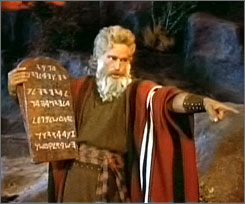
A person does not have to be religious to recognize the importance of the Ten Commandments on western civilization, literature and life. Even when one disregards their intrinsic merit, their literary significance remains. That said, it is important that those who consider themselves well educated should be acquainted with the message of this foundational document.

The statistics reveal a rather surprising picture. It turns out sixty percent of Americans cannot identify even half of the commandments. What I find stunning about that is the fact that since they are mostly prohibitions of destructive behavior, even the illiterate should be able to guess half of them. “Okay . . . we shouldn’t commit murder . . . steal from others . . . or lie about and slander others.” Pretty common sense, and we’re already over halfway there.

“Let’s see . . . the commandments are about God, so there’s probably one that says ‘worship the real God.’” Simple logic, and we’ve nearly arrived. Four out of the five and it wasn’t all that challenging. But how do we arrive at a fifth commandment? Here are two possible paths:

“Oh, doesn’t ‘religion’ believe that it’s sinful to cheat on your spouse . . . that’s probably on the list.”

or

“What’s that weird word the Bible uses about wanting stuff that belongs to others . . . oh yeah, ‘coverting’ or something like that . . . we’re not supposed to desire the possessions of others.”

Since our world has programmed us all with insatiable materialistic desires, it’s probably unlikely that someone would “guess” that coveting our neighbor’s property is wrong, so let’s substitute a more likely alternative.

“Christians get so worked up about swearing, especially when people curse using ‘God’ or ‘Jesus’ . . . so there’s probably something about that in the Ten Commandments.”

Congratulations, we’ve reached our goal of five.

As for the enumeration of the commandments—which varies among Jewish, Roman Catholic and Protestant communions—that’s a subject for another day.

Addendum:

Don’t forget the observance of this commandment which would transform our world: “Honor your father and mother” (this is the first commandment with a promise), “that it may go well with you and that you may live long in the land.”