Our Eagle Allies

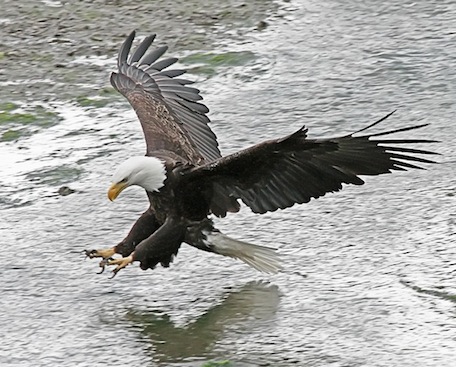
Eagles are majestic creatures. Living in the midst of a large bald eagle nesting area is something my wife and I don’t take for granted. Each year we see scores of the graceful raptors courting and then raising their young right here on Hood Canal.

Hood Canal is actually an 80 kilometer long fjord, which lies just to the east of the Olympic National Forest. It features deep blue waters at the foot of an impressive mountain range.

Eagles make a significant impression on nearly everyone fortunate enough to see them. Even though they are birds of prey, they look extremely noble. In light of that fact, it’s no accident many nations include an eagle as part of their coat of arms or national seal. These include: Albania, Armenia, Austria, Germany, Ghana, Iceland, Indonesia, Iraq, Mexico, Moldova, Montenegro, Nigeria, Panama, Russia, the United States and at least ten additional countries.

Eagles have also figured prominently in literature. For example, both of the preeminent Inklings, J.R.R. Tolkien and C.S. Lewis, featured eagles as heroes in their fictional classics.

Eagles in the Work of C.S. Lewis

Eagles are among those granted speech by Aslan at the dawn of Narnia’s creation. They reward their Creator’s gift by serving faithfully throughout the entire history of the land. Eagles play a role in virtually every battle that occurs in Narnia. They are always on the side of good.

In addition to fighting in the campaign against the White Witch, eagles are responsible for the rescue of Edmund from her camp. When Aslan calls his army to rush toward the climactic battle in The Lion, the Witch and the Wardrobe, he says:

And now! Those who can’t keep up—that is, children, dwarfs, and small animals—must ride on the backs of those who can—that is, lions, centaurs, unicorns, horses, giants and eagles. Those who are good with their noses must come in the front with us lions to smell out where the battle is.

The most noteworthy passages relate to Farsight, who is a prominent eagle during the final days of Narnia. He it is who brings to King Tirian the sad news that Narnia’s capital has fallen.

“Sire,” said the Eagle, “when you have heard my news you will be sorrier of my coming than of the greatest woe that ever befell you.” Tirian’s heart seemed to stop beating at these words, but he set his teeth and said, “Tell on.” “Two sights have I seen,” said Farsight. “One was Cair Paravel filled with dead Narnians and living Calormenes . . . And the other sight, five leagues nearer than Cair Paravel, was Roonwit the Centaur lying dead with a Calormene arrow in his side. I was with him in his last hour and he gave me this message to your Majesty: to remember that all worlds draw to an end and that noble death is a treasure which no one is too poor to buy.” “So,” said the King, after a long silence, “Narnia is no more.” (The Last Battle)

After this sad entrance, and following the “Last Battle,” Farsight is one of the leaders as the victor’s army enters into the foothills of heaven.

. . . the dogs barked, “Faster, faster!” So they ran faster and faster till it was more like flying than running, and even the Eagle overhead was going no faster than they. And they went through winding valley after winding valley and up the steep sides of hills and, faster than ever, down the other side, following the river and sometimes crossing it and skimming across mountain lakes as if they were living speedboats . . . “Further up and further in!” roared the Unicorn, and no one
held back. . . .

Only when they had reached the very top did they slow up; that was because they found themselves facing great golden gates. And for a moment none of them was bold enough to try if the gates would open. . . . “Dare we? Is it right? Can it be meant for us?” But while they were standing thus a great horn, wonderfully loud and sweet, blew from somewhere inside that walled garden and the gates swung open. (The Last Battle)

Eagles in the Work of J.R.R. Tolkien

Similar to Lewis’ distinction between dumb and speaking eagles, Tolkien distinguishes between “common” and Great Eagles. In The Hobbit he writes, “Eagles are not kindly birds. Some are cowardly and cruel. But the ancient race of the northern mountains were the greatest of all birds; they were proud and strong and noble-hearted.”

It is these noble mountain eagles who populate the six books (three volumes) of the Lord of the Rings and Tolkien’s other fiction.

At the end of the First Age, eagles fight alongside the Valar, Elves and Men in the War of Wrath. They especially contend against the dragons of Morgoth as recounted in The Silmarillion. The eagles emerge victorious, destroying most of their enemy during an aerial battle.

Near the end of the Third Age, the eagles from the Misty Mountains rescue Thorin’s troop from goblins and wargs, as related in The Hobbit. Without their aid, the Dwarves, Elves and Humans would likely have met defeat at the Battle of Five Armies.

In The Lord of the Rings (including the cinematic version) the eagles feature prominently. They are even capable of clashing head-to-head with the fearsome Nazgûl-mounted dragons.

And, of course, several of them rescued Frodo Baggins and Samwise Gamgee following the destruction of the One Ring.

Two named eagles should be mentioned. Thorondor was the initial Lord of Eagles and according to The Silmarillion was the “mightiest of all birds that have ever been.”

His descendant Gwaihir is the leader of those who aid Gandalf throughout the events of The Lord of the Rings. Not only does he rescue the wizard from the tower, but he returns him after his “resurrection” which followed the battle with the Balrog.

“Naked I was sent back—for a brief time, until my task is done. And naked I lay upon the mountain-top. . . . I was alone, forgotten, without escape upon the hard horn of the world. . . . And so at the last Gwaihir the Windlord found me again, and he took me up and bore me away. ‘Ever am I fated to be your burden, friend at need,’ I said.”

“A burden you have been,” the Eagle answered, “but not so now. Light as a swan’s feather in my claw you are. The Sun shines through you. Indeed I do not think you need me any more: were I to let you fall, you would float upon the wind.” (The Two Towers)

It may be that for this life we must remain content with seeing only the common and mute eagles that populate this mortal world. But even they, are glorious to behold.

The Dearest of Deer

Thank you, Lord, for allowing us to live in a home surrounded by a forest!

When I was driving home this afternoon I was stunned by the majestic flight of a dozen bald eagles as they danced in the sky above our small community of Seabeck, Washington. I pulled to the side of the road and enjoyed their ballet for some time before deciding that I would blog about eagles when I returned home.

Then I saw something even more precious. Just outside the window of my study a doe and her two (very) young fawns walked past. I grabbed my camera and snapped no fewer than fifty photos as they grazed on the nearby lawn. (I decided as they wandered on down another trail that the post on the eagles would wait.)

The fawns were so tiny I don’t think they could have been fourteen inches tall. (Sorry, we older Americans are still metric-impaired.) They stood as though they were still getting the feel of their tiny legs. It was a glorious scene.

C.S. Lewis graced the land of Narnia with a stunning array of creatures. Some are not found in this world, apart from myths. Unicorns and centaurs would be of that ilk.

I happen to find the others even more fascinating. The horses, dogs and bears that are familiar to us, but different. Different because they have been gifted with speech, and with it, the ability to know and follow their Maker.

As he wrote in his description of Narnia’s creation in The Magician’s Nephew:

And now, for the first time, the Lion [Aslan] was quite silent. He was going to and fro among the animals. And every now and then he would go up to two of them (always two at a time) and touch their noses with his. He would touch two beavers among all the beavers, two leopards among all the leopards, one stag and one deer among all the deer, and leave the rest. . . . The creatures whom he had touched came and stood in a wide circle around him. . . .

The Lion, whose eyes never blinked, stared at the animals as hard as if he was going to burn them up with his mere stare. And gradually a change came over them. The smaller ones—the rabbits, moles, and such-like—grew a good deal larger. The very big ones—you noticed it most with the elephants—grew a little smaller. Many animals sat up on their hind legs. Most put their heads on one side as if they were trying very hard to understand. The Lion opened his mouth, but no sound came from it; he was breathing out, a long, warm breath; it seemed to sway all the beasts as the wind sways a line of trees.

Far overhead from beyond the veil of blue sky which hid them the stars sang again; a pure, cold, difficult music. Then there came a swift flash like fire (but it burnt nobody) either from the sky or from the Lion itself, and every drop of blood tingled in the children’s bodies, and the deepest, wildest voice they had ever heard was saying: “Narnia, Narnia, Narnia, awake. Love. Think. Speak. Be walking trees. Be talking beasts. Be divine waters.”

The scene I was privileged to observe today reminded me of the innocence of nature, prior to humanity’s disobedience. It also reminded me of the Messianic promises that restored “nature” will enable lions to lie in harmony beside sheep.

In his book Miracles, Lewis discusses this from the perspective of redemption, as contrasted with simply understanding it as a consequence of a “new” creation.

The doctrine of a universal redemption spreading outwards from the redemption of Man, mythological as it will seem to modern minds, is in reality far more philosophical than any theory which holds that God, having once entered Nature, should leave her, and leave her substantially unchanged, or that the glorification of one creature [humanity] could be realised without the glorification of the whole system.

God never undoes anything but evil, never does good to undo it again. The union between God and Nature in the Person of Christ admits no divorce. He will not go out of Nature again and she must be glorified in all ways which this miraculous union demands. When spring comes it “leaves no corner of the land untouched;” even a pebble dropped in a pond sends circles to the margin.

I said a prayer this evening that the Lord would bless that lovely doe and her precious offspring with long, healthy, safe, peaceful, and even, happy lives.

Lessons Taught by Onions

This column has been written backwards. Not sdrawkcab literally, but in the opposite direction of its natural order. Usually I find something illuminating (most commonly in C.S. Lewis’ work), and then I offer some reflections on that insight. Occasionally, the post’s subject arises from a different source, and in my subsequent thoughts, I consciously consider what Lewis might have thought about the matter.

This is the first time when something utterly bizarre struck me as a valid starting point. And, only later did I find a suitable “proof text” or two from Lewis to validate discussing the odiferous subject at hand.

There’s a show I’ve been enjoying called “Parks and Recreation.” While I can’t recommend it to others, due to the casual portrayal of promiscuity which is endemic to American “entertainment.” Nevertheless, they often have quite witty writing that satirizes the crazy nature of life in our world today. This episode features a political debate between candidates for mayor of a small town.

One of the candidates responds to a question with, “No, I’m not a Vegan. I’m an Onionarian. I only eat onions and onion-based juices.”

I wonder how many other cultures can garb their dietary preferences in the robes of religious faith and devotion? Now, I love an onion more than the average person, but the notion of narrowing our diet down from God’s vast table to a single item just strikes me as a bit humorous (see Acts 10:9f).

As I enjoyed a chuckle, the thought flashed that I might relate this dialog for others who share my peculiar sense of humor . . . and I immediately wondered whether or not a Lewisian connection would be possible. Oh me of little faith. Lewis was so prolific that it doesn’t even require me to stretch.

You see, onions can teach us many lessons.

For example, look at this demonic advice offered by Screwtape to his protégé Wormword. He says Tempters should persuade human beings to care overly about what others think of them. The entire advertising world seems to be established on this principle. And how terribly vulnerable we are to this whisper. But, by the grace of God, it appears some are immune.

The man who truly and disinterestedly enjoys any one thing in the world, for its own sake, and without caring two pence what other people say about it, is by that very fact forearmed against some of our subtlest modes of attack. You should always try to make the patient abandon the people or food or books he really likes in favor of the “best” people, the “right” food, the “important” books. I have known a human defended from strong temptations to social ambition by a still stronger taste for tripe and onions. (C.S. Lewis, Screwtape Letters)

Thus we see that onions can, in some contexts, possess salvific influences. (Well, that might be pushing the lesson just a wee bit . . . but there is an important truth to be found in this epistle.)

Lewis’ arguably most famous discussion of onions is found in his discussion of concentric rings of secrecy, power, intimacy and knowledge described in his 1944 address entitled “The Inner Ring.” Rather than paraphrase his fine argument, I shall allow the following portions of his talk to speak eloquently for themselves.

Badly as I may have described it, I hope you will all have recognized the thing I am describing. Not, of course, that you have been in the Russian Army or perhaps in any army. But you have met the phenomenon of an Inner Ring. You discovered one in your house at school before the end of the first term. And when you had climbed up to somewhere near it by the end of your second year, perhaps you discovered that within the Ring there was a Ring yet more inner, which in its turn was the fringe of the great school Ring to which the house Rings were only satellites. It is even possible that the School Ring was almost in touch with a Masters’ Ring. You were beginning, in fact, to pierce through the skins of the onion. And here, too, at your university-shall I be wrong in assuming that at this very moment, invisible to me, there are several rings-independent systems or concentric rings-present in this room? And I can assure you that in whatever hospital, inn of court, diocese, school, business, or college you arrive after going down, you will find the Rings—what Tolstoy calls the second or unwritten systems. . . .

Of all the passions the passion for the Inner Ring is most skilful in making a man who is not yet a very bad man do very bad things. My second reason is this. The torture allotted to the Danaids in the classical underworld, that of attempting to fill sieves with water, is the symbol not of one vice but of all vices. It is the very mark of a perverse desire that it seeks what is not to be had. The desire to be inside the invisible line illustrates this rule. As long as you are governed by that desire you will never get what you want. You are trying to peel an onion: if you succeed there will be nothing left. Until you conquer the fear of being an outsider, an outsider you will remain. . . .

I must now make a distinction. I am not going to say that the existence of Inner Rings is an evil. It is certainly unavoidable. There must be confidential discussions: and it is not only not a bad thing, it is (in itself) a good thing, that personal friendship should grow up between those who work together. And it is perhaps impossible that the official hierarchy of any organization should quite coincide with its actual workings. If the wisest and most energetic people invariably held the highest posts, it might coincide; since they often do not, there must be people in high positions who are really deadweights and people in lower positions who are more important than their rank and seniority would lead you to suppose. In that way the second, unwritten system is bound to grow up. It is necessary; and perhaps it is not a necessary evil. But the desire which draws us into Inner Rings is another matter. A thing may be morally neutral and yet the desire for that thing may be dangerous.

While I have no doubt a number of other worthwhile onion-lessons are waiting to be found in the Inklings corpus, I would like to close now with my personal favorite. In the following passage, Lewis reverses the analogy, with each peeling away of a layer revealing ever more of reality.

In the closing paragraphs of the final Narnia Chronicle, The Last Battle, Lewis transforms the savory bulb into a metaphor for never ending epiphany.

[Lucy said:] “I see now. This garden is like the stable. It is far bigger inside than it was outside.”

“Of course, Daughter of Eve,” said the Faun. “The further up and the further in you go, the bigger everything gets. The inside is larger than the outside.”

Lucy looked hard at the garden and saw that it was not really a garden but a whole world, with its own rivers and woods and sea and mountains. But they were not strange: she knew them all.

“I see,” she said. “This is still Narnia, and more real and more beautiful than the Narnia down below, just as it was more real and more beautiful than the Narnia outside the stable door! I see . . . world within world, Narnia within Narnia. . . .”

“Yes,” said Mr. Tumnus, “like an onion: except that as you continue to go in and in, each circle is larger than the last.”

What a glorious description. And, like our Lord who elevated the humble mustard seed to literary immortality, Lewis has lifted the modest genus Allium, and secured for it a lasting place in English literature.

Generalizations (& Those Who Criticize Them)

“That’s the worst of girls,” said Edmund to Peter and the Dwarf. “They never can carry a map in their heads.”

“That’s because our heads have something inside them,” said Lucy. (C.S. Lewis, Prince Caspian).

It seems that if an author wishes to alienate vast swaths of readers today, they need do no more than “generalize.” Thus, C.S. Lewis has received unjust criticism due to some passages such as this.

To make a judgment such as Edmund’s leaves unmentioned the implied fact that there are, indeed, many useful things that are manifestly present in the heads of girls. But this example of difficulty in reading maps refers to a common perception . . . and if you’ve never heard it voiced before you read it here, you have led a shockingly sheltered life.

No one believes that there are no women capable of defeating even well-trained men in rigorous navigational competitions. Likewise, I have no doubt there are many gifted female cartographers. But please reseal the tar barrel and restuff the pillows; Lewis’ use of this dialog is not intended to be offensive!

I long for the days when a reader gave the writer the proverbial “benefit of the doubt.” A time when our assumption was that they meant something other than the meaning which offended us . . . or, at least, that they intended no malice.

I can’t speak for the rest of the world, but in most of the United States, such days of literary curtesy are long behind us. Today we often read things with an eye to finding the “problem” (ignorance, prejudice, or political viewpoint foreign to our own).

My wife and I attempted to raise our children with critical minds. (Critical in the best sense of the word.) We taught them that there are absolute truths. We informed them that, while people are entitled to hold to all sorts of notions and beliefs, that fact does not make the contending concepts “true.”

At the same time, we did our best to teach our children to respect others. To recognize that all human beings are created in the image of God. To understand that not even the basest man or woman is beyond redemption and restoration.

One practical element of this education in basic virtues took the shape of an adage we taught our kids. I’m sure others have advised this throughout history, and that many have voiced it far more eloquently, but we simply said: Judge everyone and everything by their best cases, rather than their worst.

In practice, this would mean that when a teenager compliments his dad on his wisdom, the dad does not immediately assume his prodigy is attempting to manipulate him. Now, further conversation and “investigation” may certainly prove that manipulation is indeed the goal, but it should not be the very first suspicion of the father.

As a pastor, one of your greatest challenges (and joys) comes in the pulpit. One major difficulty is discussing some extremely complex subjects in a relatively brief period of time. Pastors sometimes lapse into a sort of theological shorthand—which can be confusing or troubling to those unfamiliar with the underlying presuppositions. Taken out of context, individual statements may sound strange, or even heterodox.

I have always encouraged the members of my congregations and (especially) visitors to specifically ask me about what was meant by any statement or phrase that left them uneasy. It is no exaggeration to say that 98% of the time, that has cleared the air in and of itself, as I’ve had an opportunity to elaborate and clarify. (Of course, the other 2% of the occasions constitute a second pastoral “joy.”)

It saddens me when I hear people berate C.S. Lewis for a handful of passages that critics deem to be misogynistic or racist. They fail to extend toward him the goodwill he strove to offer to others. Most of these very few passages can simply be explained by the age in which he lived. It is disingenuous to judge by today’s standards someone who died a half century ago.

Like Lewis’ peers (and, in fact, all human beings), on occasion Lewis himself generalized. Let those who have never done the same cast the first stone. I confess that I’m guilty of it. In fact, returning to the quotation with which we began, I could most definitely echo Edmund’s words in reference to my wife. Ironically, they would be utterly inaccurate in reference to my daughter. For many years she was my “official navigator” as our family often drove across country (relying upon those seven foot by seven foot paper maps that are nearly impossible to refold.)

So, in my own nuclear family I’m batting .500 in terms of the accuracy of this generalization. The next generation may decide. Four of my six grandchildren are girls, and since the oldest girl just turned five, it’s about time to set them out in the woods with a map and a compass to see how they do!

Beware Your Personal Dragon

Readers of C.S. Lewis possess differing opinions on the film adaptations of the Chronicles of Narnia. One element from the latest film that is presented quite faithfully, is Eustace’s transformation into a dragon.

“He had turned into a dragon while he was asleep. Sleeping on a dragon’s hoard with greedy, dragonish thoughts in his heart, he had become a dragon himself.” (Voyage of the Dawn Treader).

With his brilliant insight and typical mirth, Lewis reveals for us a powerful dynamic of human existence. Two, in fact.

First, what we are inside—our genuine essence or spirit—will ultimately be revealed. This is true for most of us during this life. And, it will be experienced by all humanity as we stand before our Creator.

Second, what we desire—the longings upon which we focus our hearts and energies—shape that very essence. In a sense, Lewis is saying, we become what we covet!

What a wonderful lesson for us. It resounds with echoes of the Scriptures.

The title of this column suggests that we beware of the dragons to which we are particularly vulnerable. They vary from person to person, of course. And, they frequently shift, dependent on our biological age circumstances.

Martin Luther alludes to this in his broader comments about temptation and spiritual maturity:

To feel temptation is therefore a far different thing from consenting or yielding to it. We must all feel it, although not all in the same manner, but some in a greater degree and more severely than others; as, the young suffer especially from the flesh, afterwards, they that attain to middle life and old age, from the world, but others who are occupied with spiritual matters, that is, strong Christians, from the devil. But such feeling, as long as it is against our will and we would rather be rid of it, can harm no one. For if we did not feel it, it could not be called a temptation. But to consent thereto is when we give it the reins and do not resist or pray against it. (Luther’s Large Catechism).

Lewis reveals vividly what becomes of us when we surrender to our dragons. It’s not a pretty sight. And, sometimes it’s terminal. It would have been so, in Eustace’s own case, had not Aslan come to him with his healing grace

And so it is with us. No matter how dragonish you and I have grown, we can be healed of the affliction by the same Aslan, who is known in our world by a different name . . . Yeshua (Jesus).