
Reading is not only one of life’s pleasures, the content and ethos of what we read, subtly influences the shape of our very lives.
C.S. Lewis loved books with genuine passion. While many people only perceive books as compilations of information or as sources of fleeting entertainment, he knew them as far more. Only someone sharing Lewis’ affection and wisdom will identify with the following passage from his essay “An Experiment in Criticism.”
The man who is contented to be only himself, and therefore less a self, is in prison. My own eyes are not enough for me, I will see through those of others. Reality, even seen through the eyes of many, is not enough. I will see what others have invented. . . .
Literary experience heals the wound, without undermining the privilege, of individuality. There are mass emotions which heal the wound; but they destroy the privilege. In them our separate selves are pooled and we sink back into sub-individuality.
But in reading great literature I become a thousand men and yet remain myself. Like the night sky in the Greek poem, I see with a myriad eyes, but it is still I who see. Here, as in worship, in love, in moral action, and in knowing, I transcend myself; and am never more myself than when I do.
Lewis scholar and emeritus professor of English, Dale J. Nelson, has been providing a wonderful service in recent years as he explores the books which found a place in C.S. Lewis’ personal library. “Jack and the Bookshelf” is a continuing series which appears in CSL, journal of the New York C.S. Lewis Society. Founded in 1969, the organization “is the oldest society for the appreciation and discussion of C.S. Lewis in the world.”
Nelson’s task of editorially archiving C.S. Lewis’ library is complemented by the work of our mutual friend, Dr. Brenton Dickieson. In a “comment” praising Dickieson’s compilation of “C.S. Lewis’ Teenage Bookshelf,” Nelson offers a commendation with which I fully concur.
Thank you for assembling that list of books . . . I’d encourage Lewis’s admirers to take their appreciation of CSL to the next step and delve into the things he liked to read throughout his life.
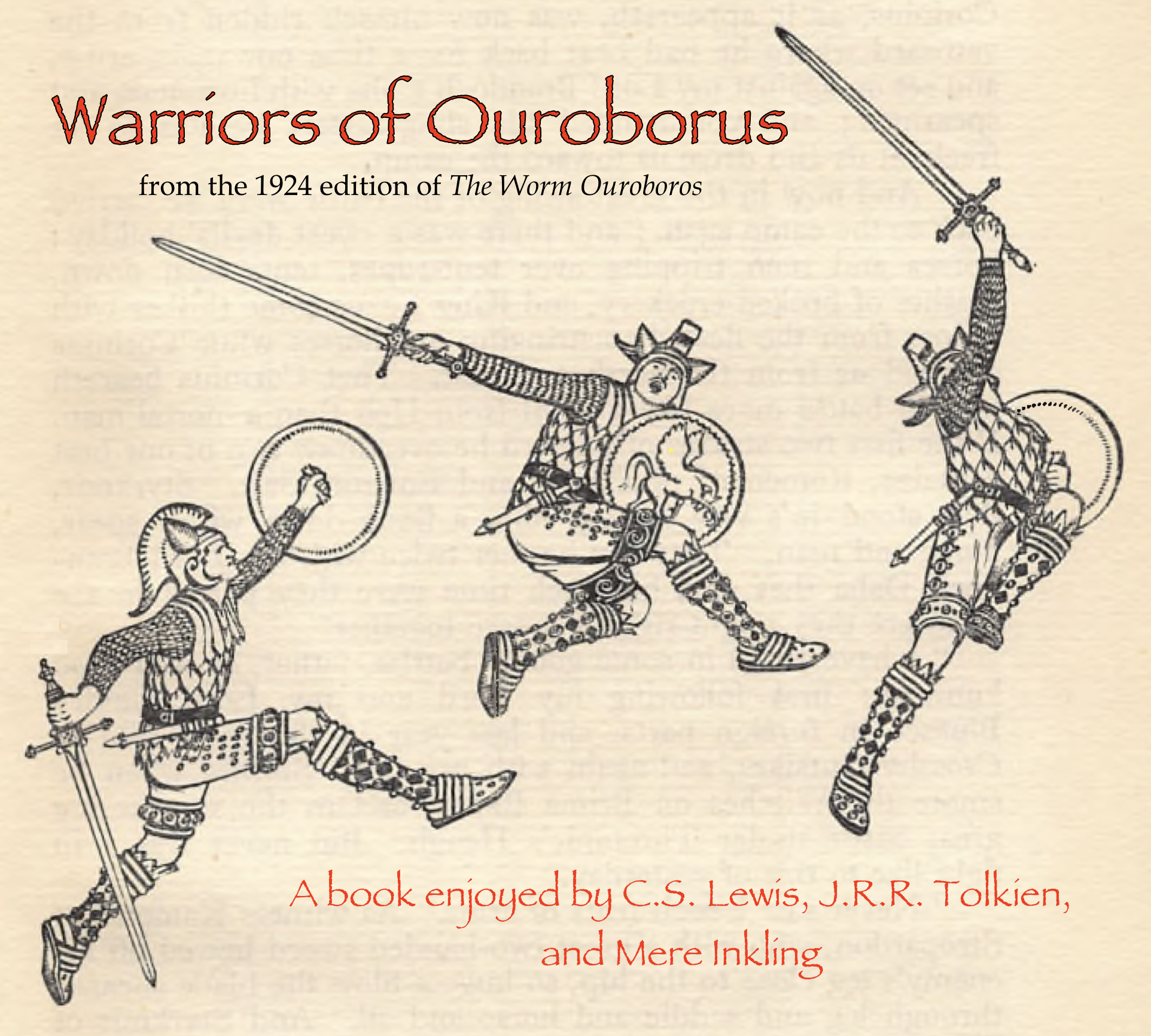
Nelson’s contribution to the December 2023 issue is the fifty-ninth in his series, and discusses a fantasy work titled The Worm Ouroboros by E.R. Eddison. Eddison (1882-1945) was a Norse scholar, and his fascination with mountains combined with that, to resonate with Lewis’ passion for northernness.
Dr. Nelson, who has added an array of science fiction to his own academic work, possesses superb credentials for exploring the connection between Lewis and Eddison.
Nelson relates that, at C.S. Lewis’ invitation, Eddison attended two gatherings of the Inklings. At the second, Eddison – who relished critiques of his works in progress, as do many serious writers – read from a project which would not be published due to his death the following year.
Eddison’s themes more closely resembled J.R.R. Tolkien’s than Lewis’ own. In Nelson’s words, both “Tolkien and Eddison wrote masterpieces of heroic fantasy whose values differed markedly.”
Another distinction is that while Tolkien’s Lord of the Rings has maintained its mythic rigor, Eddison’s oeuvre feels rather anchored to the formative years of the genre, prior to the so-called Golden Age of science fiction (and fantasy).
If you would like to read this book, which was enjoyed by both Lewis and Tolkien, you can download a copy of it at Internet Archive. If you enjoy dwarves, goblins, manticores and hippogriffs, you are unlikely to be disappointed.
 Mere Inkling Press
I enjoyed reading this, thanks for sharing!
I loved this quote, “Here, as in worship, in love, in moral action, and in knowing, I transcend myself; and am never more myself than when I do.”
Transcending our earthbound, fallen nature certainly does introduce us to the true “us,” the person God created us to be and who we will again be when we are with the Lord in heaven.
Interesting and informative.
(\ /)
( . .)
c(“)(“)
Happy Easter!
And you enjoy a joyous celebration of Christ’s resurrection as well!
Thank you for the compliments! But I will take up your use of “golden age” to apply to a period after publication of Eddison’s great romance in the 1920s. If one wants to focus specifically on science fiction, well, OK, it’s common to refer to a period around 1940 as the Golden Age of SF — thanks largely to John Campbell as editor of Astounding and the activity of Heinlein, Asimov, &c. at that time.
But I advocate that 1887-1912 be the 25-year period that deserves to be called the Golden Age of Fantasy — at a time when fantasy, science fiction, and the supernatural horror genres (as they became) might all be regarded as fantasy. This was the period when CSL and Tolkien were young readers and absorbing influences, of course.
Here’s what I wrote for an online forum…
I would seriously nominate 1887-1912 as the Golden Age of Fantasy and Science Fiction — although I wouldn’t say that my very favorite works appeared in those 25 years.
But in that quarter-century you have everything from Haggard’s She at one end to Conan Doyle’s Lost World at the other. In 1887-1912, among other things, you have H. G. Wells’s best (The War of the Worlds, The Time Machine, various short stories); Dunsany’s major short stories (though I’m not the Dunsany fan I used to be — but he was influential — “The Hoard of the Gibbelins” even influenced Tolkien); all of William Morris or at least all of the great works (The Well at the World’s End, The Wood Beyond the World, The Water of the Wondrous Isles); all of William Hope Hodgson (The House on the Borderland, The Night Land, etc.); notable stories by Arthur Machen and Algernon Blackwood; Yeats’s faerie poetry; George MacDonald’s magnificent Lilith; and odd gems like Lucy Lane Clifford’s “The New Mother.” The period includes more:The Wind in the Willows. Poems by Walter de la Mare. Many of Kipling’s most notable weird stories. Many more still-enjoyable romances (not just She) by Rider Haggard. For the Edgar Rice Burroughs fans, Under the Moons of Mars and the magazine serialization of Tarzan of the Apes. You also have the best of Sherlock Holmes!—-
My thought is that this really is the Golden Age, because it doesn’t just contain so many works that I like, but it contains so many works that embody what we seek in fantasy and science fiction (and, if you read dark fantasy, Dracula falls in this period, by the way, and M. R. James’s Ghost Stories of an Antiquary, and Henry James’s The Turn of the Screw). Wells has an importance, as a pioneer, for sf, that I would suggest no one else can have. And at the same time that he is writing sf, you have William Morris and George MacDonald for fantasy. It’s not just that they are early explorers of the form, but that they are so amazingly good at it.
And there was so much! Imagine being a youngster of 12 or so and reading She when it appeared in 1887. For year after year as you continue reading fantasy and science fiction, works that would turn out to be classics appear.
Very informative, Dale. The distinction between science fiction and fantasy during this formative years is quite important.
I think I may start referring to the period of Eddison’s work as the “Stone Age,” or perhaps the “Bronze Age” of the genre.
One could argue for the “Golden Age” of 1887-1912 and then for 1930-1956 as The Inklings Era, covering about the same number of years, from the publication of Williams’s War in Heaven to the publication of The Last Battle and Till We Have Faces. ”The Golden age of Science Fiction” will remain that Campbell-Asimov-Heinlein period, I trust.
By the way, the Tolkien newsletter Beyond Bree should be starting, with the April issue, an Inklings Century series by me and David Llewellyn Dodds, a short century from 1886-1973, from the birth of Charles Williams to the deaths of Tolkien and W. H. Lewis. The idea is to entertain and, perhaps, give some insights into accomplishments, by giving some social history and interesting factoids. The entries are written in a non-academic way. Seven columns have been written so far, which should take us through October — assuming they all are published. I’ll send you a sample by email, Rob.
Thank you for the columns, Dale. They should make for some pleasurable and edifying reading on Easter Monday.
Hi Rob,
I will check it out. So many good books but so little time.
Thanks, Gary
Gary Avants Forbear Productions * *garyavants66@gmail.com garyavants66@gmail.com
The number of worthy “reads” certainly exceeds the available time.
But, from my experience, this sort of “primitive” science fiction doesn’t demand too much from its readers. At least give it a quick look.
You bet.
I’m not sure why I’ve ignored Eddison’s novel though it has been on my bookshelf for many a year and the title such a stand-out, but no longer! It’s fascinating to read what the authors we most admire read and admired.
I’m looking forward to hearing what you think of it. Of course, pulp era science fiction possesses a unique flavor of its own. It’s not very similar to your own elegant writing, Dora.
The best compliments are unsought, so thank you, Rob! My husband’s collection of sci-fi from that period introduced me to its singular glories. At the very least, Eddison’s tale will be familiar.
Ah, I didn’t know you already had this genre orbiting around your home. (I thought you might have come across Eddison due to the C.S. Lewis link.)
You are a font of knowledge about CS Lewis. :)
I do now a “few” things… but most of it is attributable to a sizable Lewisian library, combined with my enthusiasm for sharing wisdom from C.S. Lewis’ life.