

Mensa & C.S. Lewis

crossword puzzleSeveral decades ago, I worked with a Roman Catholic priest, who just happened to be a member of Mensa.

We were good friends, a relationship reinforced by the fact that our bigoted boss thought that both our eternal destinies were in definite jeopardy . . . Pete’s because he was “Catholic,” and mine because Lutherans are “almost Catholic.”

Well, Pete and I got along quite well, although there were two issues we never could resolve. The first was that he smoked large, smelly stogies. Yes, this was long enough ago that you were still allowed to smoke in government buildings.

Even when the rest of the staff successfully begged him to stop parading the halls with his billowing cigars, my friend continued to fill his own office with clouds that would billow out whenever the door was opened.* I had great sympathy for the lungs of the Roman Catholic laity who entered his smoking lounge for counseling.

Aside from the tobacco, there was only a single matter we really disagreed on.

As I mentioned above, Father Pete was a member of Mensa. That’s commendable, in itself. The problem is that he always left his Mensa magazines lying (alone) on the coffee table in the center of his office. He would only smile in a patronizing way when I would (repeatedly) warn him that there could be only two consequences of such brazen self-aggrandizement.

“The first,” I said, “is that they won’t know what Mensa is . . .  and your braggadocio is wasted. The second is worse. They might know what the magazine represents and think to themselves, my, our priest is rather full of himself.” **

At any rate, I have no misconception that I could pass Mensa’s muster. My brain, adequate as it is, simply doesn’t work the way that I guess those of genius’ do. A perfect example of that truth was displayed just a few moments ago, as I read through a few pages of a 2010 Mensa Puzzle Calendar I found among my father’s papers.

I have no doubt that some of you will easily solve this puzzle, but I have to be honest—I missed answering it by a mile.

What do all the words below have in common?

Environment

Bedcovers

Responsibility

Outsource

Confederacy

Slugfest

Jihad

Nunavut

I actually had to look one of the words up. It turns out that “bedcovers” means a bedspread, or anything else one uses to cover a bed. No, seriously, I re-learned that Nunavut is a territory in northern Canada, but I imagine all of you knew that.

Okay, have you taken the time to try to determine what the words have in common? Easy, right?

It turns out that each of them contains a three-letter sequence of adjacent letters in the alphabet, going in reverse. For example, the gfe in “slugfest.”

I doubt I would have been able to figure it out, even if I understood the question, but I must admit my utter ignorance in not even reading the question properly!

I was so enamored by this eclectic collection of words—superficial links between the three combative terms leapt out at me—that I was distracted by seeking bonds between the meanings of the words, rather than in the words themselves. (And, I suspect that may be precisely what those inscrutable devils at Mensa Headquarters intended for simpletons like me.)

Alas, it will take a few days for my bruised ego to rebound. Fortunately, since my memory isn’t as keen as it used to be, I may forget all about this humiliation before the week is out.

C.S. Lewis was a brilliant man. I believe he was a genius. I imagine he could have solved this word puzzle with three-quarters of his mind occupied by higher matters, like watching a wary hedgehog scurry between bushes.

Lewis recognized that our minds are, in fact, a gift from God, to be exercised and celebrated. But, at the same time, he knew better than most the dangers of seeking ultimate meaning in mental pursuits that erect nearly impervious walls to God’s gracious revelation of his love in his only begotten Son.

In The Weight of Glory Lewis explains how those Christians who are blessed with exceptional intelligence owe a duty to their sisters and brothers in the faith. (This, of course, has nothing to do with the subject of holiness or spiritual maturity; there is little or no correlation between piety and intellect.) What he says is, however, worthy of our reflection.

If all the world were Christian, it might not matter if all the world were uneducated. But, as it is, a cultural life will exist outside the Church whether it exists inside or not. To be ignorant and simple now—not to be able to meet enemies on their own ground—would be to throw down our weapons, and to betray our uneducated brethren who have, under God, no defence but us against the intellectual attacks of the heathen.

Good philosophy must exist, if for no other reason, because bad philosophy needs to be answered. The cool intellect must work not only against cool intellect on the other side, but against the muddy heathen mysticisms which deny intellect altogether. Most of all, perhaps, we need intimate knowledge of the past. Not that the past has any magic about it, but because we cannot study the future, and yet need something to set against the present, to remind us that the basic assumptions have been quite different in different periods and that much which seems certain to the uneducated is merely temporary fashion.

A man who has lived in many places is not likely to be deceived by the local errors of his native village: the scholar has lived in many times and is therefore in some degree immune from the great cataract of nonsense that pours from the press and the microphone of his own age. The learned life then is, for some, a duty.

So, let this be a reminder to those of you who qualify for membership in the aforementioned society, but still love Jesus despite your vast intellects. After all, as Jesus once said, from “everyone to whom much was given . . . much will be required” (Luke 12:48, ESV).

_____

* I must confess this is a slight exaggeration, lest I be held accountable for breaking the eighth commandment (or the ninth, if you are Jewish or a Christian of the Reformed persuasion).

** This might not be a verbatim account of the way I said it, although I’m pretty confident that I did use the word “braggadocio.”
Sinister Initiations

fumieSomething unbelievable just happened in America. Something offensive, abusive, and utterly intolerant.

At Florida Atlantic University, one of the professors taught a lesson so distasteful that, had it maligned any faith other than Christianity, it would have led to his dismissal. Instead, the student who challenged it was suspended from the course.

The class is entitled “Intercultural Communication,” and the instructor happens to be the county vice-chair of one America’s major political parties.

So, what was the malicious class exercise? The students were instructed to write the name “Jesus” in large letters on a piece of paper which they laid on the floor in front of them. Then, they were directed to stomp—yes, stomp—on the name of the person millions of people throughout the world regard as their Savior.

It’s difficult to comprehend anyone would design such an offensive “lesson,” let alone that they would actually attempt to implement it. And, since lessons are created to teach someone, one wonders precisely what Deandre Poole wanted his students to learn by encouraging their blasphemy . . .

C.S. Lewis would not be surprised by this event. He foresaw precisely where the wholesale rejection of God within academia would lead. There is a passage in his book That Hideous Strength that seems almost prescient. In this scene the protagonist, a sociology professor named Mark Studdock, is being initiated into an elite and secretive inner circle at the Institute where he has come to work. The organization has global plans and great influence. Studdock is a confirmed agnostic, yet he is disturbed by something his mentors describe as a “minor” portion of the initiation process.

Meanwhile, in the Objective Room [where candidates are taught to think properly], something like a crisis had developed between Mark and Professor Frost. As soon as they arrived there Mark saw that the table had been drawn back. On the floor lay a large crucifix, almost life size, a work of art in the Spanish tradition, ghastly and realistic.

“We have half an hour to pursue our exercises,” said Frost looking at his watch. Then he instructed Mark to trample on it and insult it in other ways.

Now whereas Jane had abandoned Christianity in early childhood, along with her belief in fairies and Santa Claus, Mark had never believed in it at all.

At this moment, therefore, it crossed his mind for the very first time that there might conceivably be something in it. Frost who was watching him carefully knew perfectly well that this might be the result of the present experiment. He knew it for the very good reason that [he had briefly experienced, and dismissed, the same thought during his own initiation].

“But, look here,” said Mark.

“What is it?” said Frost. “Pray be quick. We have only a limited time at our disposal.”

“This,” said Mark, pointing with an undefined reluctance to the horrible white figure on the cross. “This is all surely a pure superstition.”

“Well?”

“Well, if so, what is there objective about stamping on the face? Isn’t it just as subjective to spit on a thing like this as to worship it? I mean— damn it all— if it’s only a bit of wood, why do anything about it?”

“That is superficial. If you had been brought up in a non-Christian society, you would not be asked to do this. Of course, it is a superstition; but it is that particular superstition which has pressed upon our society for a great many centuries. It can be experimentally shown that it still forms a dominant system in the subconscious of many individuals whose conscious thought appears to be wholly liberated. An explicit action in the reverse direction is therefore a necessary step towards complete objectivity. It is not a question for a priori discussion. We find it in practice that it cannot be dispensed with.”

The parallels are evident. I can readily imagine Dr. Poole justifying his own exercise in similar language. However, that something like this could happen in a civilized land is sobering indeed.

This incident reminded me of powerful scene in the book and miniseries Shogun. [Appended below.]

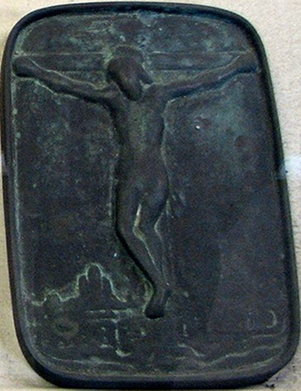
Christianity had been embraced by a number of provinces early in Japan’s history, but the rising ruler had vowed to extinguish it. The Shogun required that samurai suspected of being “Kirishitan” prove they were not by stepping on holy images of Christ or Mary. The Christians (all Roman Catholic in the seventeenth century) would not abuse holy images and were arrested on the spot. Fumi-e were images created for the sole purpose of desecrating, and some examples (like the tile shown above) have survived to this day.

If the individual failed to recant their faith in Jesus, they would be tortured and ultimately martyred. As recently as 2008, the Roman Catholic Church beatified a new group of 188 Japanese Christians. They joined 45 saints and 395 previously beatified martyrs. They represent only a small segment of the estimated 35,000 believers who accepted death rather than denying their Lord.

The newly beatified include 183 lay people, four priests and one monk. The laity included thirty samurai warriors, as well as farmers, artisans, civil servants, teachers, painters, writers, former slaves, pregnant women and even children as young as three.

If Dr. Poole was historically-informed, he would recognize that the odious ritual he thrust upon his vulnerable students carried a significant deal of baggage. And that’s not to mention the direct affront it poses to those who believe Jesus’ claim that he “is the way, the truth, and the life.” Ultimately, all people of goodwill—believers and atheists alike—will find his behavior repugnant.

Excerpt from Shogun:

In James Clavell’s book, it is the English protagonist who ironically desires to weed the [Roman Catholic] Christians out of his samurai contingent. (Their loyalties rest in a cause other than his own.)

. . .

“Can’t it wait until tomorrow?”

“No, Sire, so sorry.” Uraga was looking up at him in front of the assembled samurai vassals, the Dutch crew gathering into a nervous knot near the quarterdeck railing. “Please excuse me, but it is most important you find out at once. You are their most enemy. Therefore you must know, for your protection. I only wish to protect you. Not take long, neh?”

“Are they all on deck?”

“Yes, Sire.”

Blackthorne went closer to the railing and called out in Japanese, “Is anyone Christian?” There was no answer. “I order any Christian come forward.” No one moved. So he turned back to Uraga. “Set ten deck guards, then dismiss them.”

“With your permission, Anjin-san.” From under his kimono Uraga brought out a small painted icon that he had brought from Yedo and threw it face upward on the deck. Then, deliberately, he stamped on it. Blackthorne and the crew were greatly disquieted by the desecration. Except Jan Roper. “Please. Make every vassal do same,” Uraga said.

“Why?”

“I know Christians.” Uraga’s eyes were half hidden by the brim of his hat. “Please, Sire. Important every man do same. Now, tonight.”

“All right,” Blackthorne agreed reluctantly.

Uraga turned to the assembled vassals. “At my suggestion our Master requires each of us to do this.”

The samurai were grumbling among themselves and one interrupted, “We’ve already said that we’re not Christians, neh? What does stamping on a barbarian god picture prove? Nothing!”

“Christians are our Master’s enemy. Christians are treacherous—but Christians are Christian. Please excuse me, I know Christians—to my shame I forsook our real gods. So sorry, but I believe this is necessary for our Master’s safety.”

At once a samurai in front declared, “In that case, there’s nothing more to be said.” He came forward and stamped on the picture. “I worship no barbarian religion! Come on, the rest of you, do what’s asked!”

They came forward one by one. Blackthorne watched, despising the ceremony.

Van Nekk said worriedly, “Doesn’t seem right.”

Vinck looked up at the quarterdeck. “Sodding bastards. They’ll all cut our throats with never a thought. You sure you can trust ’em, Pilot?”

“Yes.”

Ginsel said, “No Catholic’d ever do that, eh, Johann? That Uraga-sama’s clever.”

“What’s it matter if those buggers’re Papist or not, they’re all . . . samurai.”

“Yes,” Croocq said.

“Even so, it’s not right to do that,” van Nekk repeated.

The samurai continued to stamp the icon into the deck one by one, and moved into loose groups. It was a tedious affair and Blackthorne was sorry he had agreed to it, for there were more important things to do before dusk. His eyes went to the village and the headlands. Hundreds of the thatch lean-tos of the Musket Regiment camp spotted the foothills. So much to do, he thought, anxious to go ashore, wanting to see the land, glorying in the fief Toranaga had given him which contained Yokohama. Lord God on high, he told himself, I’m lord of one of the greatest harbors in the world.

Abruptly a man bypassed the icon, tore out his sword, and leaped at Blackthorne. A dozen startled samurai jumped courageously in his way, screening the quarterdeck as Blackthorne spun around, a pistol cocked and aimed. Others scattered, shoving, stumbling, milling in the uproar. The samurai skidded to a halt, howling with rage, then changed direction and hacked at Uraga, who somehow managed to avoid the thrust. The man whirled as other samurai lunged at him, fought them off ferociously for a moment, then rushed for the side and threw himself overboard.

Four who could swim dropped their killing swords, put their short stabbing knives in their mouths, and jumped after him, the rest and the Dutchmen crowding the side.

Blackthorne jumped for the gunwale. He could see nothing below; then he caught sight of swirling shadows in the water. A man came up for air and went down again. Soon four heads surfaced. Between them was the corpse, a knife in his throat.

“So sorry, Anjin-san, it was his own knife,” one called up over the roars of the others.

“Uraga-san, tell them to search him, then leave him to the fish.”

The search revealed nothing. When all were back on deck, Blackthorne pointed at the icon with his cocked pistol. “All samurai-once more!” He was obeyed instantly and he made sure that every man passed the test.

Then, because of Uraga, and to praise him, he ordered his crew to do the same.