
Why War?

bulletsI recently read a profound statement penned by G.K. Chesterton. Although he was not a military veteran himself, he was absolutely on target when he wrote: “The true soldier fights not because he hates what is in front of him, but because he loves what is behind him.”

Terrible things are happening today in Syria. Yesterday, over lunch, I “debated” one of my sons regarding the merits (and drawbacks) of American intervention in that Levantine cauldron.

He believes we can’t “stand by” while the world watches as a civil war rages around another of the world’s mad dictators. I argued the United States isn’t morally responsible to serve as the world’s guardian of peace. And, even if we as a single, fallible, divided people were accountable . . . what about the violence and injustice in so very many other places. Sudan, Myanmar (Burma), the Congo, and scores of other lands cry out for intervention on behalf of the oppressed.

There is an almost unlimited amount of injustice around the globe today. And, looking in the mirror, it’s evident we have problems to resolve right here.

Sending American troops to intervene in foreign civil wars is ugly business. Taking sides against dictators does not always provide a safer and more just world—we need look no further than the so-called Arab Spring to reveal that.

I was proud to serve my nation—and causes I believed in—during the liberation of Kuwait and the retaliation for the September 11 attacks on the United States a decade later.

I am now retired from active duty, and I’ve lived long enough to witness how little positive fruit seems to follow war.

Like C.S. Lewis, I remain persuaded that some evils are so malevolent (Hitler, for example, comes to mind) . . . that they must be confronted. As he wrote in “The Conditions for a Just War,”

If war is ever lawful, then peace is sometimes sinful.

At the same time, however, war is something into which we should never rush. It demands our conscious consideration of the cost and an accurate determination that the blood spilled—include that of noncombatants inevitably caught up in the horror—is a price worth paying.

It is that question which moral men and women must debate and ponder.

“Learning in War-Time” is a brilliant essay included in the collection which goes by the name of Lewis’ speech, “The Weight of Glory.” In the essay, Lewis discusses the seriousness of war. As a combat casualty during the First World War, he vividly understood its nature.

However, as a Christian, Lewis recognized that warfare is not the worst thing that can befall a human being.

What does war do to death? It certainly does not make it more frequent: 100 percent of us die, and the percentage cannot be increased. It puts several deaths earlier, but I hardly suppose that that is what we fear. Certainly when the moment comes, it will make little difference how many years we have behind us.

Does it increase our chances of painful death? I doubt it. As far as I can find out, what we call natural death is usually preceded by suffering, and a battlefield is one of the very few places where one has a reasonable prospect of dying with no pain at all.

Does it decrease our chances of dying at peace with God? I cannot believe it. If active service does not persuade a man to prepare for death, what conceivable concatenation of circumstances would? Yet war does do something to death. It forces us to remember it.

True. To die at enmity with God is a fearful thing. Still, even better than coming to faith during war (Lewis would surely agree), is recognizing God’s love and living a life of peace.
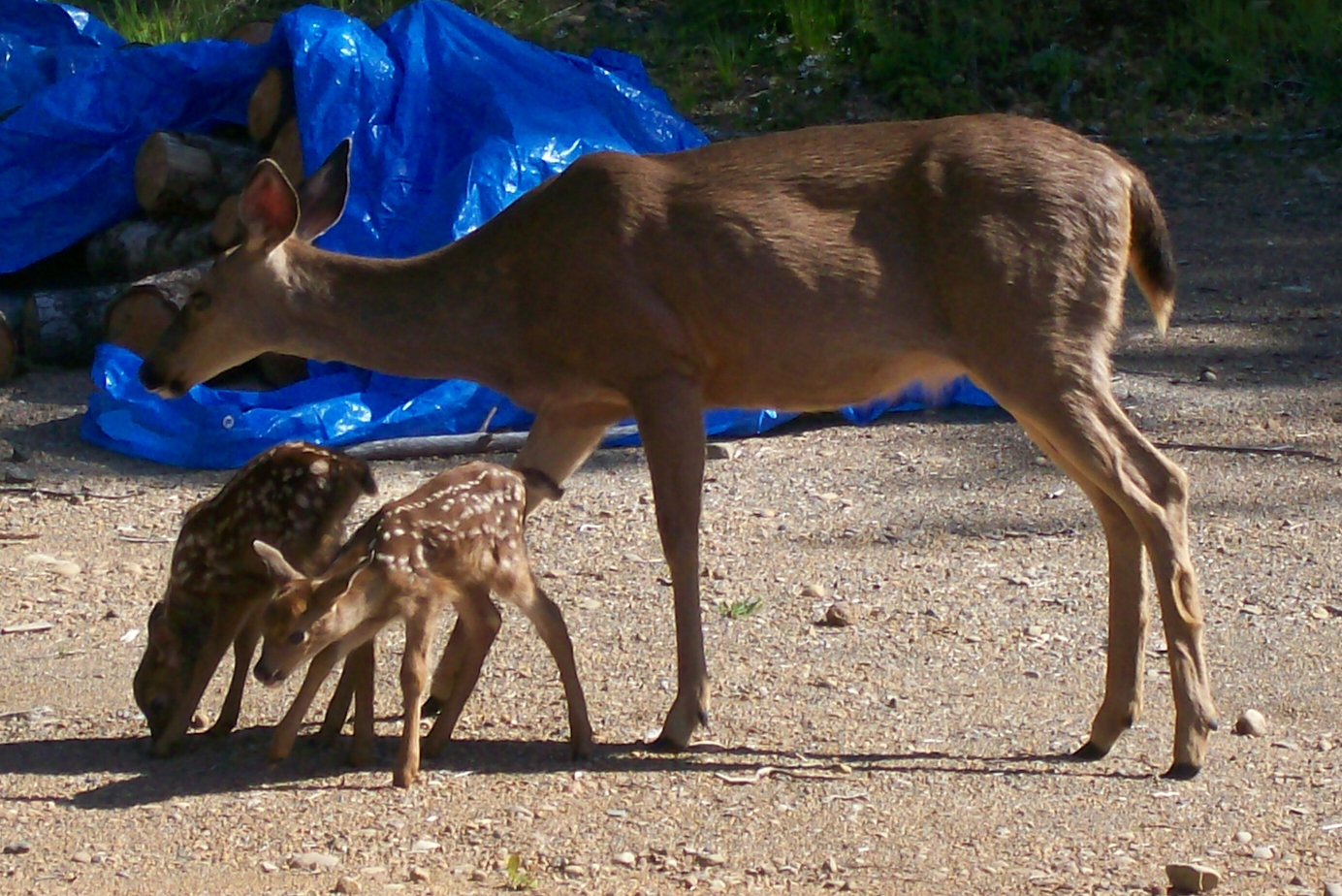
The Dearest of Deer

Thank you, Lord, for allowing us to live in a home surrounded by a forest!

When I was driving home this afternoon I was stunned by the majestic flight of a dozen bald eagles as they danced in the sky above our small community of Seabeck, Washington. I pulled to the side of the road and enjoyed their ballet for some time before deciding that I would blog about eagles when I returned home.

Then I saw something even more precious. Just outside the window of my study a doe and her two (very) young fawns walked past. I grabbed my camera and snapped no fewer than fifty photos as they grazed on the nearby lawn. (I decided as they wandered on down another trail that the post on the eagles would wait.)

The fawns were so tiny I don’t think they could have been fourteen inches tall. (Sorry, we older Americans are still metric-impaired.) They stood as though they were still getting the feel of their tiny legs. It was a glorious scene.

C.S. Lewis graced the land of Narnia with a stunning array of creatures. Some are not found in this world, apart from myths. Unicorns and centaurs would be of that ilk.

I happen to find the others even more fascinating. The horses, dogs and bears that are familiar to us, but different. Different because they have been gifted with speech, and with it, the ability to know and follow their Maker.

As he wrote in his description of Narnia’s creation in The Magician’s Nephew:

And now, for the first time, the Lion [Aslan] was quite silent. He was going to and fro among the animals. And every now and then he would go up to two of them (always two at a time) and touch their noses with his. He would touch two beavers among all the beavers, two leopards among all the leopards, one stag and one deer among all the deer, and leave the rest. . . . The creatures whom he had touched came and stood in a wide circle around him. . . .

The Lion, whose eyes never blinked, stared at the animals as hard as if he was going to burn them up with his mere stare. And gradually a change came over them. The smaller ones—the rabbits, moles, and such-like—grew a good deal larger. The very big ones—you noticed it most with the elephants—grew a little smaller. Many animals sat up on their hind legs. Most put their heads on one side as if they were trying very hard to understand. The Lion opened his mouth, but no sound came from it; he was breathing out, a long, warm breath; it seemed to sway all the beasts as the wind sways a line of trees.

Far overhead from beyond the veil of blue sky which hid them the stars sang again; a pure, cold, difficult music. Then there came a swift flash like fire (but it burnt nobody) either from the sky or from the Lion itself, and every drop of blood tingled in the children’s bodies, and the deepest, wildest voice they had ever heard was saying: “Narnia, Narnia, Narnia, awake. Love. Think. Speak. Be walking trees. Be talking beasts. Be divine waters.”

The scene I was privileged to observe today reminded me of the innocence of nature, prior to humanity’s disobedience. It also reminded me of the Messianic promises that restored “nature” will enable lions to lie in harmony beside sheep.

In his book Miracles, Lewis discusses this from the perspective of redemption, as contrasted with simply understanding it as a consequence of a “new” creation.

The doctrine of a universal redemption spreading outwards from the redemption of Man, mythological as it will seem to modern minds, is in reality far more philosophical than any theory which holds that God, having once entered Nature, should leave her, and leave her substantially unchanged, or that the glorification of one creature [humanity] could be realised without the glorification of the whole system.

God never undoes anything but evil, never does good to undo it again. The union between God and Nature in the Person of Christ admits no divorce. He will not go out of Nature again and she must be glorified in all ways which this miraculous union demands. When spring comes it “leaves no corner of the land untouched;” even a pebble dropped in a pond sends circles to the margin.

I said a prayer this evening that the Lord would bless that lovely doe and her precious offspring with long, healthy, safe, peaceful, and even, happy lives.