“An army marches on its stomach.”* Military leaders have long recognized that it is difficult to arouse soldiers weakened by deprivation. Sadly, though, even a king of Israel could be foolish enough to ignore that and order his soldiers to fast before a battle.
While logisticians rarely receive the accolades of their peers who serve directly in combat, they have always been vital members of successful military ventures.
While they are concerned with securing and transporting all requirements, such as ammunition and medical supplies, there is a single necessary requirement for all campaigns. Without sustenance, soldiers will desert the flag and even the most steadfast will fall.
Nutritional value is the first priority. Palatability has historically been a distant afterthought. This has given rise to innumerable jokes made by veterans about the “combat rations” provided to them. While these “menus” have vastly improved in recent years, they remain fodder for much humor.
And even the most delicious food choices become monotonous when they are limited to a small range. In 2002, I visited a remote military detachment supplied with adequate pallets of Meals Ready to Eat, but begging for variety. They had hundreds of meals available, but only two or three different meal options! Civilians, in contrast, can readily purchase a far wider range of entrees.
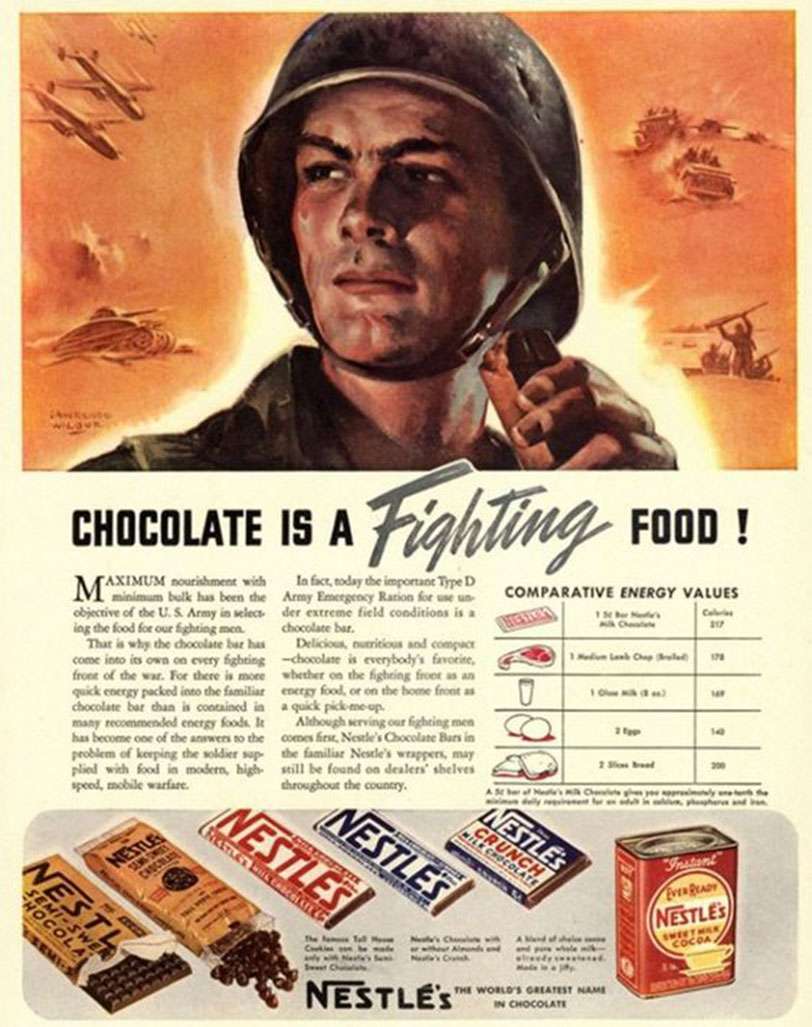
During the Second World War, the United States invested major efforts in making the combat meals more appealing. Various candies found their way into K-rations, in addition to necessities like toilet paper and cigarettes. In a comprehensive overview of the history of rations, the U.S. Army Quartermaster Foundation points to the main reason for complaint during WWII.
Like other unpopular items, misuse was a contributing factor to the waning popularity of the K ration. Although designed to be used for a period of two or three days only, the ration occasionally subsisted troops for weeks on end. . . . Continued use reduced the acceptability and diminished the value of the ration.
Adding confectionaries to rations made the meals more welcome. Chocolate was always a favorite, but the initial American versions left much to be desired.
My research was, in fact, prompted by a recent post on “Chocolate in WWII” in Pacific Paratrooper. (It is one of the very best military blogs on the internet.) They describe how the military approached a major American confectioner with a simple list of requirements (the last one is best appreciated by older veterans).
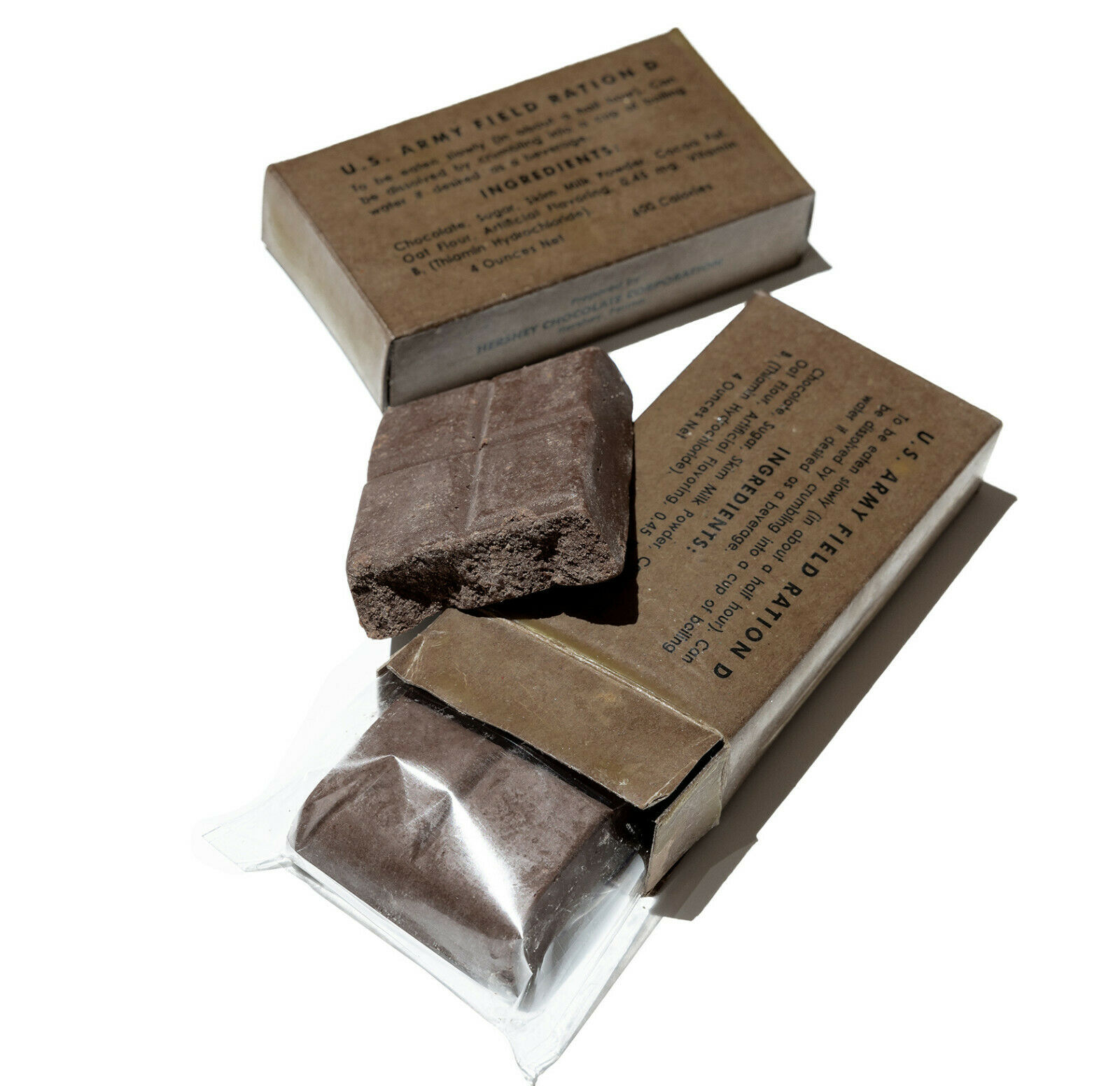
The Hershey Chocolate company was approached back in 1937 about creating a specially designed bar just for U.S. Army emergency rations. According to Hershey’s chief chemist, Sam Hinkle, the U.S. government had just four requests about their new chocolate bars: (1) they had to weigh 4 ounces; (2) be high in energy; (3) withstand high temperatures; (4) “taste a little better than a boiled potato.”
Sadly, many “who tried it said they would rather have eaten the boiled potato.” Well, it was the thought that counted, right?
There is a legend that during the war a German officer was confronted with American desserts and determined that the abundant resources of the United States signaled doom for the Nazi cause. The story likely has a fictional origin.
In the 1965 film Battle of the Bulge, Wehrmacht Colonel Hessler, shows his commanding general a treasure confiscated from American soldiers.
Hessler: “General, before you go, may I show you something?”
General: “What is it?”
Hessler: “A chocolate cake.”
Kohler: “Well?”
Hessler: “It was taken from a captured American private. It’s still fresh. If you will look at the wrapping, general, you will see it comes from Boston.”
Kohler: “And?”
Hessler: “General, do you realize what this means? It means that the Americans have fuel and planes to fly cake across the Atlantic Ocean. They have no conception of defeat.”
C.S. Lewis & Rations
Military rations during the First World War were more primitive than those provided twenty years later. One difference for the British is that they were granted a half gill of rum (or a pint of porter) each day.
This alcohol distribution was at the discretion of the commanding general, which meant that it was not available in the trenches. This was in the spirit of the American “General Order Number 1,” which typically applies to alcohol, and sometimes prohibits its presence throughout an entire theater. (I can personally attest to the ability of some elements, such as Special Ops, to circumvent such restrictions.)
C.S. Lewis wrote with some frequency about the rationing endured by the British public, during and after the world wars.⁑
Unfortunately, I’ve only uncovered one Lewisian reference to his own experience with military cuisine. In a 1917 letter to his father, he reveals that meals were not always appealing, even during training, prior to deploying to the war zone.
First of all came the week at Warwick, which was a nightmare. I was billeted with five others in the house of an undertaker and memorial sculptor. We had three beds between six of us, there was of course no bath, and the feeding was execrable.
The little back yard full of tomb stones, which we christened ‘the quadrangle,’ was infinitely preferable to the tiny dining room with its horse hair sofa and family photos.
When all six of us sat down to meals there together, there was scarcely room to eat, let alone swing the traditional cat round. Altogether it was a memorable experience.
A Hobbit, a Wardrobe, and a Great War describes how WWI affected C.S. Lewis and J.R.R. Tolkien. After relating a passage following Miraz’s defeat of Caspian’s force, when the momentarily defeated were “a gloomy company that huddled under the dripping trees to eat their scanty supper,” the author observes:
The military blunders, the fruitless acts of bravery, the bone-chilling rain, the meager rations: there were many days and nights just like these along the Western Front. Imaginary beasts aside, such scenes could have been lifted from the journal of any front-line soldier.
Like Tolkien, though, Lewis includes these images not for their own sake, but to provide the matrix for the moral and spiritual development of his characters . . .
Rations in Ukraine
Although the eyes of the world are riveted today on the war in Ukraine, there are currently 110 armed conflicts being monitored by the Geneva Academy. However, since Ukraine is in the news daily, it is worth noting both modern armies are employing military rations.
Apparently, Ukrainian troops have great Meals Ready to Eat (MREs). “Most importantly, when making, eating, or even talking about the food, the men seem to be genuinely happy.” The MRE link in this paragraph contains the details, including the note that “among the contents, you’ll find a small packet of dried apricots and a dark chocolate bar.”
There is also a vendor on ebay who sells what are purported to be captured Russian supplies, including a confiscated chocolate bar. The candy appears to be conventionally purchased, but could be part of an illicit chocolate conspiracy finding its way to the Russians from Latvia. “The Russian confectionery company ‘Pobeda’ ПОБЕДА has been producing chocolates, truffles, waffles and other types of sweets for more than six years in Ventspils, via a Latvian subsidiary.”
A month ago in Russia, “Pobeda” received thanks from an organization called the “Battle Brotherhood” for the fact that since the beginning of the Ukrainian war, the company has sent at least 15 tonnes of its products to Russian soldiers.
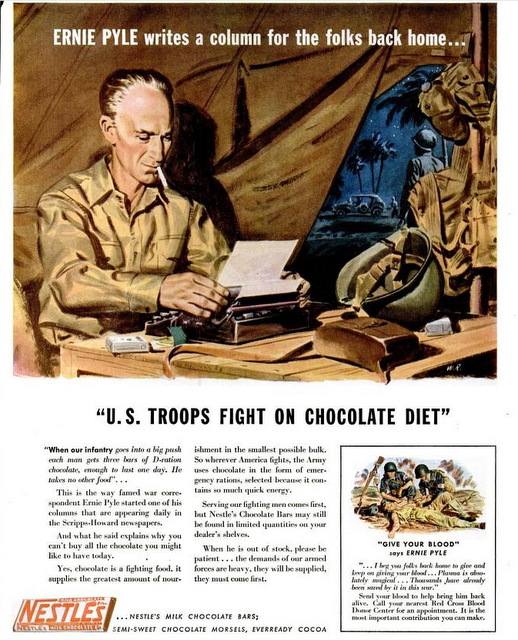
Chocolate does indeed appear to fuel armies. For a fascinating article on how chocolate can also be used to promote propaganda, check out this Ukrainian site.
Russian propaganda continues to dehumanize Ukrainians with the help of outright fakes.
Another “proof” of our apparent bloodthirstiness was the image of a chocolate bar with a remarkable name “Death of Alyoshka.” A portrait of a boy in a helmet with a mourning ribbon is placed on the wrapper of the confectionery. Propagandists claim that Ukrainians wish Russian children dead.
Become an MRE Connoisseur
If you are curious about the contents of various international MREs that are available for purchase by civilians, visit MREmountain, which began “in 2017 when people discovered the hobby of trying army rations.”
Most veterans, I suspect, would find the “hobby” of eating military rations rather peculiar. But then again, you can check out the French options, which the site labels “The best MRE in the world.” Only there, I imagine, could one discover “meals not found in any other MRE like Kebob Meatballs, Duck Confit, Deer Pate, Wild Boar.”
And, of course, France’s 24-hour ration also includes chocolat müesli, chocolate biscuits, five snack bars (at least one of which is pure chocolate), and a hot cacao packet. Yummy. It appears that les Français also consider chocolate to be a staple of modern soldiers.
* This quotation has been attributed to Napoleon and Frederick the Great. Whatever its modern origin, it is obvious starvation and its frequent companion, disease, have crippled as many armies as blade and shot.
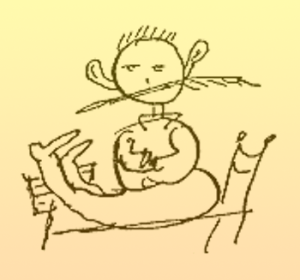
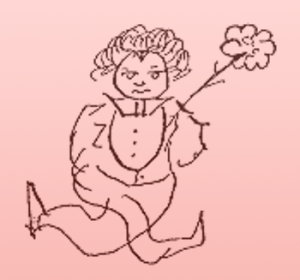
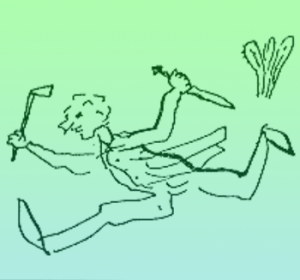
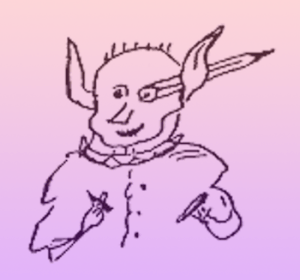
Mark Twain drew a number of sketches that he (hopefully) never intended for publication. Four of them appear here.
Perhaps Twain drafted them as a starting point for a one-day illustrator. It’s odd to think they were intended to appear in their initial, rough state. However, since “How to Make History Dates Stick” was published posthumously, Harper’s Monthly Magazine decided to capitalize on the use of the author’s own “illustrations.”
Calling the scribblings “illustrations” is quite generous. The manuscript drawings remind one of the quick drawings that C.S. Lewis sometimes included in his correspondence.
In this essay, Twain says the key to learning and remembering key historical dates is associating them with pictures.
These chapters are for children . . . Dates are difficult things to acquire; and after they are acquired it is difficult to keep them in the head. But they are very valuable.
They are like the cattle-pens of a ranch—they shut in the several brands of historical cattle, each within its own fence, and keep them from getting mixed together.
Dates are hard to remember because they consist of figures; figures are monotonously unstriking in appearance, and they don’t take hold, they form no pictures, and so they give the eye no chance to help.
Pictures are the thing. Pictures can make dates stick. They can make nearly anything stick—particularly if you make the pictures yourself. Indeed, that is the great point—make the pictures yourself. I know about this from experience.
Setting aside the merits of Twain’s suggestion, the final encouragement to personally draw the illustrations is intriguing. It suggests that Twain may have honestly desired that these very sketches would be included in the published text. In this scenario, the writer would be setting the illustrative bar so low that no one could doubt their ability to draw at least as well as the author of Tom Sawyer.
Twain’s Antipathy Towards Editors
Many writers sympathize with how Twain wielded the blade of his wit against unsympathetic editors. “I hate editors,” he declared, “for they make me abandon a lot of perfectly good English words.” (Abroad with Mark Twain and Eugene Field)
He also praised the French emperor for committing a misguided murder. “How often we recall, with regret, that Napoleon once shot at a magazine editor and missed him and killed a publisher. But we remember with charity, that his intentions were good.” (Correspondence, 1906)
Editors played a major (usually unwelcome) role in Twain’s existence. Thus, it is unsurprising that a major digression in “How to Make History Dates Stick” involves these denizens of the publishing world.
Incorporating editors into his study requires a bit of a stretch, and each sketch is associated in the text with a British monarch. You can see them in that context at TwainQuotes.
I’ve culled the four editors from Twain’s work, and provided a portion of his description about each. They appear here out of order since I wish to end with the one I find most entertaining . . . because it evokes the image of an impish helper in Screwtape’s sulfurous scriptorium.
That is an editor. He is trying to think of a word. He props his feet on a chair, which is the editor’s way; then he can think better. I do not care much for this one; his ears are not alike . . .
I could make him better if I had a model, but I made this one from memory. But it is no particular matter; they all look alike, anyway. They are conceited and troublesome, and don’t pay enough.
That is a society editor, sitting there elegantly dressed, with his legs crossed in that indolent way, observing the clothes the ladies wear, so that he can describe them for his paper and make them out finer than they are and get bribes for it and become wealthy.
That flower which he is wearing in his buttonhole is a rose—a white rose, a York rose—and will serve to remind us of the War of the Roses, and that the white one was the winning color when Edward got the throne and dispossessed the Lancastrian dynasty.
This editor is a critic. He has pulled out his carving-knife and his tomahawk and is starting after a book which he is going to have for breakfast.
This one’s arms are put on wrong. I did not notice it at first, but I see it now. Somehow he has got his right arm on his left shoulder, and his left arm on his right shoulder, and this shows us the back of his hands in both instances. It makes him left-handed all around, which is a thing which has never happened before, except perhaps in a museum.
That is the way with art, when it is not acquired but born to you: you start in to make some simple little thing, not suspecting that your genius is beginning to work and swell and strain in secret, and all of a sudden there is a convulsion and you fetch out something astonishing.
This is called inspiration. It is an accident; you never know when it is coming. I might have tried as much as a year to think of such a strange thing as an all-around left-handed man and I could not have done it, for the more you try to think of an unthinkable thing the more it eludes you; but it can’t elude inspiration; you have only to bait with inspiration and you will get it every time.
Look at Botticelli’s “Spring.” Those snaky women were unthinkable, but inspiration secured them for us, thanks to goodness.
It is too late to reorganize this editor-critic now; we will leave him as he is. He will serve to remind us. [One can only imagine what a delightful time an editor would enjoy, chopping up that stream of consciousness writing?]
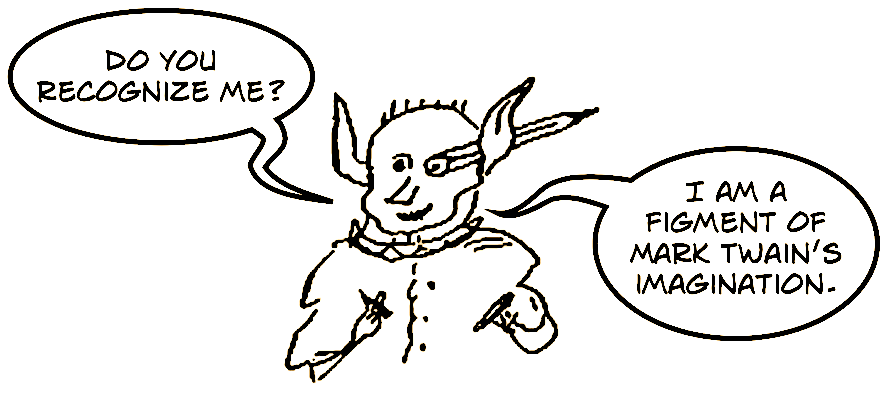
And now for the goblinesque editor. It offers Twain’s most artistic element, which was most likely an accident. Note how the end of the pencil serves to substitute for the eye which may or may not reside behind it.
Another editor. That thing behind his ear is his pencil. Whenever he finds a bright thing in your manuscript he strikes it out with that. That does him good, and makes him smile and show his teeth, the way he is doing in the picture.
This one has just been striking out a smart thing, and now he is sitting there with his thumbs in his vest-holes, gloating. They are full of envy and malice, editors are.
Hopefully, if you are a writer who has submitted your work to an editor, you have been fortunate enough to have avoided these characters.
Editors are, after all, our friends. Well, that may be a bit of an exaggeration, but good editors can certainly help make our work better. May God graciously lead you to editors of that sort.

 Mere Inkling Press