Avoiding Fantasy Clichés

We’re all familiar with that classic paradigm of suspenseful introductions: “It was a dark and stormy night.” While this is not intrinsically poor writing, it has been parroted and ridiculed for so long as a lightweight cliché, that the author’s name has become a byword for writing “purple prose.”

In the same way, there are certain plotlines or story devices that are overused, particularly in genre literature. For example, J.R.R. Tolkien’s genius in creating Middle Earth cannot be exaggerated. Yet, since his epic, dwarves, elves and orcs innumerable have been written about in chronicles ad nauseum by lesser poets. Many of Tolkien’s inventions seem rather tired when repeated by contemporary writers for the hundredth time. (Hundred thousandth time, if you count fan fiction.)

This literary dilemma has led to the creation of “The Fantasy Novelist’s Exam,” designed to be taken by aspiring authors before submitting their manuscripts for publication. (The link for the exam will be found below.)

The purpose of the test is to determine how derivative your storytelling is. If you use too many of the listed elements, you are in danger of composing a parody rather than a masterpiece. Some of the questions posed in the exam are astute, many are glib, and most are humorous. Here’s a sampling, with my responses (speculative, of course, since I haven’t written any fantasy proper).

Is your main character the heir to the throne but doesn’t know it?

How about an anonymous member of minor nobility?

Do inns in your book exist solely so your main characters can have brawl?

I never visit bars, but isn’t hosting altercations a primary purpose of all drinking establishments?

Do you think you know how feudalism worked but really don’t?

Ah, a conundrum. If I know I don’t really know . . .

Do any of your female characters exist solely to be captured and rescued?

You mean they have another role they can perform? (Wait, I’m just joking!)

Do you think that “mead” is just a fancy name for “beer?”

My Viking ancestors would never forgive me if I did!

Do you think horses can gallop all day long without rest?

I wasn’t raised on a ranch, but I’m not that stupid.

Is this the first book in a planned trilogy?

Whoops.

As you see, the questions are fun to read, but there’s one that bothered me a bit. Well, not the question itself. It’s innocent enough. But it alludes to a particular scene in The Lord of the Rings films which I find stunning—in the original sense of the word. It strikes me viscerally, almost leaving me breathless.

Do you really think it frequently takes more than one arrow in the chest to kill a man?

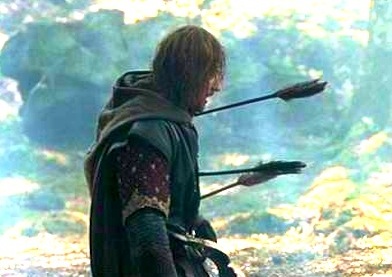
Generally, no . . . but if that hero is Boromir, most certainly!

The Death of Boromir

One of the most moving scenes in The Lord of the Rings involves the death of Boromir as he sacrifices his life in a futile battle to allow the hobbits time to escape the Uruk-hai. It’s impact is magnified by the fact that it immediately follows Boromir’s near-betrayal, under the corrupting influence of the Ring.

The irony is that this spectacular scene is not described in detail in Tolkien’s book. It is a tribute to director Peter Jackson’s cinematic brilliance. This is the original telling:

Even as [Aragorn] gazed his quick ears caught sounds in the woodlands below, on the west side of the River. He stiffened. There were cries, and among them, to his horror, he could distinguish the harsh voices of Orcs. Then suddenly with a deep-throated call a great horn blew, and the blasts of it smote the hills and echoed in the hollows, rising in a mighty shout above the roaring of the falls.

“The horn of Boromir!” he cried. “He is in need!” He sprang down the steps and away, leaping down the path. “Alas! An ill fate is on me this day, and all that I do goes amiss. Where is Sam?”

As he ran the cries came louder, but fainter now and desperately the horn was blowing. Fierce and shrill rose the yells of the Orcs, and suddenly the horn-calls ceased. Aragorn raced down the last slope, but before he could reach the hill’s foot, the sounds died away; and as he turned to the left and ran towards them they retreated, until at last he could hear them no more. Drawing his bright sword and crying Elendil! Elendil! he crashed through the trees.

A mile, maybe, from Parth Galen in a little glade not far from the lake he found Boromir. He was sitting with his back to a great tree, as if he was resting. But Aragorn saw that he was pierced with many black-feathered arrows; his sword was still in his hand, but it was broken near the hilt; his horn cloven in two was at his side. Many Orcs lay slain, piled all about him and at his feet.

Aragorn knelt beside him. Boromir opened his eyes and strove to speak. At last slow words came. “I tried to take the Ring from Frodo” he said. “I am sorry. I have paid.” His glance strayed to his fallen enemies; twenty at least lay there. “They have gone: the Halflings: the Orcs have taken them. I think they are not dead. Orcs bound them.” He paused and his eyes closed wearily. After a moment he spoke again. “Farewell, Aragorn! Go to Minas Tirith and save my people! I have failed.”

“No!” said Aragorn, taking his hand and kissing his brow. “You have conquered. Few have gained such a victory. Be at peace! Minas Tirith shall not fall!” Boromir smiled.

“Which way did they go? Was Frodo there?” said Aragorn.

But Boromir did not speak again.

“Alas!” said Aragorn. “Thus passes the heir of Denethor, Lord of the Tower of Guard! This is a bitter end. Now the Company is all in ruin. It is I that have failed. Vain was Gandalf’s trust in me. What shall I do now? Boromir has laid it on me to go to Minas Tirith, and my heart desires it; but where are the Ring and the Bearer? How shall I find them and save the Quest from disaster?”

He knelt for a while, bent with weeping, still clasping Boromir’s hand. So it was that Legolas and Gimli found him. (Lord of the Rings, Book III Chapter 1).

So, we understand that while a single arrow might slay a common warrior, it could well take a quiver full to lay low a champion such as this.

___

If you would like to review “The Fantasy Novelist’s Exam,” simply follow this link.
Your Writing Style

Each of us writes in a unique manner.

You can study writing patterns in various ways, by considering vocabulary, changes in sentence lengths, repeated phrases, and various other measurable elements.

Then there are more subjective aspects of our writing, but these too are recognizable. They would include tone and more abstract things like pacing.

When you add them all together, you arrive at an amorphous quality called the writer’s “voice.” And, as I said above, each of our “voices” are different.

It may be that we dabble in a variety of forms and genres. For example, in addition to these casual blog posts, I also write about theology and military ministry from a much more “professional” perspective. And, shockingly (to my own writing identity) I’ve recently received encouragement related to poetry with which I’ve been experimenting.

Even when we write in various literary forms, and they clearly differ from one another in their voice, the truth is that for each of these documents we develop a personal, inimitable voice.

Now, after emphasizing our literary uniqueness, I want to switch perspectives and consider that our various styles and voice resemble those of others. Occasionally, when reading someone’s work it strikes you as familiar. You may even recall the author that the work reminds you of. (I’m not referring to plagiarism, of course, although the internet has apparently made that particular plague even more common now than in the past.)

It would be vanity to claim that our own writing voice resembles that of no one else. Yes, some voices are so peculiar that they are clearly “rarities,” but others have shared even those odd personalities in the past. I suspect that’s even true for the senseless ramblings with which some self-styled “artists” assail the public. (Even insanities can resemble one another.)

In any case, if you ponder this subject it’s natural to wonder: who do I write like?

Today, through the amazing processing abilities of the computer, you may be able to get an answer to that very question. It’s not a definitive answer, because as I said above, our writing voice possesses both material (words and syntax) and spiritual (ephemeral and aesthetic) dimensions. And, while a computer may be without peer in comparing the former, I believe it to be quite deficient in discerning the latter.

Nevertheless, a rudimentary program is available online to compare your writing with that of a number of writers of varying reputation. The program has a number of limitations, but I think there may be something to it. It requires an extensive section of your writing (several paragraphs, at least). I assume more would be better, in terms of promoting accuracy.

As I just mentioned, it includes a limited number of authors currently entered into the database, and I suspect that the gifted C.S. Lewis is not among them. (I say this not because I expected to be aligned with him, but because of some of the included authors I am aware of. In addition, the program’s creator is actually Russian, so I would be curious to learn how the represented English authors were selected.)

It would limit the program’s value, for example, if I only input data on three writers and you were matched with the one you resembled most closely. Would you prefer, for example, to be told you write like Edward Bulwer-Lytton, Georgette Heyer, or Fabius Planciades Fulgentius?

Even with a significant number of writers included, the program’s accuracy will be affected by the quantity (and specific choice) of what is included to represent each. For example, the programmer properly included Stephen King. How valuable would that be, however, if he had only used King’s poetry and excluded his prose works? (Yes, the horror master has also penned poetry—now, that’s a scary thought!)

Well, despite the limitations of the “I Write Like” program, it is fun to try out. And it sounds impressive, in that it relies upon a naive Bayesian classifier. (Well, the “naive” part doesn’t sound especially remarkable, but the formula looks pretty imposing to someone who never took calculus.

You can use take the “test” at this site.

Make sure you include lengthy selections from your work. Also, testing the program with different genres (assuming you write in different styles) will actually give you new matches. (That is, of course, as it should be.)

If you do decide to experiment with it, a comment below about your results would be interesting for others. And now, for the moment that you have been awaiting . . . with whose writing did the program match mine?

I tried a number of times (no—not fishing for results I wanted, but using a variety of types of my writing) and here were the repeated results:

For my blog posts: H.P. Lovecraft or J.R.R. Tolkien

For my more formal essays: J.R.R. Tolkien or Jonathan Swift

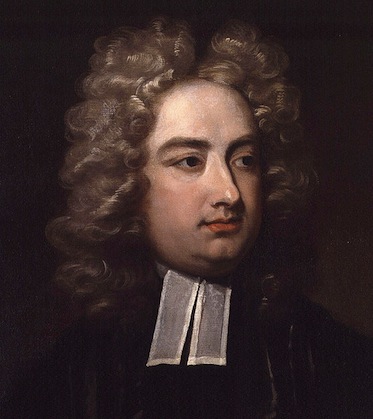
(It’s Swift’s picture, you’ll note, that begins this post.) Actually, the majority of the results linked to Swift, whose work I don’t recall ever reading in full, not even Gulliver’s Travels. However, our shared emphasis on wit, advocacy and satire account for what I deem a genuinely accurate assessment. And it does not hurt that Swift was Anglo-Irish, like my favorite author!

So, until Dmitry Chestnykh adds C.S. Lewis to the writers included in the “classifier,” I’m quite content to rest on my matches. Because even if I don’t share Lovecraft’s worldview, I can still respect his literary skill. And being identified with the other gentlemen, is a grand compliment.

[Special thanks to Julie Catherine who introduced me to the site via her post on the subject.]

Literary Words

I must confess that I like words. In fact, it’s not excessive to say that I delight in brilliantly witty “turns of phrase” and elegantly painted landscapes that allow me to clearly see what the author is painting with his or her words.

I’ve grown convinced that loving words is a handicap to becoming an excellent writer. Yes, scribblers like me can become adequate or even appreciated writers . . . but to stand in the highest ranks a writer must be willing to ruthlessly slash and slay excess words that impede their perfect vision.

Self-editing is a discipline. It’s something that can be learned and refined through practice. That it forever remains a bit painful for some of us is clear evidence we are overly attached to the words we have put to paper.

C.S. Lewis addressed this general subject in a 1932 letter to his good friend Arthur Greeves. While he was not a slave to the number of words required, he aimed for simplicity and clarity. Lewis wrote:

I think I see, from your criticisms, that you like a much more correct, classical, and elaborate manner than I. I aim chiefly at being idiomatic and racy, basing myself on Malory, Bunyan, and Morris, tho’ without archaisms: and would usually prefer to use ten words, provided they are honest native words and idiomatically ordered, than one “literary word.” To put the thing in a nutshell you want “The man of whom I told you,” and I want “The man I told you of.”

I smiled as I typed Lewis’ remark about “ten words.” He used that to illustrate his willingness to use excessive verbiage to communicate clearly. Brevity was, however, an admirable goal. And brevity is a virtue I’ve seldom been accused of possessing.

In the military, comrades and associates are frequently presenting plaques and remembrances to those who are “rotating” to new assignments. Having served in a dozen different “permanent” assignments, I have boxes full of such memorabilia.

Two of the few I display are genuinely precious. The first is an icon of Saint Athanasius, presented to me by the best “boss” I ever had, an Orthodox priest by the name of John Stefero. The reasons for the personal gift were theological and I accepted it with genuine appreciation and humility.

The second prized gift is a gracefully curved etched glass keepsake featuring the seal of the United States Air Force Chaplain School where I served for three wonderful years. The commandant was speechless as he presented the plaque to me, reading for the first time the inscription that my closest companions had composed for me.

He says in a book what others say in a sentence.

The commandant (later our Chief of Chaplains) was stunned. I was delighted. I led the gathering’s laughter and bellowed, “Yes, and it’s a book well worth reading!”

Jack Lewis may have chided me a bit for the underlying reason for the accolade, but I am confident he would have delighted in the affectionate friendship and esprit de corps with which it was presented.

So much for my shortcomings. For all other writers (including, perhaps, you?) . . . I would recommend following the master’s example, rather than my own.