Skillful Turns of Phrase

frank burnsEveryone loves an exquisite turn of phrase. Those of us who dabble in writing are particularly susceptible to their numinous power.

I’ve been doing some research on the Father Mulcahy character from M*A*S*H. William Christopher transformed the fictional character from a caricature of military chaplaincy, into a compassionate and respected representative of the Holy. During my research, I’ve been reviewing episodes of the series in which he was featured.

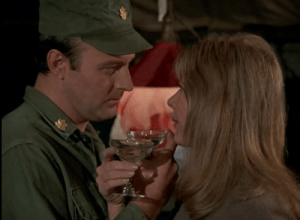
In “Alcoholics Unanimous,” which originally aired in 1974, Mulcahy has been tasked with delivering a lecture on temperance. In an interesting twist he wears full clerical garb and prepares what is essentially a sermon. Since the lecture is a “mandatory formation,” the mess tent (which doubles as the chapel) is filled to capacity.

Sitting in the front row are the hypocritical Majors Burns and Houlihan. (For those unfamiliar with the show, they constantly call for the most rigid of military standards, even as they are all the while breaking the military’s Uniform Code that prohibits adultery.) Major Houlihan’s nickname, in fact, is “Hotlips.”

In the aforementioned episode they have a delightful little exchange that illustrates through its witty banter the skill of the Hollywood writers at their best. As the hospital’s temporary commander, Burns has banned all alcohol and mandated attendance at the lecture. The tent is filled to its limits as Houlihan turns adoring towards her paramour and says:

Houlihan: Frank, what a turnout!

Burns: Lemmings must be directed to the sea.

Houlihan: You’re magic with a phrase!

It requires skill to create a well-crafted turn of phrase. Well, even a fool like Frank Burns can stumble across a clever phrase, but only a master can repeatedly coax them from their ethereal realms.

C.S. Lewis was just such a master. His works abound with profound and captivating language. And he recognized it in the works of others. In “Dante’s Similes,” in Studies in Medieval and Renaissance Literature, he wrote:

[Dante] is the most translatable of the poets—not, probably, that he entrusts less wealth than others to the music of the words and the nuance of the phrase but that he entrusts more than others to the “plain sense.”

In The Four Loves, Lewis reveals just how impoverished much of our language is . . . even when it relates to the most inspiring of matters. Describing the difference between carnal “love” and genuine love, he shows that even impoverished phrases can begin to grasp the truth behind the dynamics of affection and commitment.

We must do the works of Eros when Eros is not present. This all good lovers know, though those who are not reflective or articulate must be able to express it only in a few conventional phrases about “taking the rough along with the smooth,” not “expecting too much,” having “a little common sense,” and the like. And all good Christian lovers know that this programme, modest as it sounds, will not be carried out except by humility, charity and divine grace; that it is indeed the whole Christian life seen from one particular angle.

Surely those who are more articulate can more expressively communicate our love for our spouse. Yet, even in so-called matters of the heart, we frequently utter phrases that are utterly mundane.

The History of the Phrase “Turn of Phrase”

One online dictionary uses these definitions:

a turn of phrase

1. a way of saying something “Significant other,” meaning “partner,” now that’s an interesting turn of phrase.

2. the ability to express yourself well She has a nice turn of phrase which should serve her well in journalism.

The Phrase Finder website provides excellent information about numerous phrases. And, in discussing this idiomatic phrase about phrases, they do not disappoint.

So, a phrase was a style of speaking or writing, and style meant beauty of expression. We can now interpret a fine “turn of phrase” as analogous to a skillfully crafted piece of wood turned on a lathe. John Dryden referred to the “turning” of words in this sense in The Satires of Decimus Junius Juvenalis, 1693: “Had I time, I cou’d enlarge on the Beautiful Turns of Words and Thoughts; which are as requisite in this, as in Heroique Poetry.”

Check out their entire article about turns of phrase at the link above. And, may your own writing be filled with impressive verbal ballets, replete with inspiring leaps and unforgettable pirouettes.

Mastering the Anacoluthon

Allow me to once again display my grammatical ignorance. I was reading an online book review and the author used lots of multisyllabic words. (That’s something I actually enjoy.) But then he went and threw in one of those words I had to rush to dictionary.com to define. (That’s another thing I love—learning new words.)

Naturally, I could partially decipher the definition from the context. However, whenever I have a dictionary within reach, that shortcut doesn’t satisfy me.

In this case, the word was anacolutha, the plural form of anacoluthon. It is defined as “a construction involving a break in grammatical sequence, as ‘It makes me so—I just get angry.’” Well, we can all agree that is not a good sentence; it’s a fine example of what a writer should avoid.

Not all grammar rules make sense. Take for example the notion that one cannot end a sentence with a preposition. Some of us literally had our knuckles rapped for scribbling such grammatical “obscenities.” While it’s true that you can avoid using prepositions in this manner, it’s not the great sin we were taught it was. In his Letters to an American Lady, C.S. Lewis writes:

[Regarding] a sentence ending with a preposition. The silly “rule” against it was invented by Dryden. I think he disliked it only because you can’t do it in either French or Latin which he thought more “polite” languages than English.

Well, isn’t that an interesting historical note to become aware of?

But, back to anacolutha . . . let’s see if it’s difficult for a trained pen to sever the ties of logic, and compose this sort of literary construction.

Reepicheep was a great swordsman who, “a tail is the honor and glory of a Mouse” was his creed.

Frodo pondered his options while—the Nazgûl loathed bathing more than once each fortnight.

Wow, that’s a lot harder than it looks. If you can think of better examples (not difficult, I’m sure), feel free to share them in a comment! But only write them here, and don’t allow any anacolutha to slip into your real writing!

Mastering the Contranym

English is a fascinating language. Certainly not the simplest to learn, but extremely versatile. You might say that among the circus of languages, English is the contortionist. (That analogy might make German the strong man and Romani the fortune teller.  As for the bearded lady . . . I’ll leave that to your personal conjecture.)

I’ve formally studied several other languages, yet I consider myself a master of none. Nevertheless, when it comes to English, I do take some pride in my skills, and would be willing to claim for myself the status of journeyman. Among other credentials I have my “verbal” score on the Graduate Record Exam, which placed me in the 97th percentile.

It goes without saying that C.S. Lewis (along with most of his fellow Inklings) was a Master of English. One of his many insights warned of language’s occasional tendency to confuse rather than illuminate.

Language exists to communicate whatever it can communicate. Some things it communicates so badly that we never attempt to communicate them by words if any other medium is available. (C.S. Lewis, Studies in Words).

As much as I discover about English, I find there is still more to learn. This week I enjoyed thinking about contranyms. It’s uncommon enough a word that you know your spell checker won’t recognize it. One of those words only an English major is expected to know.

We all know, of course, what synonyms and antonyms are. Useful little tools for playful manipulation of language. A contranym is a word that possesses two “contradictory” meanings. For example a “citation” which can be awarded for either good or issued for bad behavior. Or, consider “literally,” which has its literal meaning as well as its recently developed and contradictory definition of “figuratively.” For lovers of words that’s a particularly discomforting contranym, and it literally makes my head explode. (No, seriously, please don’t ever write or say something like that unless it is in the form of dialog you’re composing for a semi-literate character.)

There are many more examples.

“They left for London, without a thought as to the luggage they left at the station.”

“He was certainly bound for jail if they discovered the Internal Revenue agent he had left bound in his basement.”

“He buckled his belt a mere moment before his legs buckled beneath him as he was struck by the errant meteorite.”

“Apparently there are many thoughtless oversights when programs are left to governmental oversight.”

Homophonic contranyms are not spelled alike, but they are pronounced similarly. “My aural test is scheduled tomorrow, immediately before the oral defense of my dissertation.”

There are actually a couple of alternative names for contranyms. They can be called antagonyms or autoantonyms, which only serves to make the hazy water that much murkier.

Our next lesson will feature that amazing category of words that are “polysemy.” (Not really, I think this has been enough linguistic thinking to cover us for at least a week.)

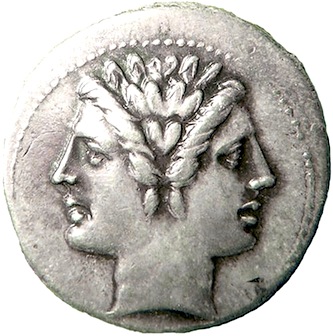
Oh, one final note, for those who were curious about the choice of the image above for this column. Contranyms are also referred to as “Janus words,” in honor of the Roman deity who constantly gazes in two directions. Very fitting.