
C.S. Lewis, Stereotypes & Polarization

Do you think in terms of stereotypes? Be careful before answering, since nary an adult is free of them. (Case in point, you may well have preconceptions or prejudices about a writer who would use the word “nary” in an opening sentence.)

Stereotyping is common, despite the fact most of us would disavow its use. Most of us would agree with C.S. Lewis who described how stereotypes bar us from embracing new knowledge. In his inaugural lecture on the faculty of Cambridge University, he cautioned that “a stereotyped image can obliterate a man’s own experience” (“De Desciptione Temporum”).

Oddly, while most of us would intuit that thinking stereotypically is a pattern for “the less intelligent,” it appears the reverse is true. According to one study,

Superior cognitive abilities are often associated with positive outcomes, such as academic achievement and social mobility . . . However, our work shows that some cognitive abilities can have negative consequences – specifically, that people who are adept at detecting patterns are especially quick to learn and apply social stereotypes.

Fortunately, although “people with better pattern detection abilities are at greater risk of picking up on and applying stereotypes about social groups,” there is still hope for those “afflicted” with cognitive skill. Fortunately, “these individuals are better able to diminish their stereotyping when presented with new patterns that challenge existing stereotypical associations.”

Another study argues that “our brains want our expectations to be supported . . . Because of that reward engagement, we can start becoming addicted, in a way, to stereotyping.” The researchers offer this suggestion for combatting the addiction: “simply understanding that this happens is an important way to check those assumptions and not let them influence your judgment.”

Generalizing by way of stereotypes can indeed be addictive, if its endemic presence in western culture is any indication. In America, for example, if there is ever a season when nasty stereotypes run unbridled, it is during political campaigns. Especially during presidential elections, where a person of faith would hope to witness the greatest amount of compassion and earnest intercession for God’s guidance.

Stereotypes give way to even uglier projections when we come to despise others. Several years ago I wrote an article about how wartime propaganda often strives to portray a nation’s enemies as evil, and unworthy of treatment in a humane way. It is titled “Demonizing Our Enemies & Dehumanizing Ourselves.”

When nations war, it is in the interests of the leaders of the opposing causes to engage their people in that effort heart, mind and (if possible) soul. A soldier who cognitively recognizes the need for fighting, but does not  possess a visceral animus for the foe, will only be a half-hearted warrior.

On the other hand, if rulers can generate a mental and emotional disgust, or even hatred, for the enemy, they have a winning formula. Soldiers who not only understand their cause, but also desire the utter destruction of their opponent, are single-minded in their purpose. Such fighters win wars.

You can see this sort of us/them polarization during peacetime too, even in non-election years. Sadly, it seems to be manifesting more and more frequently. And, surprisingly, it appears to have become just as common within national populations, as in international contexts. The results can be catastrophic, which is why First Lady Eleanor Roosevelt pled: 

Pit race against race, religion against religion, prejudice against prejudice. Divide and conquer! We must not let that happen here.

Stereotyping the Inklings

Although none of the Inklings have been spared, I believe C.S. Lewis has been the subject of the worst stereotyping. (I have an educated suspicion why that is true.)

Diana Pavlac Glyer has an excellent article which addresses this injustice head on.

There’s a rumor going around that C. S. Lewis was an irritable introvert, isolated and lonely and scared to death of girls. Maybe it all comes from some grim stereotype of smart people or college professors or, maybe, published writers.

That whole image is completely wrong. Lewis wasn’t an introvert. Or a loner. No – he was a large man with a booming voice, a hearty laugh, a robust enjoyment of everyday life. And that is why he was a man with friends.

At A Pilgrim in Narnia, Brenton Dickieson dispels another common misperception of the great author – that he was narrow-minded. 

So much of C.S. Lewis’ uniqueness comes down to his sheer love of diversity. He loved variability, colour, the exchange, the alienation of encounter and unity with others. His weird dystopia That Hideous Strength was, in many ways, a protest against the tendency of totalitarianism to create monoculture by erasing the individual. . . .

Lewis loved difference and diversity and freedom of expression–doctrines in danger in today’s culture war. It doesn’t take long within any of today’s major social movements to find out that diversity is fine and great as long as everyone acts like us or looks like us or thinks like us or uses the same secret words we use.

Most readers of Mere Inkling would be exceptions to the rule that human beings (especially those with “superior cognitive abilities”) default to stereotyping. Most of you, I sincerely believe, share my appreciation for respectful conversation and debate with others who do not share my opinions. 

Such interaction – with unique individuals, and not cardboard caricatures – often result in my own growth. And I dare to hope that those with whom I dialog might also feel the same.
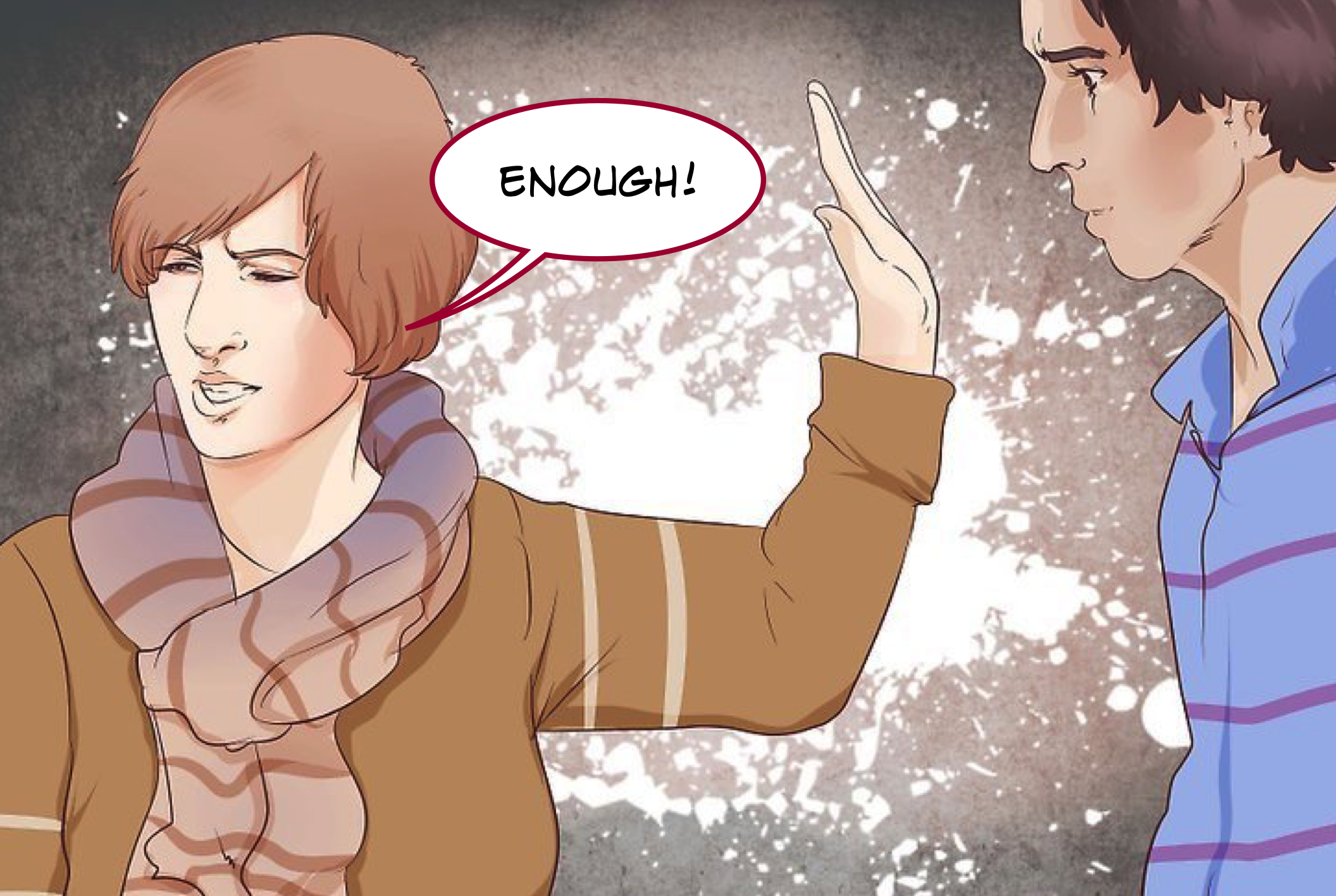
Covid’s Ancillary Destruction (Updated)

Have you severed ties with a friend or relative because you view the question of vaccination policies differently?

Apparently this tragedy is growing in frequency. Just last week, a person very, very dear to me declared that we had “come to a parting of the ways.” I pray for a restoration of the relationship when emotions cool, but for the moment, it seems I am “dead” to my sister.

She is one of the people who find themselves at one end of the vaccination spectrum. There are, of course, some who believe those who receive vaccinations are dupes, endangering their health with possibly unnecessary medicine that may have lasting side effects. At the opposite end, stand those who consider anyone unwilling to be vaccinated as tantamount to being a heartless murderer.

Sadly, those of us who lie midway along said spectrum—who understand precisely how others might arrive at those extreme positions, and call for reasonable, respectful conversation—are typically regarded with contempt by each extreme.

Ironically, my wife and I eagerly received our injections at the first possible opportunity. Yet, because our adult children (intelligent and mature, one and all) have made a different decision, we have suffered this separation from some of our extended family.

A report published this week revealed 14% of vaccinated respondents said “they ended things with friends who refused to get vaccinated.” That suggests that approximately one out of seven people are unwilling to place friendships on pause; they apparently prefer to terminate them.

“Stress from the Pandemic Can Destroy Relationships with Friends—Even Families” describes the tragedy in the following way.

The pandemic’s toll on friendships goes deeper than mere political polarization — the confusion of a mask with support for “big government.” It’s more about discovering personality differences between you and your relatives and friends, including different levels of risk-tolerance and what might seem like irrational optimism on one side vs. hysterical alarmism on the other.

At a time when many of us are losing sleep, picturing ourselves or someone we love gasping for air in a crowded emergency room, these differences are painfully relevant.

Taking these words to heart should help us all be more tolerant of our varying responses to the strain of living during this pandemic.

I hope that you have not experienced the pain of ruined relationships. And, I beg you, if you are inclined to write off friends who disagree with you on this controversial subject, please reconsider. After all, as C.S. Lewis wisely said to those who claim to be followers of Jesus, “to be a Christian means to forgive the inexcusable, because God has forgiven the inexcusable in you” (The Weight of Glory).

You Should Read This

I just finished the best article I’ve read on this subject, and commend it to you. Pastor Peter Leithart authored the provocatively titled “Why I Didn’t Get the Covid Vaccine.”

The title is a little misleading, since Leithart’s rationale is that as a covid survivor he currently has the resulting “natural immunity.”

The article is quite enlightening, however, because it is not an argument for or against the treatment per se. Rather, it is a very brief historical reminder of a perhaps more perilous ailment. He approaches the subject through the work of an Italian philosopher.

As Roberto Esposito put it in Biopolitics, political authority was traditionally the authority to kill. Under the reign of biopolitics, rulers care for and manage life. Once upon a time, the ruler bore a sword; now, a syringe.

“Body politic” is an ancient metaphor, but in biopolitical regimes the body becomes the real place “where the exercise of power [is] concentrated.” Public health takes center stage in a “limitless process of medicalization” as health care is “superimposed” on politics. It’s now the government’s job—its primary job—to keep us safe and healthy.

“Life becomes government business,” Esposito writes, and “government becomes first and foremost the governance of life.” To manage life, governments have to exercise social control, keep populations under surveillance, maintain constantly-updated databases, and, as necessary, isolate and separate sectors deemed dangerous to the corporate body.

In an article written more than a year ago, entitled “Biopolitics in the Time of Coronavirus,” the writer describes the evolution of the concept of biopolitics since the 1970s. He warned then, “Instead of worrying about the increase of surveillance mechanisms and indiscriminate control under a new state of exception, I therefore tend to worry about the fact that we already are docile, obedient biopolitical subjects.” One can only imagine what he might say today.

Back to Relationships

I am no philosopher, and it is not the purpose of this post to answer the big questions. What I believe is simple. The vaccine is good for some, but not all. And disease is terrifying, especially when it can be terminal.

Oh, and I believe one other thing. We should discuss such matters civilly. Graciously, even. Because differences of honest opinion about debatable matters are insufficient grounds for destroying lifelong relationships. After all, true friendships are precious . . . and rare.

C.S. Lewis discerned a little-known truth about the importance of friendships. One that reminds us they should not be discarded in the passion of a moment. Lewis describes here how there are eternal repercussions related to our actions. Refer to salvation, the resurrection and heaven as the “glory” God desires for all people, Lewis writes:

It may be possible for each to think too much of his own potential glory hereafter; it is hardly possible for him to think too often or too deeply about that of his neighbour. The load, or weight, or burden of my neighbour’s glory should be laid on my back, a load so heavy that only humility can carry it, and the backs of the proud will be broken. . . .

All day long we are, in some degree, helping each other to one or other of these destinations [heaven or hell].

It is in the light of these overwhelming possibilities, it is with the awe and the circumspection proper to them, that we should conduct all our dealings with one another, all friendships, all loves, all play, all politics.

There are no ordinary people. You have never met a mere mortal. Nations, cultures, arts, civilisations—these are mortal, and their life is to ours as the life of a gnat.

But it is immortals whom we joke with, work with, marry, snub, and exploit—immortal horrors or everlasting splendours (The Weight of Glory).

Update

[April 2024] When I originally posted this, I expressly shared that “I pray for a restoration of the relationship…” God has answered that prayer. My sister had been under great pressure when we had initially spoken; her youngest grandson was severely ill from the virus. Thus her quite understandable intensity in her concern about the potential role of the unvaccinated at that time.

Our meeting this week was filled with grace and healing. She was wounded not only by my children’s decisions, but also by this post itself. I had no intention to embarrass anyone, but instead to caution others about the dangers of argumentation that substitutes for discourse—which is something that to which both political parties in the United States have inexcusably contributed.

One reason for adding this update is to encourage anyone who reads this column to pursue reconciliation and healing in all of your damaged relationships. Though deeply saddened during the months of estrangement, I knew that God specializes in healing… and the Lord loves each one of us more than we will ever know. As long as you live, don’t give up hope. Keep praying and extending a humble and loving invitation to the friends and loved ones with whom you differ.

Oh, we didn’t discuss vaccinations per se, since that wasn’t the important concern. It was all about relationship.