
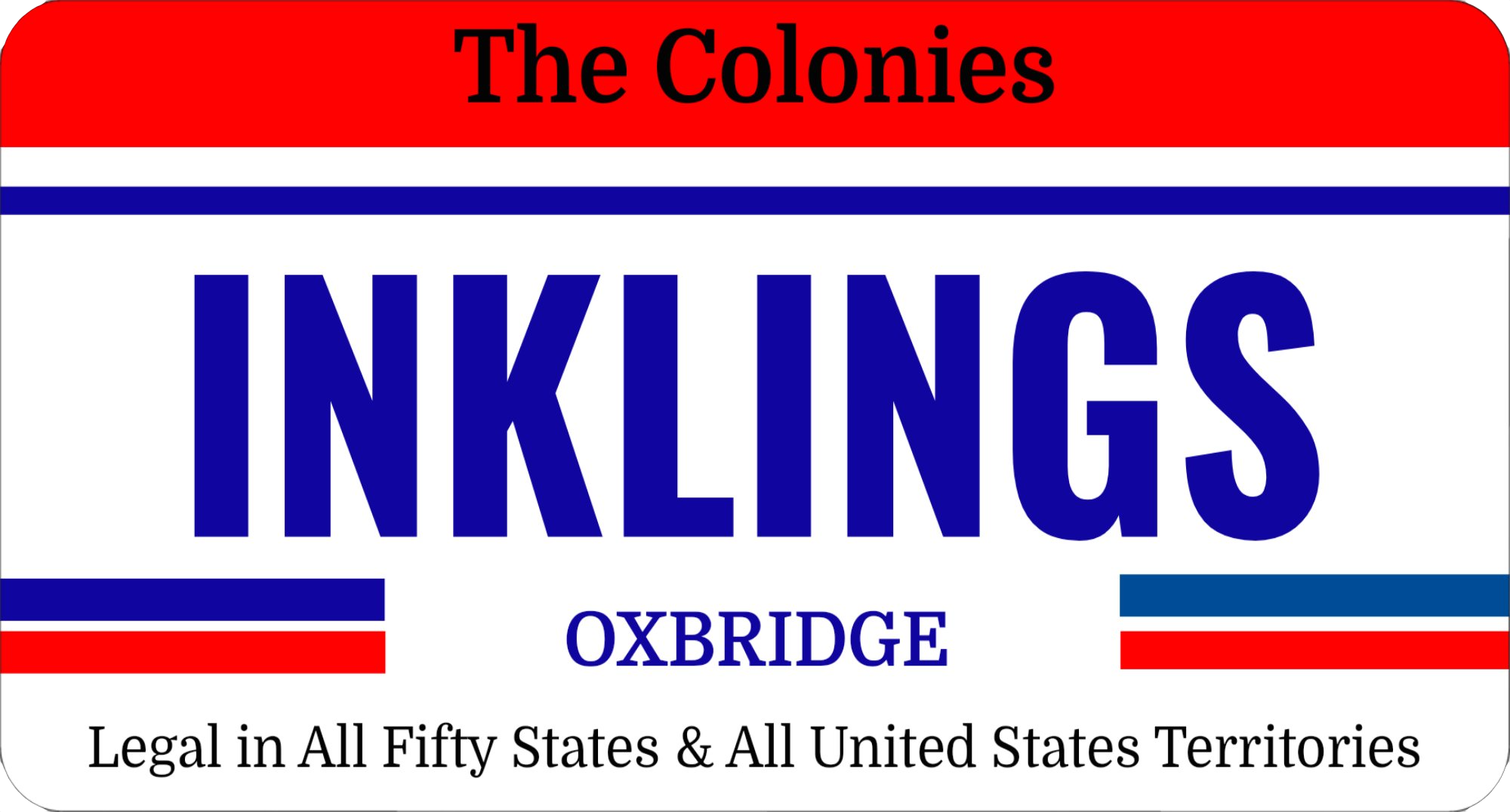
One of the peculiar things about the United States is the extreme degree to which people are driven to stand out from the crowd. We are able to do this with our automobiles, for example, in a rather odd way.
C.S. Lewis was immune to the temptation discussed here, since he was never a fan of cars, as I discussed in “C.S. Lewis & Automobiles.”
In his autobiography, Lewis declared “I number it among my blessings that my father had no car, while yet most of my friends had, and sometimes took me for a drive.” Those who are curious about Lewis’ dichotomy concerning vehicles, should refer to that post.
I don’t know how many other countries do this, but in most of the United States states, people have the option of getting random numbers and letters on their license plates – or opting for so-called vanity plates.
These individually emblazoned metallic placards perform a sort of Third Estate heraldic device. They often include variations on surnames or words significant to the bearer.
Obviously, offensive words are prohibited, but they are frequently quite creative. Here are a few examples: SO 4CHN8 and its opposite, EN-V ~ GONA B L8 which is probably an insufficient excuse to the cop who pulls you over ~ IBMEUBU with its live and let live philosophy versus URAMESS ~ UH AS IF from California, of course ~ IOU DAD from a grateful child ~ BWAHAHA and the clearer message from Vermont, BBRRRR ~ TWOCUTE can either refer to attractive twins, or to an illiterate narcissist ~ BBQ=LUV celebrates a common American favorite ~ and, this provocative phrase ITS A SIN. Hundreds more examples are online if you’re curious.
It’s fascinating that Americans will pay often exorbitant surcharges to individuate their auto plates. Especially in light of the fact that we already have different plates for each of the 50 states and a Federal District (for our national capital), as well as others for Territories and Protectorates. Prepare yourself. Seriously, prepare for a shock.
All of the 8,331 License Plates in America
States now offer a vast menu of personalized plate options for a dizzying array of organizations, professions, sports teams, causes and other groups.
Such plates typically include a surcharge to support the theme identified on each choice, as for Maryland’s Beekeepers, Barbershop Quartet Singers, or the Baltimore Bicycling Club. And we mustn’t forget their plate promoting the museum of the B&O Railroad (of Monopoly fame).
How can we arrive at that unbelievable number? Well, consider Illinois, for example. They boast no fewer than forty different options related to military alone. Hawaii has the fewest overall varieties at fourteen. Maryland, likely desperate for revenue, actually has nine hundred and eighty-nine. I am curious why they bothered to stop short of an even thousand.
Add to that the fact that nineteen states do not require a license on the front of the car, which invites the substitution of an individualized alternative. Consequently, there are statutes ensuring “most states also require that you do not mount your plate upside down.” In many of these, you would be legally allowed to mount decorative or business plates, but not alternative license plates, misleadingly different from your true registration.
Individuality run amok. The chaos sadly seems strikingly American.
Which brings me to the reason I was thinking about this unusual topic. Heading to church on Sunday I saw a plate with a curious message. It was one of my state’s options for Fire Fighters. The message it bore consisted of just three letters: UGH.
What does that convey to you? Since it appeared on a vocational emblem, my thought is that it reflects the feelings of someone who has grown tired of their profession. The best construction I can imagine is someone frustrated by the fact that after every fire they suppress there will come another. Resulting in a sense of futility or ennui. If you interpret it differently, please let me know.
I mean, we’ve all had ugh-days. But to feel ugh enough about life to indelibly express it this way . . . well, all I could do was hope it was an unconventional joke, and offer a quick prayer for the driver, in case it wasn’t.
C.S. Lewis offered many insights about our God-given individuality and uniqueness. Individualism, as a driving force, however, is something different. I recently read a wonderful article about how Lewis assessed individualism’ interplay with collectivism – two relentless forces in many Western cultures. “C.S. Lewis on Individualism, Equality and the Church” focuses on a World War Two speech delivered at Oxford and published as “Membership.”
Our personal uniqueness is not accidental. As C.S. Lewis wrote in The Problem of Pain,”
[God] makes each soul unique. If He had no use for all these differences, I do not see why He should have created more souls than one. Be sure that the ins and outs of your individuality are no mystery to Him; and one day they will no longer be a mystery to you.
In contrast, hyper-individualism is normally deleterious. Yet, the fact that God regards us as precious, irreplaceable beings, and calls each of us by our personal name, is wondrous news. It can accomplish two things related to the discussion above: (1) it puts personalized license plates in their proper perspective, and (2) it reminds us that even though we occasionally feel frustrated or despondent, our overall life attitude should never be summed up with an ugh.
Editor’s Note: In the interest of journalistic transparency, yours truly, while experiencing many moves, has participated in the automotive bacchanalia described above. Twice I secured military-related plates, Alabama’s Desert Shield/Desert Storm veterans and Illinois’ POW/MIA remembrance commemorations. In addition, while stationed in Guam, I secured plates with my surname.
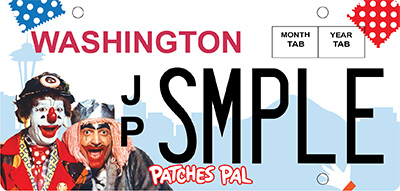
I have asked my children to have me hospitalized for dementia should I ever decide to order our Washington State J.P. Patches Pal license plate. The reasons for that decision are obvious.
 Mere Inkling Press