What is Courage?

We live in an age where our courage matters more than ever. With social, cultural and international relationships all in terrible disarray, facing the future is not for the timid.

Courage is essential for living a life of integrity. Without it, we bend and fold whenever the pressure grows too great. Some people even go so far as to compromise their conscience.

In The Screwtape Letters, C.S. Lewis described how it is only when courage is required, that a person’s true values come into focus.

Courage is not simply one of the virtues, but the form of every virtue at the testing point, which means, at the point of highest reality.

A chastity or honesty or mercy which yields to danger will be chaste or honest or merciful only on conditions. Pilate was merciful till it became risky.

Samuel Johnson, an eighteenth century English writer, was highly esteemed by C.S. Lewis. His words on this subject foreshadow Lewis’ own thoughts. “Courage,” according to Johnson, “is the greatest of all virtues, because if you haven’t courage, you may not have an opportunity to use any of the others.”

Two millennia earlier, an influential Greek philosopher described this same truth. Aristotle, who did not look to the Greek pantheon for inspiration, also deduced that courage is a necessary attribute for the virtuous.

You will never do anything in this world without courage. It is the greatest quality of the mind next to honor.

Examining Ourselves

As a boy, I used to imagine myself playing heroic roles. These often involved rescuing innocent people from barbarians or tyrants, often in ancient settings. As a man I shed those imaginations and pondered realities. In the military, I witnessed courage up close, and I became persuaded that Mark Twain was correct when he declared “Courage is resistance to fear, mastery of fear, not absence of fear.”

True courage is not found in the cloying display of heroics, especially when arising from an ignorance of genuine danger. Neither is simple risk-taking an evidence of courage, since it may merely be the mark of an adrenaline junkie

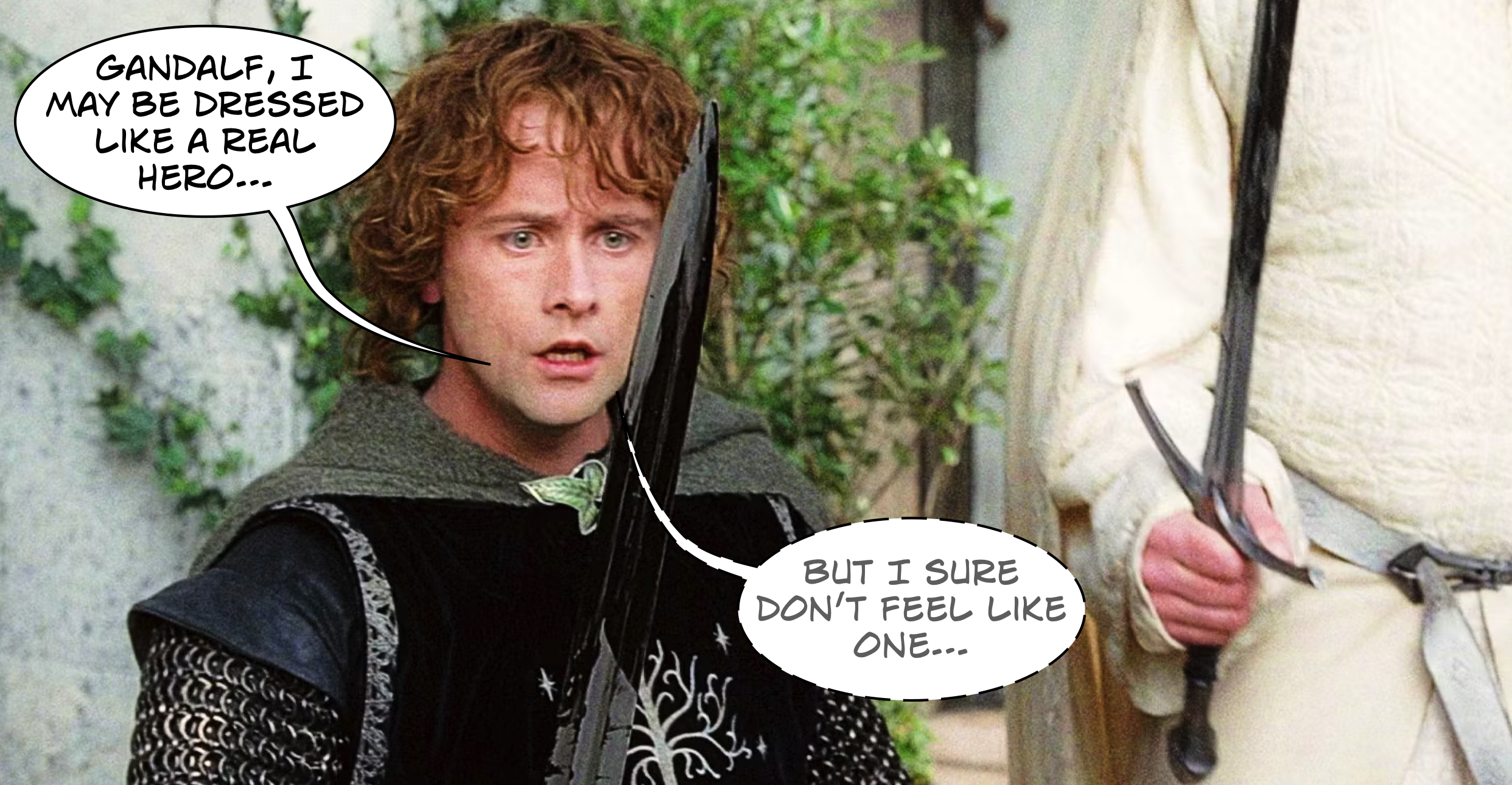
I haven’t personally been confronted with many situations which required physical courage, and when I have, I’ve been tempted to feel a little like I was “pretending.” But then I recall that truly courageous men and women also need to overcome their fear.

And, I honestly suspect that even those who have done the most selfless and courageous things possible, also recognized their limits. They ventured forth because they were truly courageous, not because they lacked fear. This is precisely what happened in a garden on Jerusalem’s Mount of Olives called Gethsemane.

Although encounters with physical dangers have been rare, my courage has been tested numerous times in the service of maintaining my integrity. I can recall a number of academic, professional, and personal occasions where standing for truth came at a very real cost. And, who knows how many times to which we are oblivious, that enemies have wished (and worked) us ill, because we did not surrender to their coercive manipulations.

Happy are those – I am sure Lewis, Johnson, Aristotle and Twain, would agree – who do not compromise their convictions. It appears that courage is a matter of character, not of the moment.

Two uplifting insights provide a fitting end to our meditation on this subject. While the courageous sometimes feel like they stand alone, Billy Graham reminds us of an encouraging fact.

Courage is contagious. When a brave man [or woman] takes a stand, the spines of others are often stiffened.

And, C.S. Lewis’ dear friend J.R.R. Tolkien provides us with another keen observation. In The Fellowship of the Rings, an elf named Gildor protects the hobbits at the outset of their journey, and observes, “courage is found in unlikely places.” Indeed, it is.

It may even be found in us.
C.S. Lewis and Military Service

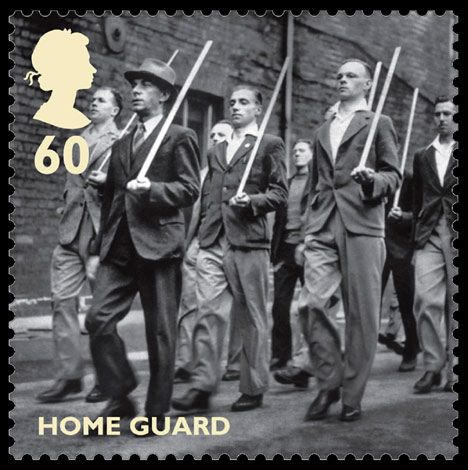
home guard stamp

If you were going to enlist in the military, which branch of the armed forces would you choose? And why?

The choice would have great consequences. The simple fact is that despite their similar charters, not all branches are created equal. Your choice will influence countless aspects of your life, including your post-military employment options and even the likelihood of whether or not you’ll survive your enlistment.

Gallup recently completed research into which branch of the armed forces most Americans would encourage someone to join. The Air Force came out on top.

Americans hold all branches of the U.S. military in high regard, but that does not necessarily translate into a desire to see their loved ones enlist. Fewer than half would be likely to recommend joining the Coast Guard (48%), Marines (43%) or Army (41%) to their children or grandchildren, while a majority would be likely to recommend the Navy (53%) or Air Force (64%).

As a chaplain, I heard some amazing reasons for people’s choice of service. One Army NCO told me, “I was leaning toward the Air Force until the Army recruiter pulled out this huge poster covered with every imaginable weapon, and said, ‘we’ll teach you how to use all of these.’” Not a bad technique for persuading testosterone-fueled eighteen-year-olds to sign on the dotted line.

One young woman who had served a tour in the Marines told me she didn’t even consider another option. “It was the Corps or nothing,” she said, before shouting “Semper Fi!” The USMC has the advantage of requiring fewer recruits and has brilliantly fostered a reputation as “the most prestigious of the military branches.”

A common motivator for Navy recruits seems to be the exotic locations of many of their installations. Can’t argue with that. Most of them are located on or near coasts, while the Air Force strategically places its bases where a falling aircraft would have the smallest chance of injuring someone on the ground. Places like Lubbock, Texas, where I served my first active duty tour at Reese AFB. [The people in Lubbock are amazing patriots.]

The Coast Guard, a sometimes-military organization, attracts people interested in their search and rescue ethos. This despite the fact that most of their mission involves enforcing laws and protecting the nation’s borders.

The Air Force draws lots of recruits who are interested in pursuing technical fields. The other services have similar career paths, of course, but the clear perception is that the Air Force offers the most. Still, it’s a bit embarrassing to share here the reason one friend of mine chose the USAF. Actually, it was his reason for choosing the chaplain assistant career field in particular. “I told them at basic training that I would take any job where I worked in a climate-controlled environment.” He was serious, but the last laugh was on him. When we deploy to the field, chaplain assistants are not only responsible their own safety, they have to protect their noncombatant chaplains as well (in any weather).

The different branches of the military go to war against their nation’s enemies—but they also maintain intense rivalries with their sister services. This competition is usually fun to observe . . . as long as alcohol is not in the vicinity.

C.S. Lewis’ Military Service

In the United Kingdom, the Navy is the senior service. Seems fitting for an island nation. That doesn’t mean that the Army traditions, which date back to historic militias, lack prestige.

During the First World War, C.S. Lewis was exempt from the draft. This, because he was from Northern Ireland. Despite this, he followed his brother Warren into the Royal Army.

Warnie was a career officer, graduating in 1914 from an expedited course at the Royal Military College, Sandhurst. Jack, in contrast, was one of many young college students who were subjected to a far more rapid training regimen, commissioned, and shipped off to the front.

In 1918 C.S. Lewis was severely wounded. One writer summarizes this event quite effectively.

The Lewis who crawled away from the carnage was not yet the C.S. Lewis of The Chronicles of Narnia, The Space Trilogy, The Screwtape Letters and Mere Christianity. Then, he was like so many others who fought in World War I—just another wounded soldier desperate not to bleed to death.

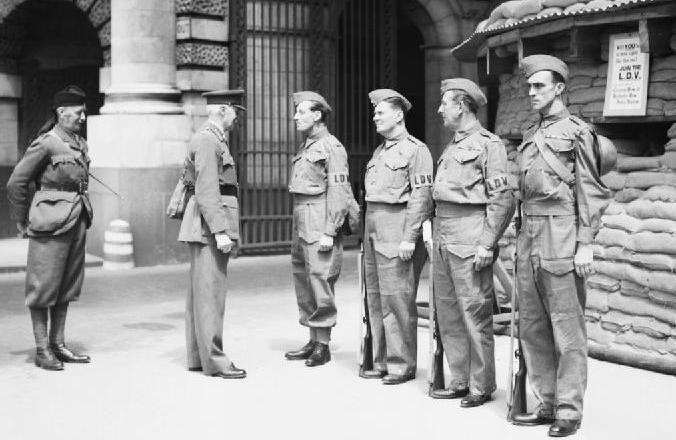
Eventually Lewis would wear another “military” uniform during the Second World War—that of the Home Guard (originally called the “Local Defence Volunteers”). But that is a curious story for another day. Lewis patrolled Oxford in a uniform similar to those portrayed in the photos on this page.

Lewis did not have formal personal ties to the Navy, although his maternal grandfather, a Church of Ireland priest, had served as chaplain in the Royal Navy.

During WWII Lewis developed a warm relationship with members of the Royal Air Force. He offered lectures at a number of installations and taught at the RAF Chaplain School. Although his first lecture began rather inauspiciously, his work with the airmen proved extremely fruitful.

Lewis is a fine example of the man of gentle demeanor who “does his duty” when called upon by his country. Had his lifetime not overarched two global conflicts, he would have been utterly content to remain a civilian and wear the “uniform” of an Oxbridge professor.

home guard