
 English is a fascinating language. Certainly not the simplest to learn, but extremely versatile. You might say that among the circus of languages, English is the contortionist. (That analogy might make German the strong man and Romani the fortune teller. As for the bearded lady . . . I’ll leave that to your personal conjecture.)
I’ve formally studied several other languages, yet I consider myself a master of none. Nevertheless, when it comes to English, I do take some pride in my skills, and would be willing to claim for myself the status of journeyman. Among other credentials I have my “verbal” score on the Graduate Record Exam, which placed me in the 97th percentile.
It goes without saying that C.S. Lewis (along with most of his fellow Inklings) was a Master of English. One of his many insights warned of language’s occasional tendency to confuse rather than illuminate.
Language exists to communicate whatever it can communicate. Some things it communicates so badly that we never attempt to communicate them by words if any other medium is available. (C.S. Lewis, Studies in Words).
As much as I discover about English, I find there is still more to learn. This week I enjoyed thinking about contranyms. It’s uncommon enough a word that you know your spell checker won’t recognize it. One of those words only an English major is expected to know.
We all know, of course, what synonyms and antonyms are. Useful little tools for playful manipulation of language. A contranym is a word that possesses two “contradictory” meanings. For example a “citation” which can be awarded for either good or issued for bad behavior. Or, consider “literally,” which has its literal meaning as well as its recently developed and contradictory definition of “figuratively.” For lovers of words that’s a particularly discomforting contranym, and it literally makes my head explode. (No, seriously, please don’t ever write or say something like that unless it is in the form of dialog you’re composing for a semi-literate character.)
There are many more examples.
“They left for London, without a thought as to the luggage they left at the station.”
“He was certainly bound for jail if they discovered the Internal Revenue agent he had left bound in his basement.”
“He buckled his belt a mere moment before his legs buckled beneath him as he was struck by the errant meteorite.”
“Apparently there are many thoughtless oversights when programs are left to governmental oversight.”
Homophonic contranyms are not spelled alike, but they are pronounced similarly. “My aural test is scheduled tomorrow, immediately before the oral defense of my dissertation.”
There are actually a couple of alternative names for contranyms. They can be called antagonyms or autoantonyms, which only serves to make the hazy water that much murkier.
Our next lesson will feature that amazing category of words that are “polysemy.” (Not really, I think this has been enough linguistic thinking to cover us for at least a week.)
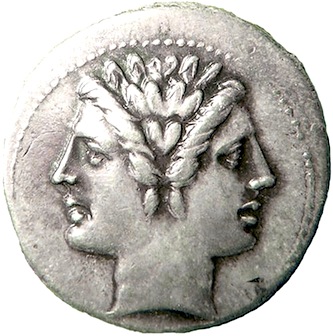
Oh, one final note, for those who were curious about the choice of the image above for this column. Contranyms are also referred to as “Janus words,” in honor of the Roman deity who constantly gazes in two directions. Very fitting.

 Mere Inkling Press