
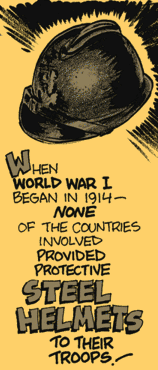
 War is deadly business. And, if a kingdom or nation hopes to emerge victorious, they are wise to equip their soldiers properly. That’s why this fact, included in today’s Ripley’s Believe It or Not comic, is so shocking.
It’s inconceivable that as the world marched to war in 1914, not a single one of the world powers equipped their troops with steel helmets. Elegant helms that looked superb on the parade ground . . . yes. Elaborate crests that exaggerated height to intimidate the foe . . . of course. Comfortable fabrics that kept the scorching sun off of the scalp . . . certainly.
But steel helmets that might actually spare men from bullet and shrapnel wounds . . . not those.
It’s not like the danger of ballistic wounds caught the Europeans off guard. Muskets had given way to deadly rifles long before. Artillery had advanced to the point where the Germans actually built not one, but two unique weapons: (1) Big Bertha, a huge howitzer that lobbed an eighteen hundred pound shell nearly eight miles, and (2) the Paris Gun, a siege cannon able to fire its shell eighty miles!
As soldiers like C.S. Lewis and J.R.R. Tolkien rallied to the flag and fought the Huns, they would eventually be issued more protective equipment. But it didn’t exist at the war’s outset. And even with it, Lewis was severely wounded in combat. in 1939 he wrote, “My memories of the last war haunted my dreams for years.”
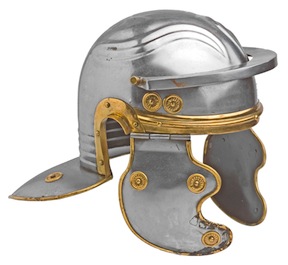 The irony about metal helmets is that even ancient peoples recognized the importance of protecting the skulls of their warriors with the strongest materials available. In my office I have a replica Roman legionary helmet. Trust me, it was capable of saving lives.
Today’s combat helmets are highly advanced, and great effort is made to protect military members from head trauma. Sending them into battle with anything less than the best equipment available should be a crime.

 Mere Inkling Press