
Faith Makes Sense of Our Existence

“If we discover a desire within us that nothing in this world can satisfy, also we should begin to wonder if perhaps we were created for another world.” (C.S. Lewis, Mere Christianity).

It would be a sad thing if we existed only for this brief lifetime. And an awareness of this tragic fact rests like a dark cloud over human existence. Many atheists cling to this as a fundamental justification for their rejection of God. “Because of our awareness of our own mortality,” they argue, “people create gods to worship.”

Now, we Christians can acknowledge one aspect of their reasoning. It actually is reasonable to think that if there were no Creator, people would be inclined to invent something to explain the cosmos. We see evidence of this in the fact that when people reject the Son of God—they vainly strive to fill the vacuumleft in their spirits. Human beings share a deep spiritual emptiness (called by some a “God-shaped hole”). And while atheists use that fact to argue against faith . . . C.S. Lewis provides us with the true reason for the conundrum.

It is precisely because of our broken relationship with God—because we were created for a perfect world we no longer inhabit—that we have an innate yearning for the eternal which only God can satisfy. You and I were created to live in the presence of our Lord in a Garden richer than we could ever imagine. And those who trust Christ now will find that a place has been prepared for us in a glorious new home.

 †††
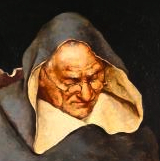
Our faithful commentatorComment: Amen. As the North African Church father Augustine of Hippo wrote: Crede, ut intelligas. “Seek not to understand that you may believe, but believe that you may understand.”

What’s So Important about the Milvian Bridge?

Constantinian Triumph CoinWhile pondering what to write about today, I visited one of those “This Day in Christian History” websites. It cited 27 September as the day of Constantine the Great’s “conversion” (in the year A.D. 312). Ironically, the website was in error, with the actual date being the evening of 27 October.

Many people might say “what difference does it make?” but writers will be reminded once again of the necessity of accuracy in their writings! What sort of credibility do you think that website now holds for me?

At any rate, returning to the subject of Constantine’s October 312 conversion . . . it was one of the pivotal events in the history of the world. Not only did Constantine end the persecution of the Church, he raised Christianity to the status of favored religion. Contrary to most quasi-historians, it would be left to a later emperor to establish Christianity as the empire’s official faith.

The early fourth century was a turbulent and fascinating time. Constantine had to battle a number of other so-called Imperators. (“Caesar” remained one of their many titles, but it was no longer the synonym for the ultimate ruler.) One of Constantine’s challengers—who allied himself completely with the pagan faction which still vastly outnumbered the Christians—was Maxentius.

On the evening before the battle, in response to a divine vision, Constantine had his soldiers mark their shields with a symbol for Christ (most likely, a chi-rho). He would ultimately march under that sign to victory over all of his enemies. Licinius, his final foe, would also throw his lot with the pantheon of Rome and other pagan deities. Like Maxentius, he too would fall.

This coin was minted by Constantine to commemorate his victory over these agents of the “Serpent.” The Labarum (Constantine’s standard, topped by the chi-rho) pierces the creature. The legend on the coin reads “Spes Publica,” which means “hope of the people.”

On the matter of just how transformative Constantine’s spiritual conversion actually was . . . well, that’s a subject for another day. Suffice it to say now that he regarded his allegiance to Christ as sincere, and he never recanted. Oh, and the importance of the Milvian Bridge . . . if Maxentius had not fallen there, history would read quite differently today.